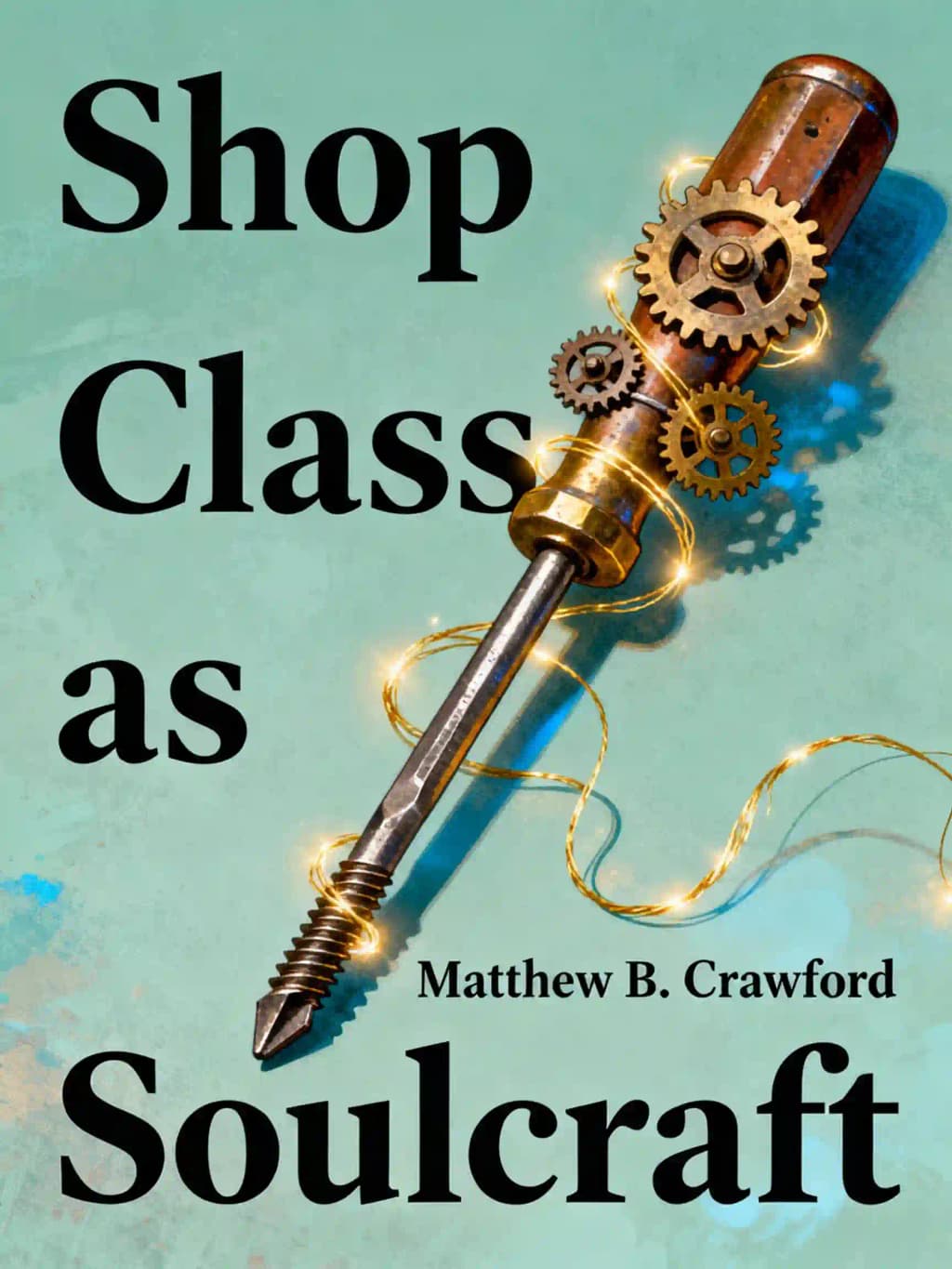
In "Shop Class as Soulcraft," philosopher-mechanic Crawford challenges our worship of knowledge work. Called "the sleeper hit" by The Boston Globe, this bestseller reveals a radical truth: working with your hands isn't just practical - it's the path to authentic meaning in our disconnected world.
Matthew B. Crawford is a philosopher, New York Times bestselling author, and motorcycle mechanic, renowned for blending hands-on experience with political theory in Shop Class as Soulcraft: An Inquiry Into the Value of Work.
This philosophical memoir, rooted in Crawford’s dual career as a University of Chicago-trained thinker and owner of Richmond’s Shockoe Moto repair shop, challenges modern assumptions about labor by arguing for the intellectual and ethical richness of skilled manual trades. His critiques of abstraction in education and workplaces draw from his earlier career at a Washington think tank, where he rejected ideological rigidity to pursue concrete problem-solving.
Crawford, a research fellow at the University of Virginia’s Institute for Advanced Studies in Culture, expanded his exploration of human agency in The World Beyond Your Head: On Becoming an Individual in an Age of Distraction and Why We Drive: Toward a Philosophy of the Open Road. A contributing editor to The New Atlantis, he has been featured in the documentary Merchants of Doubt and lectures globally on technology’s impact on self-reliance. Shop Class as Soulcraft became a cultural touchstone, sparking national debates about vocational education and the dignity of craftsmanship.
Shop Class as Soulcraft by Matthew B. Crawford critiques the modern devaluation of manual labor, arguing that skilled trades and craftsmanship offer deeper fulfillment, critical thinking, and tangible problem-solving compared to abstract "knowledge work." Crawford blends philosophy, personal experience as a motorcycle mechanic, and cultural analysis to challenge societal biases against hands-on professions.
This book is ideal for educators, professionals questioning workplace meaning, tradespeople, and anyone interested in the philosophy of work. It resonates with readers seeking insights into the cognitive and ethical value of manual competence, as well as critics of modern education’s shift away from vocational training.
Yes. Crawford’s compelling blend of memoir, philosophy, and social critique offers a fresh perspective on the dignity of manual labor. Its arguments about the psychological rewards of craftsmanship and the pitfalls of corporate abstraction remain relevant, especially in debates about education and career paths.
Crawford contends that manual work fosters autonomy, critical thinking, and direct engagement with reality, unlike many white-collar jobs mired in bureaucracy. He highlights the decline of shop classes as symbolic of a broader cultural shift that undervalues tactile skills and overvalues abstract, often meaningless knowledge work.
Crawford’s PhD in political philosophy and career as a motorcycle mechanic ground his analysis. His firsthand experience in both intellectual and manual trades lends credibility to his critique of workplace alienation and advocacy for hands-on problem-solving.
Crawford critiques the modern economy’s preference for adaptability over mastery, calling it a "psychedelic stance" that prioritizes reinvention over tangible achievement. This mindset, he argues, clashes with the concrete demands of skilled trades, where expertise requires deep engagement with physical reality.
Some argue Crawford overly romanticizes manual labor or neglects systemic barriers in trades. Others note his focus on self-employed craftsmanship may not address challenges faced by wage workers in industrial settings.
The book warns that eliminating shop classes deprives students of critical hands-on learning. Crawford links this trend to a broader educational obsession with standardized testing and college readiness at the expense of vocational and creative skills.
Crawford uses motorcycle repair as a metaphor for meaningful work, illustrating how troubleshooting mechanical problems requires logic, creativity, and direct interaction with the material world—contrasting sharply with abstract office tasks.
The book encourages readers to seek work offering autonomy, measurable outcomes, and skill mastery. It’s particularly relevant for those disillusioned with corporate jobs or considering transitions to trades, entrepreneurship, or craft-based careers.
Unlike Bullshit Jobs by David Graeber (focusing on meaningless work), Crawford emphasizes solutions through skilled trades. It also complements The Craftsman by Richard Sennett but adds a personal, polemical edge.
As AI and automation reshape jobs, Crawford’s defense of human-centric, tactile skills gains urgency. The book fosters discussions about reskilling, education reform, and the enduring need for work that connects us to the physical world.
Erlebe das Buch durch die Stimme des Autors
Verwandle Wissen in fesselnde, beispielreiche Erkenntnisse
Erfasse Schlüsselideen blitzschnell für effektives Lernen
Genieße das Buch auf unterhaltsame und ansprechende Weise
We've become passive consumers who buy what we once made and replace what we once fixed.
Craftsmanship involves the desire to do something well for its own sake.
The repairperson, unlike the narcissist, must notice things carefully and listen.
We're given the 'muscled arm' but not 'the thought bright behind the eye.'
You can't hammer a nail over the Internet.
Zerlegen Sie die Kernideen von Shop Class as Soulcraft in leicht verständliche Punkte, um zu verstehen, wie innovative Teams kreieren, zusammenarbeiten und wachsen.
Destillieren Sie Shop Class as Soulcraft in schnelle Gedächtnisstützen, die die Schlüsselprinzipien von Offenheit, Teamarbeit und kreativer Resilienz hervorheben.

Erleben Sie Shop Class as Soulcraft durch lebhafte Erzählungen, die Innovationslektionen in unvergessliche und anwendbare Momente verwandeln.
Fragen Sie alles, wählen Sie die Stimme und erschaffen Sie gemeinsam Erkenntnisse, die wirklich bei Ihnen ankommen.

Von Columbia University Alumni in San Francisco entwickelt
"Instead of endless scrolling, I just hit play on BeFreed. It saves me so much time."
"I never knew where to start with nonfiction—BeFreed’s book lists turned into podcasts gave me a clear path."
"Perfect balance between learning and entertainment. Finished ‘Thinking, Fast and Slow’ on my commute this week."
"Crazy how much I learned while walking the dog. BeFreed = small habits → big gains."
"Reading used to feel like a chore. Now it’s just part of my lifestyle."
"Feels effortless compared to reading. I’ve finished 6 books this month already."
"BeFreed turned my guilty doomscrolling into something that feels productive and inspiring."
"BeFreed turned my commute into learning time. 20-min podcasts are perfect for finishing books I never had time for."
"BeFreed replaced my podcast queue. Imagine Spotify for books — that’s it. 🙌"
"It is great for me to learn something from the book without reading it."
"The themed book list podcasts help me connect ideas across authors—like a guided audio journey."
"Makes me feel smarter every time before going to work"
Von Columbia University Alumni in San Francisco entwickelt

Erhalten Sie die Shop Class as Soulcraft-Zusammenfassung als kostenloses PDF oder EPUB. Drucken Sie es aus oder lesen Sie es jederzeit offline.
In a world where we're increasingly disconnected from physical reality, Matthew Crawford's exploration of manual work arrives like a revelation. We've been sold a false narrative-that success means escaping physical labor for the pristine world of ideas. But what if this narrative has robbed us of something essential? When shop class disappeared from schools in the 1990s, we lost more than just vocational training. We lost a fundamental way of engaging with reality. Today's students can answer standardized tests but often can't fix a leaky faucet or change a tire. Our possessions have become mysterious black boxes-cars with engines hidden beneath secondary hoods, appliances requiring specialized tools to open, devices designed to be replaced rather than repaired. This transformation has profound consequences for how we understand ourselves and our capabilities. When we can no longer comprehend how our everyday objects function, we surrender a form of agency and independence that was once commonplace. Meanwhile, skilled trades face critical worker shortages while some college graduates return to technical schools seeking marketable skills their university education never provided.