Kapitel 1
When Pop Culture Can't Stop Looking Backward
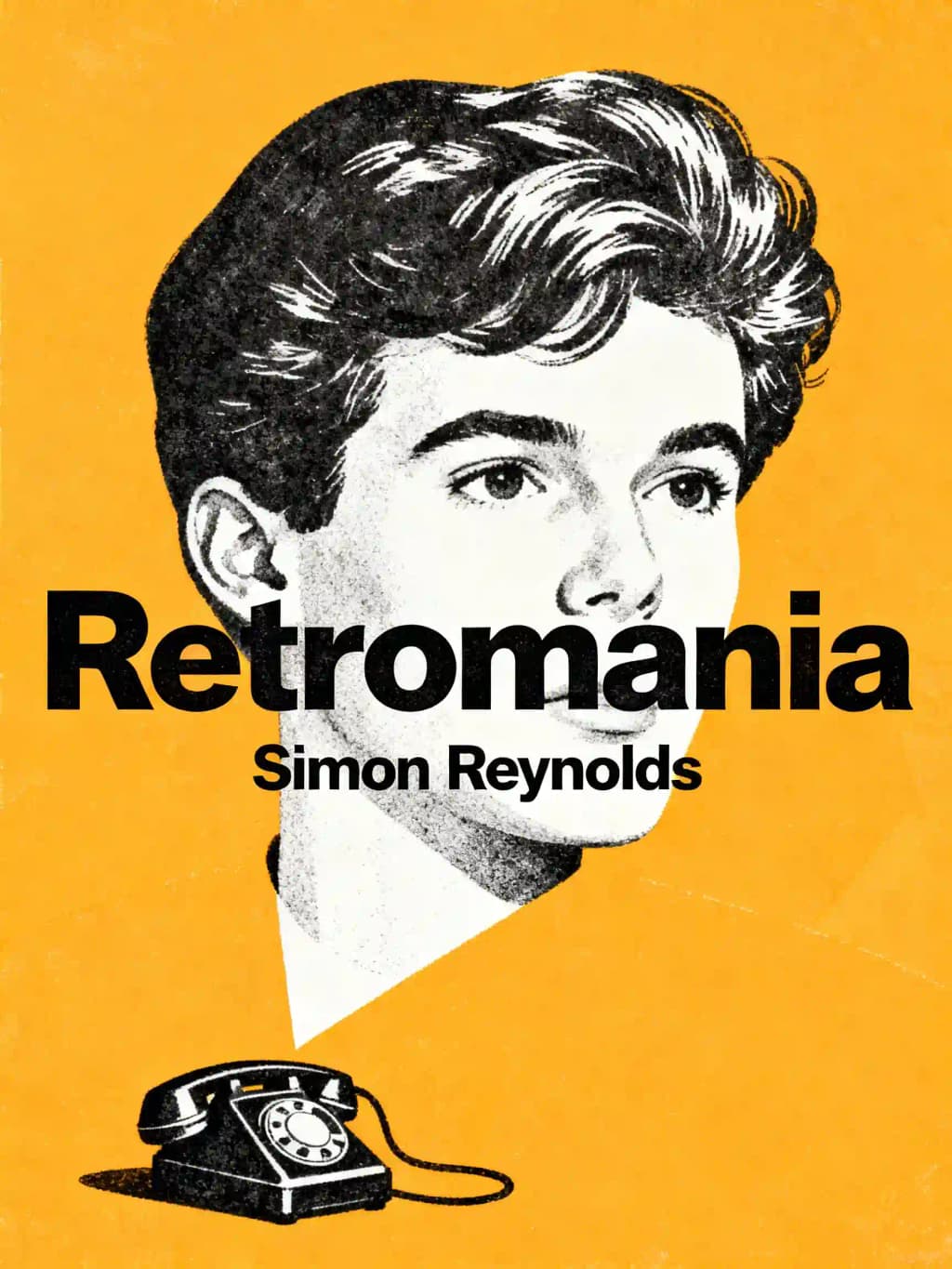
In an era where Spotify streams the entire history of recorded music and Hollywood churns out endless reboots, Simon Reynolds' "Retromania" feels more prescient than ever. Published in 2011, this cultural critique has become required reading for artists and critics grappling with our society's obsession with its own past. Beyonce cited it as inspiration for her forward-looking "Renaissance" album, while The Guardian declared it "the definitive text on how the internet has changed our relationship with culture." Reynolds, a veteran music journalist whose previous works examined post-punk and rave culture, here turns his analytical eye to a troubling question: Has innovation in popular culture stalled because we can't stop looking backward? With surgical precision, he dissects our collective inability to create genuinely new forms, exploring whether nostalgia is stopping culture's forward momentum or whether we're nostalgic precisely because culture has stagnated.
Kapitel 2
The Retroscape: Our Pop Culture Time Machine
The 2000s weren't defined by innovation but by an unprecedented wave of cultural recycling-band reunions, reissues, remakes, and retro styling dominated the entertainment landscape. As the decade progressed, the interval between something happening and being revisited shrank dramatically, with TV shows like "I Love the New Millennium" and "Best Week Ever" wrapping up the 2000s before they even ended. This accelerated nostalgia cycle created a peculiar temporal loop where events were being commemorated almost simultaneously with their occurrence. This chronological compression manifested everywhere, from the Smithsonian's Memphis Rock 'n' Soul Museum to reunion tours grossing hundreds of millions, demonstrating how nostalgia had become our primary cultural currency.
By mid-decade, the retro phenomenon had accelerated beyond anyone's expectations. Cream's reunion concerts at Madison Square Garden grossed over $10 million in just four nights, the "Rock of Ages" musical celebrating 80s hair metal became a Broadway sensation, and The Stooges released their first album in twenty years to critical acclaim. Contemporary artists increasingly participated in this backward glance: Coldplay openly borrowed Kraftwerk's chord sequences, The Killers channeled 80s new wave, and Amy Winehouse revived 60s soul. VH1 Classic capitalized on this trend by sponsoring nostalgia tours featuring multiple acts from specific decades, while gaming companies reissued classic titles with enhanced graphics but identical gameplay.
The phenomenon extended beyond music into every cultural sphere. Television networks invested heavily in remakes of classic shows, fashion designers repeatedly mined past decades for inspiration, and even car manufacturers began producing modern versions of iconic models like the Mini Cooper and Volkswagen Beetle. The Beatles' legacy spawned multiple theatrical productions, including Cirque du Soleil's "Love" and the "Rain" tribute show. MTV's decision to celebrate its 25th anniversary by rebroadcasting its first day of programming highlighted how self-referential culture had become. Meanwhile, artists from Lou Reed to The Sex Pistols found they could earn more performing their classic albums in their entirety than releasing new material.
This obsession with the past represents a fundamental shift in how we relate to cultural history, creating what critics called a "nostalgia industry." While earlier eras had their obsessions with antiquity - the Renaissance's fascination with classical Greece and Rome, for instance - our society uniquely fetishizes its immediate cultural past, often preferring polished recreations to new creations. The trend raises profound questions about creativity and cultural evolution: is this retro addiction stopping culture's forward momentum by constantly looking backward, or are we nostalgic precisely because culture has stagnated, leaving us no choice but to mine the past? The answer may lie in how we ultimately integrate these influences into truly new forms of expression.
Kapitel 3
Museums, Reunions, and the Commodification of Rebellion
The museum-ification of rock music represents a profound contradiction. Pop's ephemeral, disruptive energy fundamentally clashes with the preservationist ethos of museums, yet institutions like the British Music Experience have transformed even punk's insurrectionary power into lifeless artifacts behind glass. These museums represent the triumph of "ROCK'S RICH TAPESTRY" where former antagonisms are smoothed over-Johnny Rotten now admits he always liked Pink Floyd, and Elvis Costello amicably interviews the establishment figures he once railed against. The rebellious energy that made rock meaningful has been neutralized, transformed into respectable history.
This cultural preservation extends beyond museums to the stage, where bands perform "whole album" shows-playing classic records in their entirety from start to finish. This trend, pioneered by Cheap Trick in 1998 and later popularized by All Tomorrow's Parties' "Don't Look Back" franchise, represents both rebellion against digital music culture and lucrative nostalgia. For the artists, these reunions can be creatively rejuvenating but are primarily financial windfalls-Sonic Youth's Daydream Nation performances grossed substantially more than their contemporary work.
The sad reality of many comeback attempts was exemplified by the New York Dolls' 2009 reunion show. With only David Johansen and Syl Sylvain surviving from the original lineup, the band refused to pander to their aging audience by playing the classics, stubbornly performing only new material. The crowd-mostly gray-haired CBGB veterans-was visibly disappointed. Despite their glam-punk legacy, the Dolls now sounded like conventional blues-rock, the revolutionary difference that had spawned punk now barely perceptible decades later. As ex-Strangler Hugh Cornwell observed, most veteran acts become "tribute bands" to themselves, competing with actual tribute acts playing their old material.
The commodification of rebellion extends to the memorabilia market, where artifacts gain value when preserved for future generations to study. "Historicity"-the intangible "aura of era"-creates a paradox where items become valuable only after losing their original utility. The market began with San Francisco psychedelic posters in the late 1960s, where first-run promotional copies command premium prices over later souvenir printings. Authentication has become scientific, with experts measuring paper thickness with calipers. Despite newer movements entering the collectibles market, Beatles, Elvis, and Stones memorabilia still dominate, with few post-60s/70s artists achieving comparable status.
Kapitel 4
Total Recall: Memory in the Digital Age
Our culture has succumbed to what Reynolds calls "Chris Farley Syndrome"-named after the SNL character who could only stammer "D'ya remember" to celebrity guests before declaring "that was... so... cool." This vacuous nostalgia has metastasized through YouTube's chaotic amateur cultural salvage, exemplifying the crisis of overdocumentation triggered by digital technology. From home videos to concert footage, from obscure commercials to forgotten TV shows, everything is being preserved and shared. With cultural data dematerialized, our capacity to store everything has vastly increased, yet our ability to process or meaningfully use this memory hasn't grown accordingly. We've become digital hoarders, saving everything without discrimination.
YouTube represents a profound shift in humanity's memory resources-we now have astronomically more space to fill with memorabilia and archival traces, which we're busily filling even as capacity continues to balloon. What's significant isn't just the "total recall" but the instant access that obliterates the delays once involved in searching physical archives. A teenager today can instantly access footage from a 1960s Beatles concert, browse through MTV videos from the 1980s, or watch yesterday's viral sensation. The presence of the past in our lives has increased immeasurably, with old content either directly permeating the present or lurking just beneath the surface, accessible with a click. This constant availability has created a peculiar flattening of historical perspective, where all eras exist simultaneously in an eternal digital present.
Our relationship to time and space has been utterly transformed. Distance and delay have eroded to nearly nothing-I can instantly satisfy any musical curiosity through YouTube rather than walking across my apartment to find a physical record. The ritual of carefully selecting and playing an album has been replaced by algorithmic suggestions and endless playlists. This creates a paradoxical combination of speed and standstill-incredibly rapid turnover of news coexisting with stubborn persistence of nostalgic content, while the recent past drops into an amnesiac void and the present becomes wafer-thin. Social media amplifies this effect, with trending topics burning bright and fading within hours while decades-old memes refuse to die.
This digital landscape has fundamentally altered our relationship with attention and engagement. Each consumer-friendly advance-from CD remotes to streaming services-has made it easier to disrupt musical flow, undermining art's ability to command our full attention. Skip buttons, shuffle play, and algorithmic recommendations have transformed how we consume media, often at the expense of artistic intention and narrative coherence. This "brittle temporality of networked life" fractures not just our experience of time but also space, as families engage in "connected cocooning"-physically together but mentally elsewhere through digital devices. Parents scroll through Instagram while children watch YouTube, each inhabiting their own digital bubble despite sharing the same room. Many now lament their diminished capacity for deep engagement, becoming "pancake people" spread thin across information networks rather than possessing the "cathedral-like" depth of literary culture. The ability to focus on a single task, book, or album for an extended period has become increasingly rare, replaced by a constant state of partial attention and digital distraction.
Kapitel 5
Lost in the Shuffle: The Twilight of Music as an Object
I've accumulated an immense private archive of audio artifacts despite never considering myself a "collector"-that term seemed reserved for those who fetishized format and packaging rather than the music itself. I justified my acquisitions as professional research material, expanding my knowledge of musical history. But the truth hit me when I realized vinyl filled every room, with more recordings stashed in basement lockers and overseas storage units. My gargantuan music collection now exerts a subliminal pressure-will there be enough life left to listen to everything I like one more time?
This represents the music obsessive's version of midlife crisis, where potential pleasures become harbingers of mortality. Psychoanalysts suggest collecting wards off death anxiety through accumulation, yet eventually these possessions remind us of inevitable loss. Like fellow collector Gareth Goddard, I worry about my collection's fate after I'm gone-these records represent untold hours of labor and love, a significant portion of what I've done with my time on this planet.
The collector's anxiety about their treasures' fate runs deep. Studies show collecting impulses peak twice: between ages seven and twelve as children seek control, and again for men in their forties. Walter Benjamin noted the "childlike element" to collecting, how it re-enchants objects by fixing them within a "magic circle." Collections are driven by systematicity and seriality-the formal structure eclipsing individual objects. This explains the genius of Pokemon cards, with their infinitely extendable series ensuring the "missing card" always exists. Collecting serves as defense against anxiety, whittling overwhelming reality down to manageable size through passionate focus.
The Internet and MP3 culture have simultaneously amplified and undermined the concept of secret musical knowledge. With minimal investment of time and money, anyone can now amass vast collections and access expertise without the previous constraints of living space or disposable income. "Sharity" blogs-a pun on "share," "charity," and "rarity"-emerged in the mid-2000s, offering complete albums through file-hosting services. The collector dynamic shifted dramatically from "I want something no one else has" to "I've found something rare and I'm immediately making it available to everybody"-a strange mixture of competitive generosity and esoteric taste-flaunting.
Kapitel 6
The Rise of the Rock Curator
The term "curated by" infiltrated music's left-field fringes in the early 2000s, elevating once-humble activities like compilation selection or festival booking with art-world prestige. This linguistic shift likely migrated from the gallery circuit, where star curators had risen to prominence. Brian Eno prophetically noted in 1991 that "Curatorship is arguably the big new job of our times," reframing the contemporary artist less as creator than as "connector of things" who perpetuates, re-evaluates, and occasionally innovates.
The modern musician increasingly functions as a self-portrait of the artist as consumer, sourcing sonic identity from record shops, flea markets, and now eBay and music blogs. Saint Etienne exemplifies this curatorial approach-their music emerges from elevated consumerism, what Jon Savage called "sonic antiquing." Their work creates alternative pop universes, imagining hybrid styles that might have existed had pop history taken different turns. This bricolage approach offers endless creative possibilities-"If someone's got a large record collection, there are so many loose ends in pop history that nobody's ever followed up," says Bob Stanley. Yet it risks emotional detachment, producing pop as "objective artifact" rather than subjective expression.
As music became increasingly self-referential in the 1990s and beyond, creativity was reduced to taste games, with bands assembling identities within an economy of influences-speculating in pasts rather than futures. Sonic Youth emerged as the decade's most relentless curators, overseeing ATP festivals, exhibitions like NOISE/ART, and eventually becoming an exhibition themselves with 2008's "Sensational Fix"-a detailed map of their "multidisciplinary activities" that functioned as both career retrospective and address book of their vast network of collaborators. Their album "The Eternal" exemplified sonic curation, with nearly every song nodding to admired artists.
Record collectors function as heroic explorers and renegade historians who venture into music's terra incognita, bringing back weird treasures while redrawing the map of pop history. This curatorial impulse has led musician-collectors to branch out as reissuers and compilers, even retroactively creating genres that never existed as recognized entities. Saint Etienne's Bob Stanley exemplifies this approach, coining or promoting concepts like "junkshop glam" (second-division glitter bands), "wyrd folk" (LSD-tinged British pastoralists), and "English Baroque" (orchestrally-embellished late psychedelia).
Kapitel 7
The Empire of Retro and the Global Hipster International
Japan represents the ultimate embodiment of musical archiving and curation, blurring the boundary between creation and curation so thoroughly that Roland Barthes' "empire of signs" could aptly be called the "empire of retro." In the early 1990s, when many important recordings remained out of print elsewhere, Japan maintained virtually everything ever recorded in its catalog, offering expensive imports to Western collectors. This preservation extended beyond just maintaining catalogs - Japanese record stores became legendary for their meticulous organization, detailed categorization, and pristine condition of their stock, with stores like Disk Union and Tower Records Japan becoming pilgrimage sites for music enthusiasts worldwide.
Japanese musicians have demonstrated remarkable facility for mimesis, from "Eleki" (Shadows-style instrumental rock) through "Group Sounds" (British Beat imitations) to 1970s freak bands that often had specific Western models. Groups like The Spiders and The Tigers perfectly replicated British Invasion sounds, while bands like Happy End and Yellow Magic Orchestra masterfully synthesized Western influences with their own innovations. What's striking isn't the "wrongness" of these imitations but their meticulous attention to stylistic detail, often surpassing their original inspirations in technical precision. In Japan, musical authenticity comes from obsessive commitment to getting details right. As W. David Marx explains, almost every Japanese rock band begins as a cover band, with no stigma attached to being "derivative." This approach reflects traditional Japanese artistic values that prioritize mastery within tradition over originality, similar to how apprentice painters traditionally learned by copying masters' works.
Japan's emphasis on details over originality merged with 1990s consumer affluence to produce Shibuya-kei, a musical movement named after Tokyo's record store district. Upper-middle-class youth created music that showcased their consumer discernment, essentially curating rather than creating. Flipper's Guitar-founded by Keigo Oyamada (later Cornelius) and Kenji Ozawa-pioneered this approach, openly borrowing melodies from Western indie pop. Their albums like "Camera Talk" and "Three Cheers for Our Side" became blueprints for the genre. Shibuya-kei taste favored the dainty and blithe: French sixties pop like Serge Gainsbourg and France Gall, Italian soundtracks from Ennio Morricone, bossa nova from Joao Gilberto, and "sunshine pop" from The Free Design. The result was a cosmopolitan hybrid drawing no indigenous Japanese influences-an "International style" of pop music that influenced artists worldwide, from Stereolab to Beck.
What truly transcended borders was the underlying curatorial sensibility, which connected Japanese hipsters with their counterparts worldwide. This "Hipster International"-young creatives in media, fashion, design, and other aesthetic industries-exists in any affluent city with a substantial upper middle class. From Sao Paulo to London, Berlin to Brooklyn, these rootless cosmopolitans share more with each other than with their physical neighbors, forming a global class united by their obsessive knowledge of obscure music and cultural history. This phenomenon has only intensified in the digital age, where platforms like Discogs and Bandcamp have created virtual record stores that mirror Japan's curatorial approach, making the "empire of retro" a truly global phenomenon.
Kapitel 8
Nostalgia for the Future
Looking at Manhattan's East Village, I'm struck by how little the urban landscape has changed since 1963-the year of my birth. The tenement buildings, corner stores, and narrow streets remain largely unchanged, defying decades of science fiction predictions. The absence of flying cars, moving sidewalks, and gleaming titanium towers creates a peculiar emotion: "nostalgia for the future" or "neostalgia." While our technological advances in medicine, telecommunications, and computing are impressive, they lack the visual grandeur that previous generations anticipated. The miniaturization of technology-smartphones that fit in our pockets, invisible wireless networks, microscopic processors-doesn't satisfy our deep-seated desire for spectacular futures. Instead of using advanced technology for heroic endeavors like colonizing Mars or building underwater cities, we document mundane lives on Instagram, chat with distant friends on WhatsApp, and wallow in pop-culture nostalgia-activities suggesting a decadent, inward-looking society losing its appetite for grand visions.
Progress itself seems to have slowed since the sixties, which marked the climax of twentieth-century innovation. Earlier decades teemed with spectacular feats of centralized planning: the Hoover Dam, Tennessee Valley Authority's rural electrification, the Interstate Highway System, and the Apollo program. Science fiction writers naturally imagined change continuing in grandiose fashion-cities enclosed in single megastructures, massive agricultural machines traversing continents, and orbital habitats housing millions. Futurology emerged during this era of ambitious state intervention, with the fifties and sixties characterized by future-mindedness and neophilia that embraced plastics, manmade fabrics, and chrome as materials of the New Frontier. This optimism manifested in everything from tail-finned cars to Space Age furniture.
Today we struggle to picture the future except in cataclysmic terms or as the present gone worse-climate disasters, surveillance states, or corporate dystopias. Futurology has faded as a popular genre, with no modern equivalents of visionaries like Buckminster Fuller or Alvin Toffler who could captivate mass audiences with bold predictions. By the eighties, thinking positively about the future became harder, as gleaming environments of plastic and fluorescent lighting gave way to shabby dystopias of rust and shadows, exemplified in films like Blade Runner and Brazil. The nineties saw a brief resurgence of techno-optimism driven by information technology, but after the dot-com bust and 9/11, futurology largely reduced to short-term trend-spotting for marketers and corporate consultants.
The early 2000s saw a surprising revival of interest in modernist architecture and design, particularly Brutalism-the Corbusier-influenced architectural style that reshaped Western urban landscapes after World War II with its bold concrete forms and utopian aspirations. This deliberately contrarian appreciation for buildings once dismissed as "monstrous carbuncles" by Prince Charles emerged alongside a cult fascination with mundane spaces like motorway service stations, power stations, and public housing projects. Owen Hatherley emerged as an eloquent advocate for this "retro-modernism," declaring "We have been cheated out of the future" while proposing to sift through "the future's ruins" that lie scattered around us in abandoned civic centers, derelict factories, and forgotten infrastructure projects-physical reminders of more ambitious times.
Kapitel 9
The Future Is Not What It Used to Be
The author identifies himself as a "future addict" shaped by post-punk's modernist ethos in the 1970s: the belief that art follows an evolutionary trajectory manifested through genius artists creating future-oriented masterpieces. Despite acknowledging that linear progress might be an ideological construct inappropriately transferred from science to culture, and noting how global crises have shaken faith in progress, he confesses he "would find it hard to break the habit of a lifetime, to kick 'tomorrow'. Giving it up would feel like giving in."
Turning his critical eye to the 2000s, he characterizes the decade as "flat"-lacking momentous musical developments that defined it as a distinct era. Unlike previous decades that produced groundbreaking new genres, the 2000s offered mostly "tweaks to established genres" or "archive-raiding styles." The author identifies a fundamental problem with musical innovation in the 2000s: the landscape has grown too cluttered. Most musical styles and subcultures that have ever existed remain active, drawing new recruits each year, with "nothing seeming to wither and die." This cluttered landscape hampers the emergence of genuinely new forms.
He contrasts this stasis with earlier revolutionary movements like hip hop and rave culture, which emerged seemingly from nowhere and inspired total conversion among youth. The 2000s, by contrast, saw recycling become a structural feature of the music scene, with "everything that ever was" getting its chance to return. The decade witnessed a strange battle between campy eighties retro and earnest sixties revivalism, creating a landscape where the past dominated the present.
The author notes a cruel irony: the very sixties era that championed perpetual progress and future-orientation has become the major generative force behind retro culture. "The decade that constituted the greatest eruption of new-ness in the entire twentieth century turned into its opposite," spawning endless Beatles/Stones/Dylan magazine covers and repackaged baby-boomer music. "It's like we can't get past this past. Neophilia turns into necrophilia."
Despite his concerns, Reynolds concludes with a list of tracks from his lifetime that delivered a "future-rush"-an "electric but impersonal" sensation about new forms rather than personalities-and affirms: "I still believe the future is out there." Perhaps our current retromania is merely a phase, a necessary processing of our accumulated cultural history before we can move forward again into genuinely new territory.