Kapitel 1
When Politics and Passion Collide: A Royal Love Story for the Ages
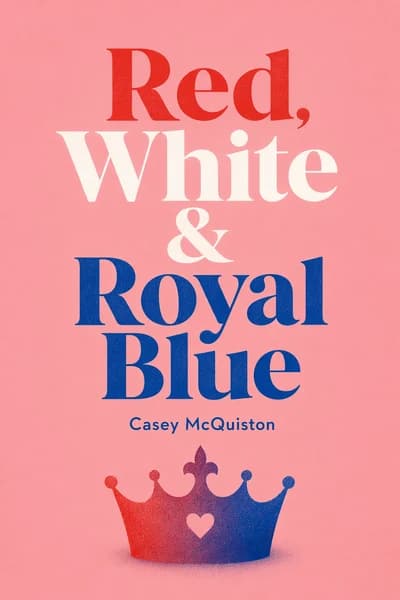
Red, White & Royal Blue took the literary world by storm in 2019, becoming an instant New York Times bestseller and cultural phenomenon. This enemies-to-lovers romance between America's First Son and a British prince captured millions of hearts with its perfect blend of political intrigue, witty banter, and heartfelt romance. Taylor Swift reportedly keeps a copy on her nightstand, while celebrities from Dan Levy to Quinta Brunson have praised its charm and emotional depth. Beyond entertainment, the novel has been celebrated for its authentic LGBTQ+ representation, earning it a place in TIME's 100 Best YA Books of All Time. Casey McQuiston's debut novel ultimately reminds us that love stories can be revolutionary, especially when they challenge the status quo of both politics and royalty.
Kapitel 2
First Sons, Royal Pains, and Cake Catastrophes
Alex Claremont-Diaz lives a life most twenty-somethings can only dream of. As the charismatic, Mexican-American First Son, he balances his public image as a White House heartthrob with his private academic ambitions. Behind his carefully crafted persona of effortless charm lies a meticulous student with reading glasses and color-coded notes, determined to become the youngest elected congressman in modern history. Alongside his sister June and their friend Nora Holleran (the Vice President's granddaughter), they form the "White House Trio" - young, beautiful, and constantly in the tabloids.
But Alex harbors one particular disdain - Prince Henry of Wales, whom he describes as "a stuck-up product of inbreeding who probably jerks off to photos of himself." This antagonism stems partly from their first meeting at the Olympics shortly after Henry's father died, when the prince was understandably cold. But there's something else too - a childhood fascination with Henry that Alex has buried beneath layers of performative dislike.
Their rivalry comes to a spectacular head at the royal wedding of Henry's brother Philip. After one too many champagnes and a heated exchange of barbs, Alex and Henry tumble backward into the $75,000 wedding cake, creating an international incident captured by dozens of flashing cameras. As they lie in the wreckage, covered in frosting with Henry bleeding from a cut on his cheek, Alex realizes his mother is going to murder him.
The diplomatic solution? A carefully orchestrated weekend of fake friendship in England, complete with staged photos, a joint TV interview, and a charity visit to a children's cancer ward. What begins as a PR exercise slowly reveals unexpected depths to the prince. Alex overhears Henry having a genuine conversation with a young Star Wars fan named Claudette, telling her that Luke Skywalker proves "it doesn't matter where you come from or who your family is - you can always be great if you're true to yourself."
When a noise like gunfire (later revealed to be fireworks) erupts, security shoves them into a supply closet together. Trapped in close quarters, they have their first honest conversation, debating Star Wars films and finding surprising common ground. Henry apologizes for his coldness at the Olympics, explaining it was shortly after his father's death from cancer. The weekend ends with Alex giving Henry his personal number "to make their continued fake friendship easier to coordinate." Neither realizes this small gesture will change everything.
Kapitel 3
Midnight Texts and Royal Confessions
What begins as occasional messages about their public appearances gradually transforms into something more intimate. Late-night texts about Henry's boring grey clothes (Alex insists he try patterns) and daily exchanges reveal a growing fondness between them. When Alex finds himself trapped in his White House bedroom with the Thanksgiving turkeys his mother is meant to pardon, he impulsively calls Henry for moral support at 3 AM. Their conversation reveals unexpected sides of the prince - he enjoys Great British Bake Off, uses face masks before appearances, and named his dog David after Bowie.
The annual "Young America New Year's Eve Gala" (unofficially known as the "Legendary Balls-Out Bananas White House Trio New Year's Eve Party") marks a turning point. Henry arrives looking stunning in a dark blue suit with a coppery-mustard tie that makes his eyes impossibly blue. Throughout the evening, they enjoy each other's company, with Henry even bonding with June at the bar. When the music shifts to early 2000s hip-hop, Alex attempts to teach a bewildered Henry how to dance, grabbing his hips and demonstrating. The prince is initially horrified by the explicit lyrics but gradually loosens up.
At midnight, Alex kisses Nora as they always do, and notices Henry watching with an unreadable expression before disappearing into the crowd. Later, Alex finds Henry outside in the snowy garden, looking at the cloudy sky. They share a drunken conversation about what they'd do if they weren't who they are - Henry admits he'd be a writer and would date more. When Alex doesn't understand Henry's hints about his romantic interests, Henry finally kisses him, leaving Alex stunned. Before Alex can respond, Henry apologizes and flees, leaving Alex touching his lips in shock.
The kiss haunts Alex for weeks. Despite trying to distract himself with his mother's meetings, congressional bills, and starting his final semester, his mind constantly returns to that moonlit moment. As he runs with June around the Reflecting Pool, he contemplates his sexuality, realizing that straight people probably don't spend this much time convincing themselves they're straight. When he thinks about Henry, something twists in his chest, and he can finally name what ignites in his stomach when he thinks about Henry's voice, hands, and impossibly blue eyes.
Kapitel 4
Forbidden Encounters and Hidden Desires
Unable to avoid Henry forever, especially when he's required to attend a state dinner at the White House, Alex arranges for Secret Service agent Amy to give them five minutes alone in the Red Room. Once there, Alex forcefully silences Henry's protests by grabbing his tie and kissing him against the wall. After initial shock, Henry responds passionately. When Henry awkwardly suggests they should "slow down" or "go for dinner first," Alex impatiently reminds him they just had dinner and tells him to "stop thinking."
Their encounter grows heated until Amy interrupts them, announcing "Time's up!" Before they part, Alex demands Henry meet him in the East Bedroom at eleven o'clock, threatening to put him on a no-fly list if he doesn't show up. This marks the beginning of their secret relationship, conducted under the guise of a public "bromance" that even earns Alex a text from his handler Zahra: "Good work, you little shit."
What follows is a whirlwind of stolen moments across continents. In Paris, they break their unspoken rule by spending the night together, with Alex discovering Henry sleeps curled on his side and has "little sharp points" along his spine that are actually soft to touch. They celebrate their birthdays together in New York, where Henry pins Alex to the mattress in a champagne-fueled encounter. During weeks apart, they communicate via Snapchat and phone calls, discussing their work and personal lives.
Alex becomes fascinated by the contrast between Henry's public persona and private self. He particularly enjoys provoking passionate responses from Henry, like his heated defense of Dracula as "essentially a work of queer erotica" and his frustration with Britain's sanitization of queer cultural figures. As they share more intimate conversations, Henry reveals the painful constraints of royal life - how his grandmother sees hiding his sexuality as "doing what must be done" rather than lying.
Their circle of confidants slowly grows to include Cash and Amy (for security reasons), Shaan (Henry's aide), Nora (who remains smug about figuring it out first), Bea (Henry's sister who accidentally discovered them during a FaceTime call), and Pez (Henry's best friend who's known all along). When June finally learns about their relationship, Alex is relieved to have her complete acceptance and support.
Kapitel 5
Love in the Spotlight
Despite their growing intimacy, both men struggle with the implications of their relationship. Henry fears disappointing his family and country, while Alex worries about his political future, especially representing Texas. Their carefully constructed secret world begins to crumble when surveillance footage from the Beekman Hotel shows them together, leading to media speculation. To divert attention, June posts a photo suggesting she and Henry are romantically involved - a painful deception that leaves Henry devastated, saying he "hates this" charade and fears he'll "never be allowed" to be himself.
The breaking point comes when their relationship is exposed in spectacular fashion. Headlines and photos of Alex and Henry kissing are splashed across newspapers worldwide, along with their private emails dubbed "The Waterloo Letters." In panic, Alex is rushed to the White House where his mother offers unconditional support, asking if Alex feels "forever" about Henry. When Alex confirms he does, the president simply says, "Fuck it," ready to back her son despite the political consequences.
After five unbearable hours of meetings with strategists and crisis managers, Alex flies to London to reunite with Henry. At Kensington Palace, they find refuge in the music room with Henry's sister Bea, who explains how their father's death created an unfathomable chasm of grief in Henry that Alex must love as part of him. Alex affirms his commitment: "I love him on purpose."
The confrontation with the royal family reaches its climax at Buckingham Palace, where Queen Mary suggests they could dismiss the photos and emails as technological manipulations. When Henry insists it's all real, she expresses disappointment, reminding him of his duty to maintain the monarchy's image and produce heirs. The standoff breaks when Catherine, Henry's mother, opens the curtains to reveal massive crowds outside with rainbow flags and supportive signs. Threatening to bring concerns about the Queen's competence to Parliament, Catherine forces her mother to accept Henry's relationship with Alex.
In a stunning twist, evidence emerges that Senator Richards - President Claremont's opponent - orchestrated the entire leak of Alex and Henry's relationship. With help from Senator Rafael Luna, who reveals he infiltrated Richards' campaign to expose his predatory behavior, the Claremont team turns the tables on Richards, transforming a potential scandal into a powerful moment of truth and authenticity.
Kapitel 6
Rewriting History, One Love Story at a Time
Alex delivers a watershed speech to the nation about his relationship with Henry, a moment that transforms both American politics and LGBTQ+ history. Standing at the podium with careful determination, he publicly embraces his bisexuality while drawing powerful parallels to iconic American love stories - "the same as Jack loved Jackie, the same as Bess loved Harry." The speech, masterfully crafted by June with both emotional resonance and political acumen, presents their love as part of a greater American narrative. Alex's words ring with authenticity as he implores Americans to see beyond labels and prejudice, declaring that "love is indomitable" and that their relationship represents not a scandal, but a testament to love's enduring power across boundaries.
The public response proves extraordinary. Supporters flood the National Mall, many wearing "HISTORY, HUH?" t-shirts - a phrase that becomes a rallying cry for acceptance and change. Oscar Diaz, Alex's father, emerges as an unexpected ally, forcefully defending the president against Richards' thinly veiled homophobic rhetoric about "traditional values." His support carries particular weight in Texas, where Latino voters become crucial to the election's outcome.
Election night unfolds like a political thriller. State by state, results pour in until Texas - Alex's home state - turns decisively blue, delivering President Claremont 301 electoral votes and a historic second term. The victory feels deeply personal as Alex stands surrounded by his chosen family - June, Nora, and Henry - watching his mother address the nation. Her speech resonates with themes of hope, progress, and the courage to choose love over fear, marking a new chapter in American history.
The formal acknowledgment of their relationship comes through carefully orchestrated royal portraits. The styling speaks volumes: Alex in casual American attire - jeans, rolled sleeves, and an easy smile - while Henry embodies British sophistication in tailored tweed and wire-rimmed glasses. During the shoot, they share private moments of laughter, marveling at how far they've come. Alex jokes about his former self's reaction to this scenario, while Henry teases him about his "revolutionary" spirit being tamed by love.
Their future plans evolve in ways neither could have predicted. Henry channels his passion into establishing an LGBT rights foundation, focusing particularly on homeless queer youth - a cause close to his heart. The foundation opens shelters across multiple continents, with a flagship location in Brooklyn becoming a symbol of hope and sanctuary. Alex, meanwhile, secretly prepares for a different path than expected, taking the LSAT and considering NYU Law. This choice represents a shift from his predetermined political timeline to a more personal mission as a civil rights attorney, allowing him to fight for equality through the legal system while being close to Henry's work in Brooklyn.
The night of Claremont's victory, Alex leads Henry on an intimate journey through Austin's celebrating streets to his childhood home in Pemberton Heights. Away from the cameras and crowds, Alex shares a deeply personal moment, using the key he's kept alongside Henry's ring to open the door to his past. These two symbols on his keychain - one representing his roots, the other his future - perfectly encapsulate how their love story has bridged worlds, creating something entirely new and revolutionary in its quiet truth.
Kapitel 7
When Personal Becomes Political
Red, White & Royal Blue isn't just a love story - it's an exploration of identity, duty, and the courage to live authentically in the public eye. Throughout the novel, both Alex and Henry grapple with the weight of expectations placed upon them by family, country, and history itself.
For Alex, the biracial son of America's first female president, politics has always been personal. His carefully planned trajectory toward becoming the youngest congressman in modern history represents not just ambition but a desire to prove himself worthy of his heritage - both his mother's groundbreaking achievements and his father's Mexican-American roots. When he discovers his bisexuality through his relationship with Henry, Alex must reconcile this new understanding of himself with his political aspirations in a country where such identities remain contentious.
Henry's struggle is equally profound but differently constrained. As a prince bound by centuries of tradition, his homosexuality represents not just a personal challenge but a potential constitutional crisis. The monarchy's expectations - that he maintain a certain image, eventually marry appropriately, and produce heirs - clash fundamentally with his authentic self. His journey involves not just accepting his sexuality but finding the courage to challenge an institution that has survived precisely by resisting change.
What makes their story revolutionary is how they ultimately refuse to choose between love and duty. Instead, they redefine what duty means - arguing that true service to country and crown comes through authenticity rather than conformity. When Henry declares he'd rather abdicate than deny his love, or when Alex addresses the nation about his bisexuality while affirming his commitment to public service, they're not abandoning their responsibilities but transforming them.
The novel suggests that personal happiness and public service aren't opposing forces but complementary ones. Leaders serve best when they bring their whole, authentic selves to their work. By choosing love - messy, complicated, inconvenient love - Alex and Henry don't diminish their capacity to make history; they enhance it.
Kapitel 8
Reimagining History Through a Modern Lens
One of the most powerful themes running through Red, White & Royal Blue is how history shapes our present while simultaneously being reshaped by our understanding of it. Throughout the novel, McQuiston cleverly weaves historical references that illuminate the long, often hidden tradition of queer love throughout history, creating a rich tapestry that connects past and present through parallel experiences and shared struggles.
Alex's discovery of Alexander Hamilton's possibly romantic letters to John Laurens parallels his own relationship with Henry - two men whose love exists alongside their service to country. The detailed correspondence between Hamilton and Laurens, with its passionate declarations and intimate tone, serves as both historical documentation and emotional validation. This parallel becomes particularly poignant when Alex reads lines like "I wish, my dear Laurens, it might be in my power...to convince you that I love you," seeing his own feelings for Henry reflected in words written centuries ago.
Henry's knowledge of the relationship between King James I and George Villiers, commemorated in the Samson statue at the Victoria and Albert Museum, reminds us that queer history has often been deliberately obscured or rewritten. The statue itself becomes a powerful metaphor - its true meaning hidden in plain sight, much like the countless LGBTQ+ relationships throughout history that have been dismissed as "close friendships" or "political alliances." The novel also references other historical figures like Eleanor Roosevelt and Lorena Hickok, Frederick the Great, and Oscar Wilde, creating a comprehensive tapestry of queer historical figures.
These historical echoes serve multiple purposes in the narrative. They provide Alex and Henry with predecessors who navigated similar challenges, offering both comfort and inspiration. The characters find strength in knowing they're part of a longer tradition of love persisting despite societal constraints. They challenge the false notion that LGBTQ+ identities are somehow modern inventions rather than constants throughout human experience. Through careful research and documentation, Alex discovers that every era has its own stories of same-sex love, though many were forced into secrecy or encoded in careful language.
When Alex and Henry decide to go public with their relationship, they're not just making personal history but contributing to a broader reclamation of queer history. Their story becomes part of a continuum that stretches back centuries - not an aberration but a continuation. The novel's title itself plays with this idea: Red, White & Royal Blue combines American and British iconography, suggesting that even these seemingly fixed national identities are subject to blending and reimagining. Their love story becomes a bridge not just between nations but between past and present.
McQuiston's narrative particularly emphasizes how historical interpretation changes based on who's doing the interpreting. The novel shows how traditional historical narratives often exclude or erase queer experiences, and how modern scholars and individuals are working to recover these hidden histories. Through Alex's research and Henry's knowledge of art history, readers see how queer people have always found ways to document their experiences, even if society forced them to do so in coded ways.
In the end, McQuiston offers a hopeful vision where understanding our past more completely - including its diversity and complexity - enables us to create a more inclusive future. History isn't just something that happens to us; it's something we actively create through our choices to live authentically and love boldly. The novel suggests that by acknowledging and celebrating the full spectrum of historical human experience, we create space for more diverse stories in our present and future.
Kapitel 9
Finding Home in Each Other's Arms
At its heart, Red, White & Royal Blue is about finding home - not necessarily in a physical place, but in another person. Both Alex and Henry have complicated relationships with their literal homes. Alex splits his time between the White House (a temporary residence laden with historical significance) and Texas (where his roots run deep but his identity as a bisexual man might not be fully accepted). Henry lives in a palace that represents both privilege and constraint - a golden cage that offers security but demands conformity.
Their journey toward each other is also a journey toward creating a shared home that transcends geography. When Henry gives Alex his signet ring and Alex places it on the chain with his house key, it symbolizes this merging of worlds - "two homes side by side." Their love creates a space where they can both be fully themselves, free from the expectations and limitations of their public roles.
This theme of home extends beyond their relationship to encompass family as well. Both men have complicated family dynamics: Alex's parents are divorced but supportive, while Henry navigates the loss of his father, his mother's emotional distance, and his grandmother's rigid expectations. Throughout the novel, they create a chosen family that includes June, Nora, Bea, and Pez - a network of support that transcends blood ties and national boundaries.
By the novel's end, both men are reimagining home in ways that honor their pasts while creating space for their future together. Henry's youth foundation in Brooklyn and Alex's consideration of NYU Law suggest they're building a life that balances duty to others with commitment to each other. Their final scene at Alex's childhood home in Austin symbolizes this integration - bringing Henry into Alex's past while looking toward their shared future.
In a world where both politics and royalty demand public performance and personal sacrifice, McQuiston suggests that true home isn't found in White Houses or palaces but in relationships where we can be fully, authentically ourselves. It's a powerful message that resonates far beyond the specific circumstances of these characters, speaking to anyone who has ever felt caught between expectations and authenticity, between duty and desire.