Kapitel 1
The Quantum Revolution: Unlocking Humanity's Greatest Challenges
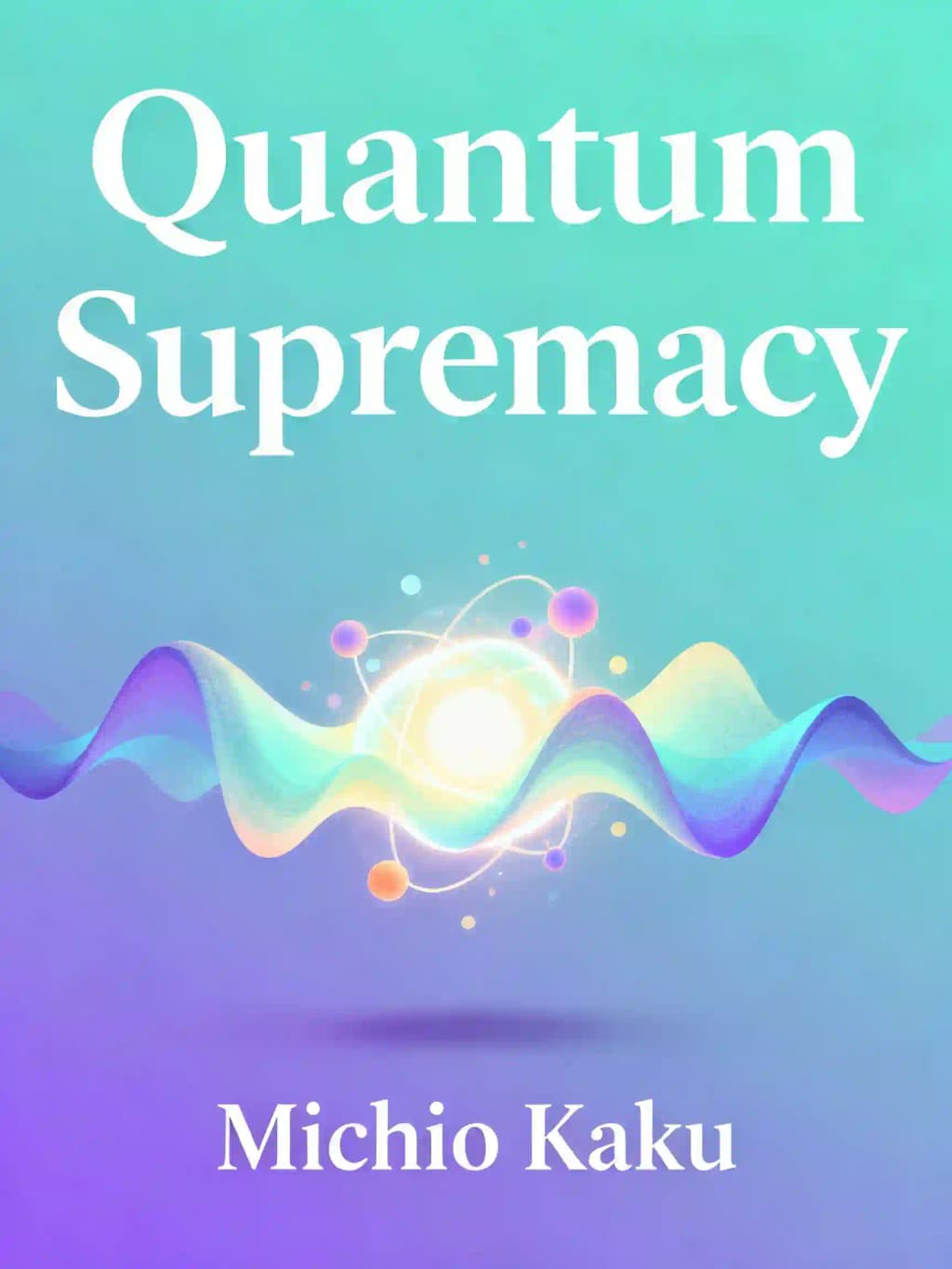
In 2019, the world witnessed a watershed moment when Google's Sycamore quantum computer solved in 200 seconds a problem that would take the world's fastest supercomputer 10,000 years. This achievement of "quantum supremacy" sent shockwaves through the scientific community and corporate boardrooms alike. Michio Kaku's "Quantum Supremacy" arrives at a pivotal moment in technological history, as we stand at the threshold between the fading Silicon Age and the dawn of the Quantum Age. The book has garnered praise from tech luminaries like Elon Musk, who called it "essential reading for understanding our technological future," and has been featured prominently in publications from Scientific American to The Wall Street Journal. As quantum computing moves from theoretical possibility to practical reality, Kaku's exploration of its revolutionary potential couldn't be more timely-or more necessary for understanding the technological revolution that will reshape our world.
Kapitel 2
The End of Silicon and the Quantum Dawn
For half a century, Moore's Law has reliably tracked the exponential growth in computing power as transistors shrank to ever-smaller dimensions. This progression began with mechanical computers in the 1800s, evolved through electrical calculators with relays, then vacuum tubes during World War II, and finally to transistors that could be miniaturized on silicon chips. Today's fingernail-sized chips contain about one billion transistors, giving pocket-sized devices more computing power than Cold War-era Pentagon supercomputers.
But we're approaching a fundamental limit. As transistors reach atomic scale-with layers just twenty atoms across-they will eventually fail at about five atoms due to quantum uncertainty effects. As Intel's Sanjay Natarajan noted, "We've squeezed everything you can squeeze out of that architecture." Silicon Valley may eventually become the next Rust Belt unless it embraces the quantum revolution.
Quantum computers derive their extraordinary power from fundamental differences in how they process information. While conventional computers use bits (0s and 1s), quantum computers use qubits based on atomic states. Unlike classical bits, qubits can exist in superposition-simultaneously representing multiple states. Additionally, qubits can interact through entanglement, doubling potential interactions with each added qubit. This makes quantum computers exponentially more powerful than digital ones. Google's Sycamore quantum computer, with fifty-three qubits, can process 72 billion billion bytes of memory, dwarfing conventional computing power.
The primary challenge facing quantum computers is maintaining coherence-keeping atoms vibrating in precise unison. The smallest impurity or external disturbance can disrupt this coherence and ruin calculations. Scientists currently use specialized equipment to cool quantum computers to near absolute zero to minimize unwanted vibrations. Yet a fascinating mystery remains: nature performs quantum processes like photosynthesis at room temperature without such elaborate equipment. If we could understand how nature maintains quantum coherence in warm environments, we might master quantum technology and potentially even life processes themselves.
The economic implications of quantum computing are profound. Quantum computers promise to transform the economy through four key capabilities: superior search engines that find patterns in mountains of data; optimization of complex systems with hundreds of variables; simulation of complex phenomena from aerodynamics to weather prediction; and revolutionary computational chemistry that can predict chemical reactions without physical experiments. This last capability could create "virtual laboratories" that bypass decades of trial and error in drug development and materials science.
Kapitel 3
From Ancient Mechanisms to Quantum Machines
The human desire to simulate and understand our world has ancient roots. The Antikythera mechanism-the world's oldest computer salvaged from a 2,000-year-old shipwreck-could calculate celestial movements with astonishing precision. This intricate mechanical device represented the pinnacle of ancient scientific knowledge, an early attempt to model the cosmos mathematically. Sadly, after the fall of the Roman Empire, it would take many centuries before scientists could again build machines of comparable sophistication.
By the 1800s, Charles Babbage envisioned creating the most advanced computing machine of his time. His ambitious project attracted Lady Ada Lovelace, who recognized that computers could manipulate not just numbers but symbols representing music, letters, and other concepts-insights that transcended Babbage's vision. Though Babbage's dream machine was never completed due to funding issues, his designs were remarkably advanced. When engineers at the London Science Museum later built one of his models following his original designs, it worked perfectly, just as he had predicted a century earlier.
While engineers built increasingly complex mechanical computers, mathematicians pursued a 2,000-year-old dream: proving that all true mathematical statements could be rigorously proven. But in 1931, Kurt Godel shocked the mathematics community by proving it was impossible to prove all true statements in mathematics given a set of axioms. This revelation shattered two millennia of Greek thinking, forcing mathematicians to accept that mathematics itself was incomplete and messy.
Alan Turing transformed computer science by introducing the concept of a universal Turing machine-a deceptively simple device with an infinitely long tape containing 0s and 1s and a processor that could perform six basic operations. This elegant model became the foundation for all modern computers. During World War II, Turing's genius was redirected to cracking Nazi Germany's supposedly unbreakable Enigma code. He helped design the bombe and contributed to Colossus-arguably the world's first programmable digital electronic computer. By 1942, Turing's team broke the Nazi code, allowing Allies to anticipate enemy plans. Historians estimate this work shortened the war by two years and saved 14 million lives.
After the war, Turing tackled artificial intelligence by asking "Can machines think?" He devised the practical "Turing test"-placing a human in one room and a robot in another, with an interrogator asking written questions to determine which was which. Tragically, Turing's brilliant career ended when he was arrested for homosexuality in 1952, forced to undergo hormonal treatments, and eventually found dead from cyanide poisoning. Despite his tragic end, his legacy lives on in every digital computer, all based on his architecture.
Kapitel 4
Quantum Physics: The Science Behind the Revolution
The quantum revolution began with Max Planck, a conservative man from a distinguished family of academics who in 1900 made a discovery that would overthrow centuries of Newtonian determinism. Facing the "Rayleigh-Jeans catastrophe"-where calculations of energy emitted by hot objects yielded impossible infinities-Planck made the radical assumption that energy comes in discrete packets called quanta. By introducing Planck's constant (h), an incredibly small number, he could precisely match experimental data while opening the door to an entirely new physics.
Planck's quantum theory gained momentum when Einstein used it to explain the photoelectric effect-how light knocks electrons from metal surfaces. Einstein introduced the concept of duality: light could behave as both particle (photon) and wave. In 1924, Louis de Broglie extended this duality to matter itself, suggesting electrons could also behave as waves. This heretical idea was confirmed by the double-slit experiment, where electrons created wavelike interference patterns rather than two distinct spots.
Erwin Schrodinger's wave equation, conceived during a romantic weekend in the Alps with his girlfriend, became the foundation of quantum theory. While previous models depicted atoms as miniature solar systems with electrons orbiting the nucleus, Schrodinger's equation showed electrons as waves forming discrete resonances around the nucleus-similar to how certain sound frequencies resonate in musical instruments. This mathematical breakthrough allowed physicists to finally peer inside the atom and explain the chemical properties of elements using pure mathematics.
The quantum model elegantly explains the periodic table. Like a hotel with specific floors and rooms, atoms have orbitals that fill in a particular order. When electrons aren't paired, they can form bonds between atoms. Carbon's four available bonds make it ideal for creating complex molecules like proteins and DNA. This mathematical approach reduces chemistry to physics, explaining the entire periodic table and even the chemistry of life from first principles.
But the Schrodinger equation raised a profound question: if electrons were waves, what exactly was waving? Max Born's answer-that matter consists of particles whose locations are determined by probability waves-split the physics community. The "old guard" (Planck, Einstein, de Broglie, Schrodinger) rejected this interpretation, while Heisenberg and Bohr championed it. This new view meant physics could only calculate probabilities, never certainties, with electrons existing in multiple places simultaneously.
Schrodinger devised his famous cat paradox to challenge quantum theory's radical interpretation. He proposed a sealed box containing a cat, poison gas, and a radioactive trigger mechanism. Before opening the box, quantum mechanics suggests the cat exists as a superposition of both alive and dead states. Only upon observation does this wave function collapse to reveal either outcome. This challenges our fundamental understanding of reality, suggesting objects don't exist in definite states until observed.
Kapitel 5
Building the Quantum Computer
Richard Feynman combined showmanship with scientific brilliance. With his truck-driver accent and colorful stories, he entertained audiences while also developing quantum electrodynamics (QED), accurate to one part in 10 billion-the most successful quantum theory ever measured. In his 1959 speech "There's Plenty of Room at the Bottom," he proposed revolutionary ideas like writing encyclopedias on pinheads, atomic-scale tools, and medical nanobots that could "swallow the doctor."
Feynman's revolutionary approach to physics began with the principle of least action-the idea that objects somehow "choose" the path requiring minimum energy from infinite possibilities. Years later, he applied this concept to quantum mechanics, creating the path integral approach where subatomic particles effectively explore all possible paths simultaneously. This elegant reformulation derived the previously unexplained Schrodinger equation and unified quantum mechanics under a single principle.
David Deutsch of Oxford University advanced Feynman's quantum computing vision by developing the quantum Turing machine-a rigorous mathematical foundation for quantum computers. While preserving the basic operations of classical Turing machines, Deutsch's model replaced classical bits with qubits that exploit superposition to exist between 0 and 1 simultaneously. The entanglement between qubits means changes to one can instantly affect others regardless of distance.
The most radical alternative to traditional quantum mechanics came from Hugh Everett in 1956, who proposed simply eliminating the wave function collapse altogether. In his "many worlds" theory, quantum waves never collapse but continue branching into infinite parallel universes representing all possible quantum states. Like a river splitting into countless tributaries, each quantum decision creates new universe branches where different outcomes occur. This elegant solution removes the artificial boundary between quantum and classical worlds but demands we accept an infinite multiverse where every possible decision path exists simultaneously.
Peter Shor's work at AT&T in the early 1990s transformed quantum computing from theoretical curiosity to national security concern. He demonstrated that quantum computers could break the RSA encryption standard by factoring large numbers exponentially faster than classical computers. While classical computers might take centuries to factorize a 200-digit number, quantum computers could perform this task in practical timeframes by computing over many states simultaneously.
The race for quantum computing supremacy has drawn Silicon Valley's biggest names, with billions invested in competing architectures. Currently, IBM leads with 433 qubits in its Osprey processor, with plans for a 1,121-qubit Condor in 2023 and an ultimate goal of one million qubits.
Kapitel 6
Quantum Biology: Unlocking Life's Deepest Secrets
Every culture has developed mythologies explaining life's beginnings-from Biblical creation to Greek cosmology, Native American origin stories to Hindu cycles of creation and destruction. Today, quantum mechanics offers a scientific framework to explain gaps in our understanding of how life originated 4 billion years ago, with quantum computers being ideally suited to unravel molecular mysteries that overwhelm traditional digital computing's capabilities.
Two monumental breakthroughs in the 1950s advanced our understanding of life's origins. First, Stanley Miller's 1952 experiment demonstrated that amino acids-the building blocks of proteins-could form spontaneously when electricity was applied to a mixture of chemicals mimicking Earth's early atmosphere. The experiment contained water vapor, methane, ammonia, and hydrogen, subjected to continuous electrical discharges simulating lightning storms. After just one week, Miller discovered that 10-15% of the carbon had formed into organic compounds, including 13 of the 20 amino acids essential for life. Quantum mechanics explains why Miller's experiment succeeded by calculating the precise energy needed to break chemical bonds and showing how carbon's unique four-bond structure enables the formation of complex molecular chains necessary for life.
The second breakthrough came from Erwin Schrodinger's 1944 book "What Is Life?" where he proposed that life is a by-product of quantum mechanics encoded in an unknown molecule. This radical idea inspired Francis Crick and James Watson to search for this molecule, which they identified as DNA using X-ray crystallography-a quantum-theory-based process. Their discovery of DNA's double helix structure revealed how four nucleic acids (adenine, cytosine, thymine, guanine) arrange themselves through hydrogen bonding to create the blueprint for all life. This insight revolutionized our understanding of heredity and launched the field of molecular biology.
A fundamental paradox remains in understanding life's origins: how could random chemical events create complex biological molecules in such a relatively short timeframe? Earth formed 4.6 billion years ago, with its first billion years being too hot for life due to constant meteorite bombardment and volcanic activity. Yet by 3.7 billion years ago-just a couple hundred million years after oceans formed-DNA had already emerged with complete reproduction mechanisms. Quantum mechanics offers an explanation through several mechanisms: quantum tunneling allows particles to pass through energy barriers that classical physics forbids, path integrals provide multiple simultaneous reaction pathways, and enzyme-assisted quantum tunneling can accelerate chemical reactions by factors of thousands or millions. These quantum processes could dramatically accelerate chemical reactions, allowing seemingly impossible molecular formations to occur rapidly.
Quantum computers are revolutionizing our understanding of molecular biology through emerging fields like computational chemistry and quantum biology. Unlike classical computers that can only reliably calculate the behavior of a couple of electrons, quantum computers can model complex molecular interactions atom-by-atom, nanosecond-by-nanosecond, accounting for quantum effects like superposition and entanglement. In 2020, Google's Sycamore quantum computer set a record by accurately simulating twelve hydrogen atoms using twelve qubits, doubling previous quantum chemistry simulations. This achievement points toward future capabilities to model entire proteins and complex biochemical reactions, potentially revealing new insights into life's quantum origins. Recent experiments have also discovered quantum effects in biological processes like photosynthesis, bird navigation, and enzyme catalysis, suggesting that life may harness quantum mechanics more fundamentally than previously thought.
Kapitel 7
Solving Global Challenges with Quantum Computing
Photosynthesis-the process converting carbon dioxide, sunlight and water into sugar and oxygen-creates 15,000 tons of biomass per second and has fundamentally reshaped Earth's atmosphere. Despite its critical importance, scientists still don't fully understand how it works. The process appears to operate with nearly 100% quantum efficiency when capturing photons. Quantum computers might finally solve this mystery, potentially enabling artificial photosynthesis, more efficient solar cells, and plants that could thrive in harsh environments.
In 2007, Graham Fleming detected quantum coherence in photosynthesis using ultrafast femtosecond spectroscopy. He showed light waves could exist in multiple quantum states simultaneously, allowing excitons to explore multiple pathways to reaction centers concurrently-explaining their near-perfect efficiency. This quantum approach could revolutionize agriculture by allowing scientists to virtually model photosynthesis improvements rather than conducting thousands of time-consuming plant experiments.
The artificial leaf represents a paradigm shift in addressing climate change by recycling CO2 instead of treating it as a villain. This technology would combine CO2 with sunlight and water to create fuel and valuable chemicals in a continuous cycle with no net carbon increase. Quantum computers could dramatically accelerate this research by simulating complex molecular processes and finding new pathways to break CO2 bonds, potentially revolutionizing solar energy and climate change mitigation.
Fritz Haber's discovery of artificial fertilizers unleashed the Green Revolution, transforming barren fields into lush farms by extracting nitrogen from air. Yet this legacy is complicated: the same chemistry creates devastating weapons, and the energy-intensive process contributes to pollution and climate change. No significant improvement to this century-old technique has emerged, making it a prime target for quantum computing optimization.
Scientists seeking to replace the energy-intensive Haber-Bosch process must understand how nature fixes nitrogen effortlessly at room temperature. The key lies in ATP (adenosine triphosphate), nature's universal battery molecule that powers virtually all biological functions. Breaking a single nitrogen molecule requires twelve ATP molecules working in concert-a process that would take years through random collisions but happens almost instantly in nature. This remarkable efficiency suggests quantum processes may be involved, making quantum computing ideal for unraveling this mystery.
Despite being titans of different energy paradigms-electricity and fossil fuels-Thomas Edison and Henry Ford maintained a close friendship, often wagering on which energy source would power the future. Though Edison's electric batteries seemed the obvious winner, gasoline's extraordinary energy density (storing 12,000 watt-hours per kilogram versus batteries' mere 200) and plummeting prices made automobiles accessible to working-class Americans. Unlike the exponential improvements of Moore's law in computing, battery efficiency has improved slowly because chemical reactions are notoriously difficult to predict. Quantum computing promises to accelerate battery development through virtual chemistry simulations.
Kapitel 8
Quantum Medicine: The Future of Human Health
Throughout human history, life expectancy averaged a mere twenty to thirty years, with people living in constant fear of plagues and famines. Medical care was often counterproductive, with wealthy patients receiving useless potions from self-important physicians while the poor died in filthy, overcrowded hospitals.
Antibiotics have become victims of their own success, as overuse has led to the emergence of drug-resistant "superbugs." Despite this urgent threat, no new classes of antibiotics have been developed in thirty years, largely because the traditional development process costs $2-3 billion and takes over a decade. Quantum computers could revolutionize this process by reversing the strategy: instead of testing substances first, we could identify molecular mechanisms that kill bacteria, then design drugs specifically for those targets.
Quantum computers promise to revolutionize medicine by analyzing millions of potential drugs simultaneously and unraveling disease mechanisms at their molecular foundations. They could tackle humanity's most pressing medical challenges: what causes cancer, Alzheimer's, Parkinson's, and ALS, and how mutating viruses respond to treatments. While the Human Genome Project mapped our genetic blueprint, quantum computers can explain how DNA and proteins actually function at the quantum level.
Traditional cancer detection often comes too late, after tumors containing billions of cells have formed. Liquid biopsies-analyzing bodily fluids for cancer cells and molecules-represent a revolutionary screening approach that can detect up to fifty different cancer types years before they become lethal. In the future, quantum computers might analyze our genome regularly to identify harmful mutations, making cancer no more dangerous than the common cold-not because we've cured it, but because we can detect it so early that it rarely progresses to deadly stages.
CRISPR technology, inspired by bacteria's natural defense mechanisms against viruses, has revolutionized genetic engineering. This precise gene-editing tool, likened to word processing for DNA, earned Emmanuelle Charpentier and Jennifer Doudna the 2020 Nobel Prize. When combined with quantum computing, CRISPR could target crucial genes like p53-the "Guardian of the Genome" whose mutations contribute to roughly half of common cancers. Beyond cancer, CRISPR shows promising results treating AIDS by editing the CCR5 gene that provides viral entry points, cystic fibrosis by repairing the CFTR gene mutation, and Huntington's disease by addressing repetitive gene sequences.
Kapitel 9
The Future of Quantum Computing
Can machines truly think? This question launched the artificial intelligence field at the historic 1956 Dartmouth Conference, where pioneers like Marvin Minsky predicted rapid progress toward human-level machine intelligence. But "AI winters" followed as researchers realized their creations were merely single-task performers, far from matching human intelligence. Now, merging AI with quantum computing offers a promising new direction: AI provides learning capabilities while quantum computers deliver the computational power needed for complex problem-solving.
AI deep learning systems are now tackling one of biology's greatest challenges: decoding protein molecules. While DNA contains life's instructions, proteins do the actual work-they're the "construction workers" that make our bodies function. By 2021, DeepMind's AlphaFold had deciphered the structure of 350,000 proteins, including 250,000 previously unknown shapes and all 20,000 proteins from the Human Genome Project, with plans to release a database of over 100 million proteins.
While textbooks traditionally attribute diseases to bacteria and viruses, another culprit exists: prions-proteins that have folded incorrectly. These misfolded proteins can force normal proteins to fold incorrectly when they come in contact, causing diseases to spread rapidly throughout the body. Prions may be responsible for human conditions affecting the elderly, including Alzheimer's-the "disease of the century" affecting six million Americans and causing one in three senior deaths. Quantum computers could create detailed 3D images of these proteins at the atomic level, revealing precisely how misshapen molecules propagate and damage the brain.
Humanity's quest for immortality stretches back to our earliest myths. Today, with modern medicine and quantum computing, we might approach this ancient quest from a new perspective, potentially creating both biological and digital immortality. Aging results from accumulating errors at molecular, genetic, and cellular levels-the Second Law of Thermodynamics catching up with us. Mistakes build up in cells and DNA, skin loses elasticity, organs fail, neurons misfire, and sometimes cancer develops.
Beyond biological immortality, quantum computers may enable digital immortality. While most of our ancestors left barely a trace-perhaps just birth and death records or a weathered tombstone-modern humans leave extensive digital footprints. Our credit card transactions alone reveal our history, personality, and preferences, creating a mirror image of who we are. This vast digital trail could someday enable the recreation of our personalities in digital form.
The race for quantum computing dominance has become a global priority, with nations and corporations investing billions. The technology promises to transform everything from medicine and agriculture to energy production and climate science. As we stand at this technological threshold, quantum computers may ultimately help us understand not just the deepest mysteries of life and consciousness, but perhaps even the fundamental nature of reality itself. The quantum revolution has only just begun.




![[6c91c732-1109-4a3a-af16-741ec685da5f:c0000] All right, everybody. Welcome back. It's this week in sta… p1-1](/_next/image?url=https%3A%2F%2Fd1y2du6z1jfm9e.cloudfront.net%2Fassets%2Fpodcast%2Fgreen.png&w=1024&q=50)
![[6c91c732-1109-4a3a-af16-741ec685da5f:c0001] All right, everybody. Welcome back. It's this week in sta… p1-1](/_next/image?url=https%3A%2F%2Fd1y2du6z1jfm9e.cloudfront.net%2Fassets%2Fpodcast%2Fyellow.png&w=1024&q=50)
![[6c91c732-1109-4a3a-af16-741ec685da5f:c0002] All right, everybody. Welcome back. It's this week in sta… p1-1](/_next/image?url=https%3A%2F%2Fd1y2du6z1jfm9e.cloudfront.net%2Fassets%2Fpodcast%2Fblue.png&w=1024&q=50)