Kapitel 1
The Bourbon Pilgrim's Journey Through Time
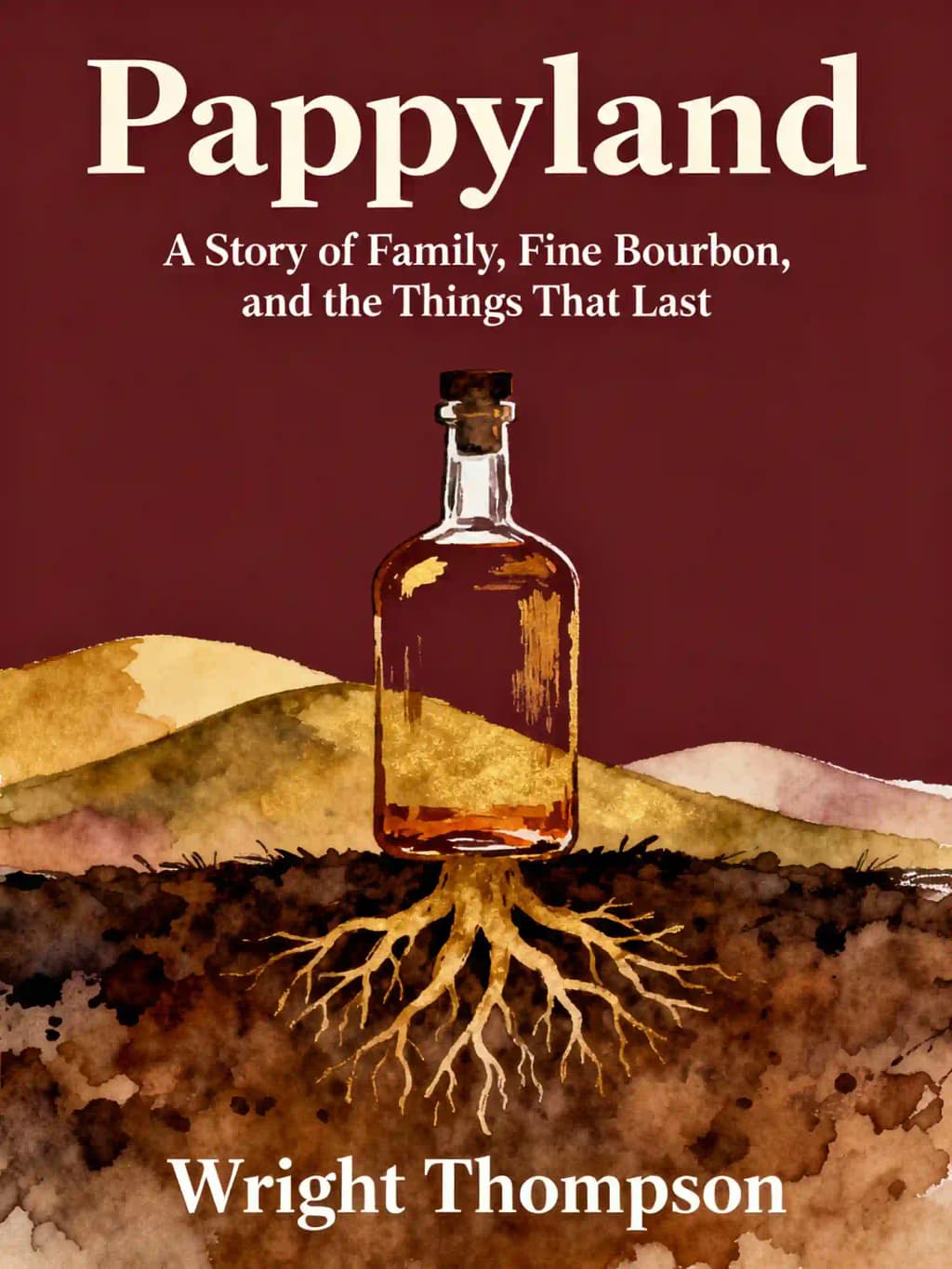
In a world obsessed with authenticity, Julian P. Van Winkle III stands as the unlikely guardian of America's most coveted bourbon. Dressed in his signature bourbon barrel-patterned bow tie at Churchill Downs, he casually shares sips from a flask of Weller 12 while the Kentucky Derby festivities swirl around him. This unassuming man with a penchant for practical jokes-he once wore fake rotten teeth to meet his daughters' in-laws-carries the weight of whiskey royalty on his shoulders. As the grandson of legendary distiller Julian "Pappy" Van Winkle Sr., he wears the same family ring his father and grandfather wore before him. What began as Wright Thompson's straightforward profile of a bourbon icon evolved into something far more profound: a meditation on fathers and sons, legacy and loss, and what we choose to preserve from the past. The timing proved serendipitous-Thompson entered Julian's life just after Julian's battle with cancer had forced him to confront mortality, while Thompson himself awaited news that would determine if he would become a father. Pappy Van Winkle bourbon has transcended mere spirit to become a cultural touchstone, with bottles fetching thousands on the secondary market and earning devotees from Anthony Bourdain to Sean Brock. Yet behind the cult status lies a deeply human story of a man who rebuilt his family's legacy one barrel at a time.
Kapitel 2
Kentucky's Living History: Where Bourbon and Bloodlines Converge
Kentucky forms the spiritual center of the Van Winkle family mythology, a place where bourbon and thoroughbreds spring from the same limestone-filtered water and cultural DNA. This is no coincidence-both are made or broken long before anyone sees them, products of careful breeding and patient aging. The limestone-rich water that filters through Kentucky's bedrock not only provides the perfect calcium-rich foundation for strong horse bones but also removes iron that would discolor whiskey and affect its taste. This geological blessing has shaped the region's twin heritage for over two centuries.
Driving through horse country east of Louisville, narrow lanes wind alongside stone walls under canopies of ancient oak and maple trees, occasionally revealing glimpses of grand estates or their ruins. These properties, with their rolling bluegrass pastures and iconic black fences, represent generations of wealth and ambition. The remnants of Green Hills mansion-four lonely Corinthian columns standing where lavish Derby parties once flowed with champagne and laughter-serve as a poignant reminder that nothing lasts forever, not even seemingly invincible fortunes. Similar stories echo across properties like Calumet Farm and Spendthrift, where dynasties rose and fell.
The hidden history of Kentucky reveals this cycle of fortunes made and lost, with each horse farm passing from one wealthy owner to another. At Churchill Downs, America's psyche is on full display: nervous rich owners pacing in private boxes, celebrities in oversized hats competing for attention, new-money families desperate to acquire status through winning horses, and old-money families desperate to maintain their legacy. The magnificence of thoroughbreds comes from centuries of careful breeding to create the perfect running machine, tracing bloodlines back to legendary sires like Northern Dancer and Secretariat. Yet even champions like Man o' War and Seattle Slew eventually die, leaving behind only memories of "the fire in their eyes" and carefully preserved genetic lines.
This same fire-of birth and blood-is bourbon's essential ingredient, more important than corn or wheat or water. Time both creates and destroys whiskey, transforming harsh white dog into complex amber liquid through years of interaction with charred oak barrels. When we sip an aged bourbon, we're traveling back decades into the past, tasting decisions made by distillers long ago - choices about grain bills, barrel char levels, and warehouse placement that echo through time. Julian's grandfather's greatest contribution was using wheat as the dominant secondary grain instead of the traditional rye, creating a smoother bourbon that survives extended aging better. This "wheated" recipe became the signature of Pappy's distinctive style. His motto "Always Fine Bourbon" wasn't just marketing-Stitzel-Weller put white dog in barrels at lower proof than legally required, costing more in taxes but making better whiskey through gentler aging.
Behind bourbon's romantic facade lies an industry where eight companies make 95% of American whiskey, most operating multiple distilleries producing dozens of brands. Today's labels often tell fictional histories invented by marketing departments, complete with sepia-toned images and tales of frontier distillers. But the Van Winkle story is authentic-rooted in the Kentucky soil where Julian's grandfather built a distillery that opened on Derby Day 1935, just after Prohibition ended, combining the state's twin heritage of horses and bourbon in a single momentous celebration.
Kapitel 3
The Lost Kingdom: How Stitzel-Weller Slipped Away
The Stitzel-Weller distillery stands as both shrine and wound in Julian's life-a 53-acre tract just outside Louisville where his grandfather built his bourbon empire. Pappy opened it on Derby Day 1935, overseeing every detail from the world's largest still to the white-columned office with its Monticello-inspired rotunda. Instead of a knocker, five brass keys hung on the white door, representing bourbon's five stages. "Fine bourbon ought to make itself," Pappy would say, "with just a little help from mother nature and father time."
Those white columns became intertwined with Pappy's image-the place where he ate frankfurters without buns and took afternoon naps on his tan sofa. Here he hunted dove and quail, keeping his gear in an office closet that smelled of leather and gun oil. It was at the cooper shop where teenage Julian had his "aha moment" about bourbon. While fixing barrels one summer, a hose missed and soaked him completely in whiskey: "I tasted it, and that's when I went, 'Damn, this is really good.' Once you taste that flavor, you never forget it."
Unlike most Kentucky distillers who inherited family businesses, Pappy built his from scratch, starting at W.L. Weller & Sons at nineteen in 1893. When large corporations began swallowing small producers, Pappy refused to sell, even testifying before Congress about industry price-fixing. But what Pappy preserved, Julian's father couldn't hold. The bourbon market collapsed in the 1960s as vodka rose in popularity (helped by James Bond), the industry panicked by raising barrel entry proof and making lighter bourbon, and most significantly, generational rebellion took hold-bourbon was what fathers drank, and nobody wanted to be like their fathers.
Julian's father, a tank captain in World War II and Princeton football player, couldn't understand why the world had suddenly changed. Unable to fend off relatives who sided with minority shareholders, he made the impossible choice to surrender rather than destroy family relationships. "We didn't get cash," Julian explained. "We got Norton Simon stock." When the conglomerate's stock plummeted to two dollars a share, Julian believes it contributed to his father's prostate cancer. For nine years after leaving Stitzel-Weller, Julian's father bought whiskey from his old distillery to bottle under his private label, Old Rip Van Winkle. He died in 1981, the shame of losing the distillery a wound that never healed.
Kapitel 4
The Father-Son Dance: Shadows and Reconciliations
Most men both compete with and imitate their fathers, craving approval while fearing disappointment. Throughout adulthood, we often try to be either exactly like our fathers or nothing like them. Julian and his dad were men of different times-the generational divide being the most important relationship either would navigate. Captain Julian P. Van Winkle Jr., a six-foot-four former Princeton football player, led Company A of the Forty-fourth Tank Battalion through the Pacific islands during World War II. At 30, he landed on Leyte in 1944 with MacArthur's forces, naming his personal tank "Old Fitz" after his bourbon. During a frontal assault at Breakneck Ridge, he was shot through his hand and stomach while directing his men outside his tank.
Julian was so focused on the man he wasn't that he never got to know the man his father was. Julian regrets never asking his father about his war experiences, always assuming he'd have more time. In letters home from the Pacific, Julian's father remained interested in news about the distillery despite being in the midst of war planning-discussing "the new well, the cooling tower, the holiday whiskey and prices." The letters reveal his confidence in MacArthur's strategy and American military superiority, while expressing homesickness for his family and simple pleasures.
Julian shaped himself into a different kind of father than the one he had-more patient, involved, and easygoing-though he deeply admired his dad's strength and work ethic. His children describe Julian's love language as spending time with them, always being present though not the disciplinarian. His daughter Chenault remembers holding back laughter when he tried enforcing rules at her mother's request, knowing discipline didn't come naturally to him.
Thompson weaves his own father's story throughout the narrative, revealing his alcoholism for the first time in his writing. His father eventually found sobriety through meetings, which enabled his most vital work. Thompson grieves that his daughter will never meet his magnetic, kind father who taught him to never be jealous of others' success and to see the best in people. When cancer took him at 58, Thompson felt his father had unfulfilled potential, driving him to work maniacally for two decades to be successful enough for both of them.
Kapitel 5
The Wilderness Years: Rebuilding from Ruins
After his father died in 1981, Julian found himself with just four years of experience in the whiskey business and a family legacy in tatters. Two years later, he purchased a dilapidated bottling plant in Lawrenceburg, Kentucky-twenty-two miles south of horse country, closer to moonshine territory. For a man raised as a sort of prince who attended fine Southern boarding schools, this stark contrast to his grandfather's pristine operation seemed like a cruel metaphor for his family's decline.
The decrepit facility had a leaking roof, faulty equipment, and raccoons "shitting in the elevator." Julian spent days fixing an old 1970 Dodge truck that constantly broke down. Despite the hardships, Julian acknowledges its purpose: "It created the Pappy Van Winkle brand." Those wilderness years nearly bankrupted him-Julian went almost a million dollars in debt, taking loans and spending his inheritance to keep Old Rip Van Winkle in bottles. He wasn't anticipating the bourbon boom; he was simply willing to go down with the ship.
During lean years, the family kept up appearances-Julian's wife Sissy would bring sandwiches for the kids to eat in the car before returning to the country club pool. Despite this pressure, Julian always made time for his son Preston-playing sports, attending games and events, shooting oranges with shotguns on his uncle's property-never letting his son see how hard he was struggling to keep things afloat.
Julian relied on help from people who remembered his grandfather, including Jimmy Russell, Wild Turkey's master distiller. When Julian's antiquated bottling equipment broke down, Russell would send mechanics to help. These acts of kindness from industry veterans are something Julian never forgets. Russell represents the old tribe of bourbon people who help each other despite competition-a connection to the farming culture that birthed the spirit. This neighborly instinct is vanishing in a business now run by brand managers and private equity firms.
Everything changed when Julian got a call from a woman named Patty at Diageo. The company was unloading bourbon barrels for as low as $200 each, not realizing their value. Julian recognized what they had-the taste of his youth and his family's legacy of fine aged wheated bourbon. After convincing a banker to extend him credit, he bought as many barrels as he could afford and created Van Winkle Family Reserve, putting Pappy's picture on the label. Six years later, Buffalo Trace called to buy into his brand. Julian had survived and made his own time, finding through his work the life-giving forces that eluded his father.
Kapitel 6
The Bourbon Boom: From Obscurity to Obsession
Four different whiskeys have been bottled under the Pappy Van Winkle's Family Reserve label, each representing a chapter in Julian's journey. The first was Old Boone distilled in the 1970s, using aged barrels Julian didn't want wasted. The second was the legendary Stitzel-Weller bourbon, considered the quintessential Pappy taste. As Julian's success grew, access to these barrels became increasingly difficult. In 2001, Buffalo Trace offered a solution: a joint venture reuniting the Van Winkles with the W.L. Weller brand.
However, the Buffalo Trace-distilled Pappy wouldn't be ready for fifteen years, and Julian was running out of Stitzel-Weller stock. He turned to Bernheim-distilled bourbon as the third iteration, which used the Van Winkle wheated mash bill but lacked the consistent excellence of Stitzel-Weller. Though some experts didn't consider it exceptional, many customers loved it, and prices continued climbing.
The bourbon boom created a secondary market for "vintage spirits," especially bottles made at Stitzel-Weller by Julian's grandfather and father. Old Fitzgerald bottles fetch up to $15,000, though Julian doesn't profit from these inflated prices. Until his wife Sissy demanded he stop, Julian would stay up late buying these bottles himself, hoarding the vanishing taste of his youth in a storage facility.
At WhiskyFest in San Francisco, the "cult bourbon" madness is on full display as lines wind around the ballroom for a taste of Pappy. The first bottle of 23-year-old vanishes in six minutes. Store owners aggressively question their allocations, not understanding that the Van Winkles have no control over distribution or pricing. The family deals with counterfeit bottles, price gouging, and even theft-like the "Pappygate" scandal where an employee stole $100,000 worth of whiskey.
Everyone with any connection to Pappy leverages that story-Stitzel-Weller tours mention him, Heaven Hill references him for Old Fitzgerald, and Weller (made from the same recipe as Pappy) has become impossible to find through association alone. But Julian alone carries the true connection-his remarkable palate and memory of how the whiskey should taste. As bourbon expert Fred Minnick noted, "Julian's great gift is his palate... That's not something you can teach. It's a straight-up gift."
Kapitel 7
The Taste of Memory: Preserving What Matters
Julian's anxiety had been building for fifteen years since partnering with Buffalo Trace. Would the new whiskey they'd made together be good enough to carry his grandfather's name? In a tasting room at Buffalo Trace, Julian examined bottles of 15-year-old raw Pappy alongside last year's release. This moment represented the culmination of fifteen years of uncertainty. In a Freudian slip, Julian referred to the new Buffalo Trace-made bourbon as "Stitzel-Weller," revealing his deep connection to his family's legacy.
The bourbon industry requires predicting America's mood a decade or more into the future-an impossible task. Julian checked the distillation date: April 22, 2002, precisely when he was negotiating the deal with Buffalo Trace that would change his family's legacy forever. His anxiety lifted immediately upon tasting. He not only liked it-he loved it. The whiskey triggered the same memories as the original Stitzel-Weller, which is all he ever wanted. "This is back the way that it used to be," he said with a glow, "and if you compare this to Stitzel-Weller, it's close."
Julian and his son Preston work together tasting barrels, a joyous collaboration where Julian often tells people his son has the better palate. They evaluate various barrels, with Julian particularly impressed by barrels 107 and 116 from the "I" rickhouse. Julian decides to select barrel 107 for the family-the first single-barrel Pappy ever bottled just for the Van Winkles in over forty years.
By making a wheated bourbon the most sought-after in the world, Julian has created a living monument to his family more meaningful than their marble gravestones in Louisville's Cave Hill Cemetery. Though not sentimental about visiting graves, Julian often thinks about his father and grandfather, wishing they could see what happened to their premium, aged, wheated bourbon whiskey. "Unfortunately, they were forty to sixty years too early," he reflects, but "Sure, they would be proud of me."
Julian has been proven right in his whiskey decisions, but his journey continues with succession planning. His daughters run a successful spin-off business, Pappy & Company, selling everything from needlepoint belts to barrel-aged maple syrup. Estate planning meetings sometimes turn into emotional therapy sessions, as Julian worries whether his children will manage the family business harmoniously after he's gone.
Kapitel 8
Legacy in a Glass: What We Pass Down Through Generations
American culture is dominated by nostalgia for a vanished agrarian past that may never have truly existed. Country music, baseball, and traditional Southern cooking all emerged when people left farms for cities, carrying romanticized memories of rural life. Bourbon embodies this same nostalgia-originally a farmer's practical solution for excess grain, now commercialized but still carrying the mythology of that earlier America.
Thompson reflects on his own tendency to romanticize his youth working on Mississippi cotton farms while omitting his privileged background as the son of a lawyer whose family owned thousands of acres. Being Southern means carrying a responsibility to see ourselves clearly without the comfort of myth. After a family funeral, Thompson kept a piece of concrete foundation where his father had signed his name in 1967-a tangible connection to his past that helps him understand Julian's devotion to his Stitzel-Weller memories.
Julian has become someone Thompson trusts for important life decisions. When asked if he believed in God, Julian answered with stories of miracles in his life-the birth of his healthy triplet daughters despite the risks, and friends whose child survived a dangerous fall. Julian keeps a photo and prayer in his wallet for two friends who died in a hunting lodge fire. Though Thompson remains uncertain about his own beliefs, Julian's quiet faith makes him reconsider-Julian believes Pappy and his father know the path he's walked, and that we are all watched over by angels.
As Thompson awaits his daughter's birth, he searches for his own spiritual roots. During bourbon research visits to Maker's Mark distillery, he discovered Thomas Merton's monastery was nearby. An unplanned detour following handmade signs reading "TO THE STATUES" into the woods became unexpectedly mystical-crossing footbridges, passing shrines, hearing rain in the canopy but feeling none on their faces. This spontaneous journey made Thompson realize how he's ordered his life foolishly, prioritizing worldly success over family and personal needs.
When Thompson's daughter Wallace is born, he wears his father's old shirt and hat when holding her for the first time. He gives a special bottle of 15-year-old Pappy to his Uncle Will, who had rushed to the hospital and stood as a proxy for Thompson's deceased father. The gesture brings tears to Will's eyes, requiring no words to convey its meaning. Weeks later, Julian sends a hand-labeled bottle of whiskey bearing Wallace's name and birth date-a gift that sits in Thompson's liquor cabinet "waiting on a time when its presence is required to properly convey what a moment means."
Kapitel 9
The Distilled Life: Finding Meaning in Craftsmanship and Connection
Julian Van Winkle thrives around a table. At his home in Michigan-not the rustic hunting lodge one might imagine, but an elegant Victorian summer home where Pappy began vacationing in the 1930s-Julian mixes his signature "Vanhattan" with half rye, half bourbon (both Van Winkle), Carpano Antica vermouth, Luxardo cherry juice, and orange bitters. The narrator observes how Julian and Sissy have created an enviable life, using their success to become fully realized versions of themselves.
Julian swims and boats on the lake, Sissy tends a garden, they read books, and their home displays photos of grandchildren. Their life includes charming details like Julian's custom urinal with a cocktail shelf, Damascus steel knives, and homemade Kahlua. As they sit on the porch under candlelight, Thompson contemplates what success should purchase-more success or a life worth living?
Julian spent the first part of his life as a quiet, reserved man nicknamed "Silent Dan" by his father's friend. Now transformed, he moves confidently in the sophisticated world of high-end spirits, sharing his expertise at dinners and public events. His sister Sally notes this dramatic change from his formerly silent demeanor. Despite his public persona, Julian admits he's not naturally confident. His daughter Chenault recalls how he once struggled to express his love, making his recent emotional outburst of pride over her magazine cover achievement all the more remarkable.
Unlike many bourbon distilleries selling manufactured stories, Julian's biography gives him genuine legitimacy. Yet he's not a dynasty's crowned king-he's someone who tried to rebuild or preserve a piece of his family's whiskey business after it was sold. Julian's greatest gift may be selling the myth of his family while not letting it consume his authentic self. His whiskey represents a private promise to himself-to return to his grandfather's success and soothe his father's pain at losing what Pappy had built.
Time is bourbon's essential ingredient. Julian wonders if whiskey "makes the trip" through aging, sometimes up to twenty-five years. When we sip an aged bourbon, we're not just tasting wood and grain-we're experiencing a message from the past, carrying the essence of the land and its people. Beyond the scientific aspects of bourbon production lies something more profound-the way Kentucky's landscape infuses itself into every bottle.
As Thompson's daughter Wallace grows, he hopes she'll understand both the beauty of their Southern heritage and its complicated history. He wants to pass down his father's sense of wonder and fairness-his belief that greatness wasn't zero-sum and someone else's joy was never your sadness. The scary part of parenthood is knowing children learn little from what we say and more from what we do, watching us intently. Like Julian preserving his grandfather's bourbon legacy, Thompson seeks to distill the best of his father's spirit for his daughter-creating something that, with proper aging and care, might just make the trip through time.