Kapitel 1
The Quest for Authentic Existence: A Journey Through Being and Becoming
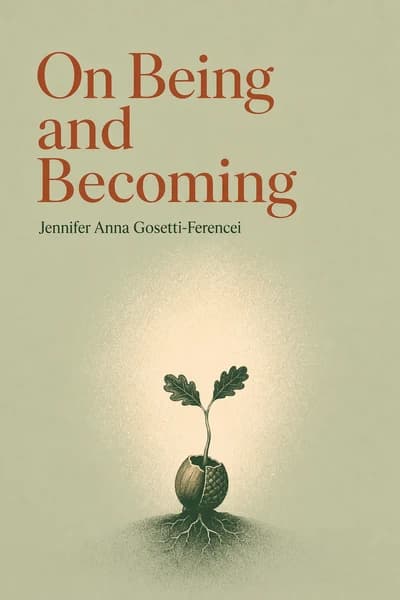
When Simone de Beauvoir proclaimed "one is not born, but rather becomes, a woman," she wasn't just making a statement about gender-she was articulating a fundamental principle of existentialist thought that has transformed how millions understand their own lives. Jennifer Anna Gosetti-Ferencei's "On Being and Becoming" arrives as a timely exploration of existentialism's enduring relevance in our age of identity crises and meaning-seeking. The book has gained particular resonance among celebrities like Lady Gaga, who cited existentialist principles during her mental health advocacy work, and filmmaker Richard Linklater, whose "Before" trilogy explicitly explores existentialist themes of time, choice, and authenticity. Beyond Hollywood, the book has found its way into corporate leadership programs and university curricula worldwide, offering a philosophical framework for navigating life's fundamental questions in an era where traditional sources of meaning continue to erode.
Kapitel 2
Existentialism: A Philosophy of Concrete Human Experience
Existentialism begins with you-not as an abstract concept, but as a living, breathing individual facing the dizzying freedom of creating your own meaning in a universe that offers no instruction manual. This philosophical approach refuses to start with grand theories or abstract systems, instead grounding itself in the messy, complicated reality of human existence. As Walt Whitman might remind us: "You are here-that life exists and identity, that the powerful play goes on, and you may contribute a verse." The existentialist asks: what will your verse be?
Unlike traditional Western philosophy with its pursuit of eternal truths and fixed essences, existentialism embraces the dynamic, ever-changing nature of human existence. When Kierkegaard declared "truth is subjectivity," he wasn't advocating relativism but emphasizing that the most important truths must be lived, not merely contemplated. Existentialists argue that while science provides valuable objective knowledge, it cannot answer our most pressing questions about how to live meaningfully.
This tension between abstract knowledge and lived experience traces back to ancient philosophical debates between Parmenides, who sought unchanging "being," and Heraclitus, who recognized constant "becoming." Existentialism aligns with the latter, emphasizing that human existence is finite, messy, vital, and full of possibility. We don't simply have predetermined essences but must define ourselves through our choices and commitments.
The existentialist view challenges us to recognize that we are not merely what we are but what we might become. As Sartre famously put it, "existence precedes essence"-we exist first, then determine what we are through our actions and choices. This perspective liberates us from fixed identities while burdening us with the responsibility of creating ourselves through the choices we make each day.
Kapitel 3
The Rich Historical Tapestry of Existential Thought
While often associated with black-clad French intellectuals smoking cigarettes in Parisian cafes, existentialism's roots reach far deeper and wider. Its influences include Socrates' commitment to examined life, Augustine's introspective explorations, Shakespeare's probing of human consciousness, and Kant's defense of human autonomy. Perhaps most surprisingly, existentialism owes significant debts to African American thinkers like W.E.B. Du Bois, whose 1903 concept of "double consciousness" predated Sartre's ideas on split consciousness by decades.
Socrates practiced philosophy not as abstract theory but as lived dialogue, questioning assumptions and examining life directly. His willingness to die rather than abandon his philosophical practice exemplified the authentic choice that later existentialists would celebrate. The Stoics contributed ideas about rational detachment from external circumstances that would influence Sartre's understanding of freedom, though later existentialists like Nietzsche would challenge the Stoic suppression of emotions.
Augustine's Confessions marked Western thought's first sustained exploration of inner life, influencing existentialists despite their often secular outlook. His introspective study of time as subjective experience particularly shaped Heidegger's understanding of human existence as fundamentally temporal. Shakespeare's Hamlet, with his agonized soliloquies and famous "to be or not to be" contemplation, anticipates what Camus would later call "the one really serious philosophical question"-whether life is worth living.
The revolutionary upheavals of the late eighteenth and nineteenth centuries created fertile ground for existentialist thought. Against the backdrop of American and French revolutions, writers explored emotional life in unprecedented ways. Kierkegaard launched existential philosophy as a critique of Hegel's systematic idealism, arguing that individual existence cannot be reduced to "a paragraph in a system." Nietzsche's proclamation that "God is dead" identified not just religious skepticism but a cultural crisis of meaning that offered both danger and opportunity.
Kapitel 4
The Self: Always Becoming, Never Complete
Who are you, really? Existentialists challenge the Cartesian notion of self as a contained mental sphere, arguing instead that the self exists through dynamic relations with the surrounding world. Heidegger describes the self's "ecstatic" structure-always outside itself through engagement with people, projects, and perceptions. Even our "innermost" feelings aren't contained within us but rebound across our perceptual field, making joy inseparable from what brings it. When we experience happiness, for instance, it's not merely an internal state but intrinsically connected to the friend whose presence delights us or the achievement that fills us with pride.
Self-reflection proves surprisingly elusive, often revealing more about our current preoccupations than any fixed essence. We grasp characteristics that may change rather than our unique possibilities. A person might identify as "ambitious" today but find this trait transformed by parenthood, or consider themselves "introverted" until circumstances draw out unexpected sociability. We are always more than our particular manifestations, what Jaspers called our "Existenz." Our temporal continuity remains precarious through inconsistent memory and changing priorities. Some experience stable self-conception while others feel alienated from their past selves, looking back at journal entries or photos with a sense of disconnection from that former version of themselves. This reflects the existential view that selfhood is always becoming, never completed.
While existentialists affirm freedom, this isn't unlimited power but rather a situated freedom within constraints. Even Sartre, who famously declared "man is wholly and forever free," acknowledged freedom is always situated within facticity-the concrete circumstances we didn't choose, such as our historical era, physical capabilities, or social context. As Merleau-Ponty noted, it's impossible to precisely determine "the share contributed by the situation and the share contributed by freedom." Our embodied existence complicates the picture beyond Sartre's absolutely free consciousness, with mental life inseparable from bodily experience. Anxiety, for example, manifests not just as mental worry but as physical tension, racing heart, and shallow breathing.
The self doesn't exist in isolation but extends through projects, activities, and perceptions-like feeling sunlight warming your being or losing yourself in playing music. As Marcel notes, I don't merely "have" my body but "am" my body - there is no clear division between physical and mental experience. This embodied self constantly engages with the world, transforming both itself and its surroundings through meaningful action. Whether learning a new skill, forming relationships, or creating art, we shape ourselves through our engagements while simultaneously being shaped by them. Our identity emerges not from internal reflection alone but through active participation in life's unfolding possibilities.
Kapitel 5
The Existential Dimension of Others
Have you ever felt truly seen by another person? Or conversely, felt reduced to a mere object under someone's gaze? Others constitute an essential dimension of our existence, enabling not just physical survival and language development, but contributing to our full reality as human selves through mutual recognition. This intersubjective dimension shapes our consciousness, self-understanding, and very being-in-the-world. Yet others can also dismiss or deny our subjectivity, leading existentialists to characterize self-other relationships in complex, sometimes contradictory ways - as both necessary for authentic selfhood and potentially threatening to individual freedom.
Fanon uses the Hegelian dialectic to describe the problem of social recognition in the context of racist oppression, where the oppressed must struggle for acknowledgment of their worth. He examines how colonialism and racism create a "zone of nonbeing" where the colonized person's humanity is systematically denied. Through detailed psychological and sociological analysis, Fanon shows how this dehumanization affects both the oppressor and the oppressed, distorting their relationship to themselves and each other. Despite exposing the devastating effects of racist oppression, Fanon insists that mutual respect can break the dialectic of oppression through restoring "human reality" to the other. This requires both parties to move beyond the master-slave dynamic toward genuine reciprocity. He affirms that humans can say "yes to life, love, and generosity" while refusing exploitation and contempt.
Marcel sharply criticizes Sartre's individualistic view of human relationships, offering instead a philosophy of intersubjective engagement and availability. Where Sartre sees inevitable conflict, Marcel sees potential for genuine communion; where Sartre sees love as appropriation, Marcel sees presence and fidelity. Through concrete examples from everyday life - a mother's care for her child, friendship's mutual trust, lovers' shared world - Marcel demonstrates how authentic relationships transcend mere subject-object dynamics. He challenges Sartre's negative view of gift-giving as "destructive appropriation," advocating instead for "creative receptivity" where giving enriches both giver and receiver, creating communion rather than domination. For Marcel, true relationships are marked by availability (disponibilite) rather than possession.
Despite their different ontologies of self-other relations, both Sartre and Beauvoir argue that recognizing one's own freedom demands recognizing the freedom of all others. This ethical dimension of intersubjectivity means that authentic self-creation requires respecting others' projects of self-creation. As Beauvoir writes, "To will oneself free is to effect the transition from nature to morality" whose range becomes universal. She develops this insight through careful analysis of concrete situations, showing how freedom can only be realized in connection with others' freedom. Authentic human relationships require respecting others' freedom rather than trying to possess or control them - a delicate balance between engagement and distance, intimacy and independence. This understanding transforms mere coexistence into ethical co-creation of meaning and value.
Kapitel 6
The World as Lived Experience
From an existentialist perspective, the world isn't merely a collection of material objects but a lived phenomenon experienced from within. We extend toward the world through activities, involvement, and interpretation-expressing our existence through projects that transform the world we inhabit. This engagement manifests in countless daily actions, from the way we arrange our living spaces to how we navigate social relationships. The world takes shape through what we do in it, though this relationship often remains implicit in everyday experience, hidden beneath the surface of routine activities.
Heidegger's example of the hammer powerfully demonstrates how our activity manifests implicit worldly relations. When using a hammer, we don't think about it as an isolated object but engage with an entire network of relations-the nails, wood, workshop, and potential users all interconnected. The hammer becomes an extension of our intention to build, repair, or create. Only when the hammer breaks might we notice this web of meaningful connections that constitutes our world. Similar examples can be found in modern contexts: a smartphone isn't just a device but a gateway to relationships, work, entertainment, and information, all interconnected in our daily experience.
We never face the world neutrally but always find ourselves attuned in particular ways. Our moods aren't just internal feelings but existential orientations that disclose the world differently-the world looks entirely different depending on whether we feel inspired or discouraged. A familiar street appears welcoming during a joyful moment but threatening when anxious. While we only ever begin with partial views, we project a "world horizon" as the general framework for our perception, creating a coherent narrative of our experience that extends beyond immediate sensations.
Existentialists also recognize that the world can feel alienating and inhospitable. This alienation stems partly from science's disenchantment of the world-while science offers knowledge, it cannot account for meaning. Modern technology, while connecting us globally, can paradoxically increase our sense of isolation. As Camus writes: "In a universe suddenly deprived of illusions and light, man feels a stranger. His is an irremediable exile." This sentiment resonates particularly in our digital age, where despite unprecedented connectivity, many experience profound disconnection from authentic human experience.
The existentialist view challenges us to recognize how our engagement with the world shapes both our experience and the world itself. Whether through work, relationships, or creative pursuits, we are constantly participating in the construction of meaning. This understanding suggests that while alienation may be an inherent possibility of human existence, so too is the capacity to create meaningful connections through conscious engagement with our world and others.
Kapitel 7
Wonder and Absurdity: Our Relationship with Earth
Have you ever suddenly felt the strangeness of everyday routines-the way we repeat the same actions day after day without questioning their purpose? Some existentialists depict the world as unpredictable or absurd-not claiming the world itself is irrational, but highlighting the contradiction between objective knowledge and human interpretation. Camus formalized this idea, describing absurdity as "born of this confrontation between the human mind and the unreasonable silence of the world."
The myth of Sisyphus exemplifies this absurdity-endlessly rolling a boulder uphill only to watch it roll down again, mirroring our repetitive efforts in a seemingly purposeless existence. Yet existentialists don't surrender to nihilism. Nietzsche and Camus insist that affirmation remains possible-even Sisyphus can be happy. Camus writes that the absurd offers a "lucid invitation to live and to create."
Beyond fragmentation and absurdity, existentialists also recognize wonder. Despite his thesis of absurdity, Camus's descriptions overflow with sensuous glory: "These scents of grass and stars at night... how shall I negate this world whose power and strength I feel?" Marcel emphasizes the "overflowing richness of reality" as "a kind of glory," while Rilke encourages acceptance: "If it has terrors, they are our terrors; if it has abysses, these abysses belong to us."
Our relationship with nature has become increasingly problematic. Nietzsche was the first existentialist to reconsider our relationship to nature in an ecological way, rejecting philosophies that favored eternal ideas "beyond the stars" over the changing natural world. In Thus Spoke Zarathustra, he implores followers to remain "true to the earth," rejecting the idea that our rational capacities make us radically distinct from nature.
Kapitel 8
Authenticity in an Age of Imitation
How can we live authentically in a world that constantly pressures us toward conformity? While existentialism defies reduction to a single template, authentic existentialist lives would generally exhibit clear-eyed reflection about freedom and choice, demand courage and creativity, eschew predetermined meanings, and recognize responsibility for one's actions and values.
The concept of authenticity raises questions about looking to existentialist philosophers themselves as models. Though existentialist thinkers may inspire those feeling trapped in purposeless lives, mere imitation contradicts authenticity's core principle of seizing one's individual existence. Yet some imitation is unavoidable-it's how humans learn. The challenge is drawing inspiration without following another's blueprint.
Nietzsche's relationship with Schopenhauer demonstrates how inspiration can lead to independence-his early devotion to Schopenhauer as "educator" eventually gave way to critique and the development of his own distinctive philosophy. As Nietzsche wrote, "One repays a teacher badly if one remains only a pupil" and "No one but you can build the bridge upon which you alone must cross the stream of life."
The existentialist critique of mass culture remains relevant despite our seemingly more individualistic society. Nietzsche linked mass culture to conformism, urging readers to assert their individuality over "manufactured" lives: "Be yourself! All that you are now doing, thinking, and desiring is not really yourself." Modern life carries us "as if in a stream," requiring little effort to swim for ourselves.
Despite contemporary emphasis on individuality, we face new conformity pressures through homogeneous corporate chains, mass-produced lifestyles, and social media that quantifies popularity and exploits FOMO. Yet authentic individuality needn't mean isolation. As Kierkegaard wrote, "The real moment in time and the real situation being simultaneous with real people... helps to sustain the individual."
Kapitel 9
Creating Rather Than Finding Yourself
Have you ever wondered who you "really" are beneath all your roles and responsibilities? The existentialist view rejects the notion of "finding oneself" as if there were a hidden, authentic self waiting to be discovered. Instead, the self must be created through choices and actions. While we might ask about our purpose or who we truly are, there is no buried inner self to uncover-only a self we can become through our decisions.
This distinction matters deeply: finding implies something pre-existing, while becoming acknowledges our ongoing self-creation. The popular notion of self-discovery appears in literature from Flaubert's "Sentimental Education" to Kerouac's "On the Road," but existentialists would interpret these journeys as constituting rather than discovering the self. For existentialists like Sartre, there is no essential core behind our actions-we are our actions. Nietzsche suggests we find ourselves not by looking inward but by examining what we've loved and valued, what has drawn us upward.
We inhabit multiple roles in life, which may be authentically embodied or not. Sartre famously critiqued the waiter who plays his part too earnestly, comparing him to an actor whose movements appear "a little too precise"-an inauthentic performance that objectifies himself. Yet role-playing seems inevitable in social life. Even Sartre himself played the role of philosopher in cafes and lecture halls.
Against Plato's rejection of multiple roles, Nietzsche celebrated donning masks, questioning whether any single essence exists beneath them. The waiter's role, rather than mere drudgery, might be undertaken with genuine artistry-noticing, anticipating, attending to others. Like actors who don't merely pretend but creatively express perspectives, we might approach our roles not as inauthentic mimicry but as creative self-expression.
Kapitel 10
Living Creatively in the Present
Creative living involves both revealing and creating oneself simultaneously through an ongoing process of discovery and intention. It doesn't require frenetic novelty or narcissistic self-expression, but rather cultivating patient revealing of the world, attunement to others, and critical self-reflection. Living creatively means recognizing our choices as meaning-creating projects that need no external justification. This dual process of revelation and creation manifests in our daily choices, relationships, and the way we engage with our environment.
We experience the present with vivid actuality that exceeds both memory and imagination - a quality of immediate awareness that cannot be fully captured in retrospect. In Sartre's Nausea, Roquentin realizes that memories are merely faded copies of former experiences-"all that was not present did not exist." This stark realization emphasizes how our direct experience of the present moment has a richness and complexity that memory can never fully reproduce. Yet Sartre recognizes we must give the present meaning through our projects, as raw existence alone is insufficient. While the past is ontologically "nothing," our present projects inevitably become past commitments, requiring a fundamental project to shape our lives. This creates a constant tension between immediate experience and the need to structure it meaningfully.
Beauvoir complicates this perspective in The Ethics of Ambiguity, noting that every free choice creates a new situation that contextualizes future freedom. "An existence would be unable to found itself if moment by moment it crumbled into nothingness." We must "ceaselessly return" to our acts and "justify them in the unity of the project." This ongoing process of integration and reintegration shows how present choices both build upon and transform past decisions. Even long-term projects must be freely seized anew and never obscure our freedom to change course. This dynamic relationship between past and present requires active engagement rather than passive acceptance.
Kierkegaard's concept of "authentic repetition" offers a way to make the past ever anew-not merely collecting experiences but affirming the same in a new way each time. This involves finding fresh meaning in familiar experiences, relationships, and commitments through conscious re-engagement. Marcel's "creative fidelity" similarly involves actively maintaining presence through openness and availability to others, suggesting that true presence requires both receptivity and active participation. Being present means being "permeable" to the world while respecting the past that makes present action possible. This creative fidelity allows us to honor our commitments while remaining open to growth and transformation.
The challenge of creative living lies in maintaining this delicate balance between continuity and renewal, between honoring past choices and remaining open to new possibilities. It requires developing a capacity for both steadfast commitment and flexible adaptation, allowing us to create meaning that is both durable and dynamic.
Kapitel 11
The Existential Dimensions of Love and Suffering
Love anchors human existence and resonates across our awareness of being and becoming. It can invest our world with renewed possibility or challenge our sense of singular being. Existentialist thinking diverges sharply from classical philosophical views of love like Plato's, which treats love as emblematic of an ideal beauty rather than a concrete relationship between particular individuals.
While the Sartre-Beauvoir relationship exemplified an existential approach to love with its emphasis on freedom, the reality was more complex than their theoretical model suggested. Sartre's philosophical writings present love as a seductive contest between competing subjectivities rather than mutual freedom. Other existentialists offered different perspectives: Marcel saw commitment in marriage as freedom's ultimate expression through self-giving; Rilke described lovers as "two solitudes who protect and border and greet each other"; and Beauvoir held that authentic love must be "founded on the mutual recognition of two liberties."
Existentialist thinkers confront human suffering head-on, dignifying it philosophically through analyses of anxiety, anguish, forlornness, dread, and despair. While this has earned existentialism its reputation for gloominess, many existential thinkers also explore paths to joy and suggest that anxiety is linked to authentic happiness, despair to genuine hope.
Unlike Stoics who sought to diminish suffering through mental discipline, existentialists see suffering as revealing our uniquely human condition. They recognize that modern life's demands-efficiency, productivity, competitiveness, social conformity-may promote mental suffering beyond individual control. While acknowledging biological factors in depression and anxiety, they warn against reducing all dysphoria to purely medical problems, pointing to cultural and existential dimensions requiring broader solutions.
Marcel links despair with hope, arguing that "there can strictly speaking be no hope except when the temptation to despair exists." This existential hope isn't passive waiting but "underpins action" while maintaining openness to the unknown. It acknowledges suffering while recognizing positive possibilities beyond our certainties, fostering sympathy with fellow sufferers and lifting private pain into philosophical reflection.