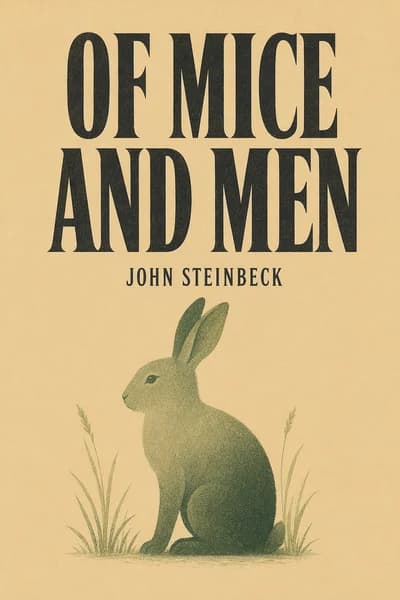
In Steinbeck's Depression-era masterpiece, two migrant workers chase an impossible dream. A literary titan that survived its own destruction - Steinbeck's dog ate the first draft! Required reading in schools nationwide, this haunting tale asks: what happens when friendship collides with harsh reality?
John Ernst Steinbeck (1902–1968), the Nobel Prize-winning author of Of Mice and Men, remains a cornerstone of American literature renowned for his exploration of social inequality and human resilience.
Set against the backdrop of the Great Depression, this classic novella delves into themes of friendship, dreams, and systemic oppression, reflecting Steinbeck’s firsthand observations of migrant laborers in his native Salinas Valley, California.
A Pulitzer Prize recipient for The Grapes of Wrath (1939) and celebrated for masterworks like East of Eden (1952), Steinbeck wove his experiences as a ranch hand and war correspondent into narratives that exposed societal fractures while championing marginalized voices.
Of Mice and Men has been adapted into three major films and a Tony-nominated play, cementing its status as a staple in literary curricula worldwide. Translated into over 30 languages, Steinbeck’s works continue to resonate for their unflinching humanity and lyrical realism.
Of Mice and Men follows two migrant workers, George and Lennie, during the Great Depression as they pursue the American Dream of owning land. Their friendship and struggles with loneliness, societal marginalization, and shattered hopes reveal themes of human fragility and the impossibility of idealized futures. The novella uses potent symbols like the dream ranch and animal imagery to critique systemic inequality.
This book appeals to readers exploring themes of friendship, systemic inequality, and the human condition. Students analyzing literary devices like symbolism (e.g., the river setting, animal imagery) or motifs (loneliness, unattainable dreams) will find it essential. Fans of Steinbeck’s social realism or Depression-era literature also benefit.
Yes—it’s a seminal work for its stark portrayal of friendship and societal barriers. Steinbeck’s concise storytelling and layered symbolism (e.g., the dream farm as false hope) offer timeless insights into human vulnerability. Critics praise its exploration of mental health stigma and economic disenfranchisement, making it relevant for modern discussions of equity.
The farm represents economic freedom and an idealized escape from hardship, but ultimately symbolizes unattainable dreams. George and Lennie’s vision seduces others like Candy and Crooks, yet its impossibility underscores Steinbeck’s critique of the flawed American Dream during the Great Depression.
Animal imagery—mice, rabbits, dogs—highlights vulnerability and societal neglect. Lennie’s accidental killing of mice mirrors his own fate, while Candy’s dog symbolizes the disposability of the weak. These motifs question how society treats those with disabilities or diminished utility.
Loneliness pervades characters like Crooks, Curley’s wife, and Candy, reflecting the isolating effects of poverty and prejudice. George’s bond with Lennie defies this norm, yet its tragic end reinforces Steinbeck’s argument that systemic inequality dooms meaningful human connections.
George kills Lennie to spare him from a violent lynching, embodying mercy and tragic responsibility. This act underscores the impossibility of protecting the vulnerable in a harsh world and severs their shared dream, symbolizing the collapse of hope in the face of systemic cruelty.
Lennie’s death represents the destruction of innocence and the inevitability of failure for marginalized individuals. His fate mirrors the euthanized dog and mice, emphasizing society’s brutality toward those deemed “weak” or nonconforming.
The repeated failure of George and Lennie’s farm dream exposes the American Dream as a myth for the working class. Steinbeck illustrates how systemic barriers—economic disparity, racism, ableism—crush individual aspirations, particularly during the Depression.
George and Lennie’s friendship defies the pervasive loneliness of ranch life, offering temporary solace. However, their bond is strained by societal pressures, culminating in George’s tragic choice to kill Lennie—a paradoxical act of love and surrender to systemic hopelessness.
Steinbeck portrays migrant workers’ instability, poverty, and limited rights. Characters like Candy (disabled) and Crooks (Black) face systemic exclusion, mirroring historical discrimination. The novella critiques unfair labor practices and societal neglect of marginalized groups.
Its themes—systemic inequality, mental health stigma, and the elusive nature of dreams—resonate in modern conversations about equity. The symbolism of “otherness” (e.g., Lennie’s disability) parallels contemporary struggles for inclusion and fair treatment.
Critics argue the novella oversimplifies mental disability through Lennie’s portrayal or romanticizes sacrifice. Others note limited female representation (Curley’s wife is unnamed). However, most praise its unflinching social commentary and symbolic depth.
Like The Grapes of Wrath, it critiques socioeconomic injustice but uses tighter focus and allegory. While less epic in scope, its concentrated symbolism and tragic economy of language make it a staple of American literature.
Erlebe das Buch durch die Stimme des Autors
Verwandle Wissen in fesselnde, beispielreiche Erkenntnisse
Erfasse Schlüsselideen blitzschnell für effektives Lernen
Genieße das Buch auf unterhaltsame und ansprechende Weise
"Nobody never gets to heaven, and nobody gets no land."
"We got a future," George declares when the dream seems within reach.
"We got somebody to talk to that gives a damn about us."
"Lennie's a God damn nuisance most of the time, but you get used to goin' around with a guy an' you can't get rid of him."
"I coulda made somethin' of myself," she laments.
Zerlegen Sie die Kernideen von Of Mice and Men in leicht verständliche Punkte, um zu verstehen, wie innovative Teams kreieren, zusammenarbeiten und wachsen.
Destillieren Sie Of Mice and Men in schnelle Gedächtnisstützen, die die Schlüsselprinzipien von Offenheit, Teamarbeit und kreativer Resilienz hervorheben.

Erleben Sie Of Mice and Men durch lebhafte Erzählungen, die Innovationslektionen in unvergessliche und anwendbare Momente verwandeln.
Fragen Sie alles, wählen Sie die Stimme und erschaffen Sie gemeinsam Erkenntnisse, die wirklich bei Ihnen ankommen.

Von Columbia University Alumni in San Francisco entwickelt
"Instead of endless scrolling, I just hit play on BeFreed. It saves me so much time."
"I never knew where to start with nonfiction—BeFreed’s book lists turned into podcasts gave me a clear path."
"Perfect balance between learning and entertainment. Finished ‘Thinking, Fast and Slow’ on my commute this week."
"Crazy how much I learned while walking the dog. BeFreed = small habits → big gains."
"Reading used to feel like a chore. Now it’s just part of my lifestyle."
"Feels effortless compared to reading. I’ve finished 6 books this month already."
"BeFreed turned my guilty doomscrolling into something that feels productive and inspiring."
"BeFreed turned my commute into learning time. 20-min podcasts are perfect for finishing books I never had time for."
"BeFreed replaced my podcast queue. Imagine Spotify for books — that’s it. 🙌"
"It is great for me to learn something from the book without reading it."
"The themed book list podcasts help me connect ideas across authors—like a guided audio journey."
"Makes me feel smarter every time before going to work"
Von Columbia University Alumni in San Francisco entwickelt

Erhalten Sie die Of Mice and Men-Zusammenfassung als kostenloses PDF oder EPUB. Drucken Sie es aus oder lesen Sie es jederzeit offline.
Picture a dusty California valley in 1937, where two men walk single file down a path worn into the earth by countless desperate footsteps. One moves with quick, sharp gestures; the other lumbers behind like a loyal bear, mimicking his companion's every movement. They carry everything they own in rolled blankets slung over their shoulders. What makes them different from thousands of other Depression-era drifters isn't what they carry-it's that they travel together at all. In a world where loneliness has become the default human condition, George and Lennie possess something rare: each other. Their story, compressed into three fateful days, reveals both the transcendent power of human connection and the brutal forces that destroy it.