Kapitel 1
The Art of Seeing What Others Miss
Have you ever wondered why some people consistently spot opportunities that everyone else overlooks? In 1968, a lanky engineering student named Dick Fosbury shocked the world at the Mexico City Olympics. With mismatched shoes and an unconventional technique that involved turning his back to the high jump bar, he not only won gold but revolutionized his sport forever. What became known as the "Fosbury Flop" has been used by nearly every Olympic high jumper since. This wasn't genius-it was non-obvious thinking. Fosbury simply noticed what others didn't: the introduction of foam landing mats made it possible to land safely on your back, opening up entirely new jumping techniques.
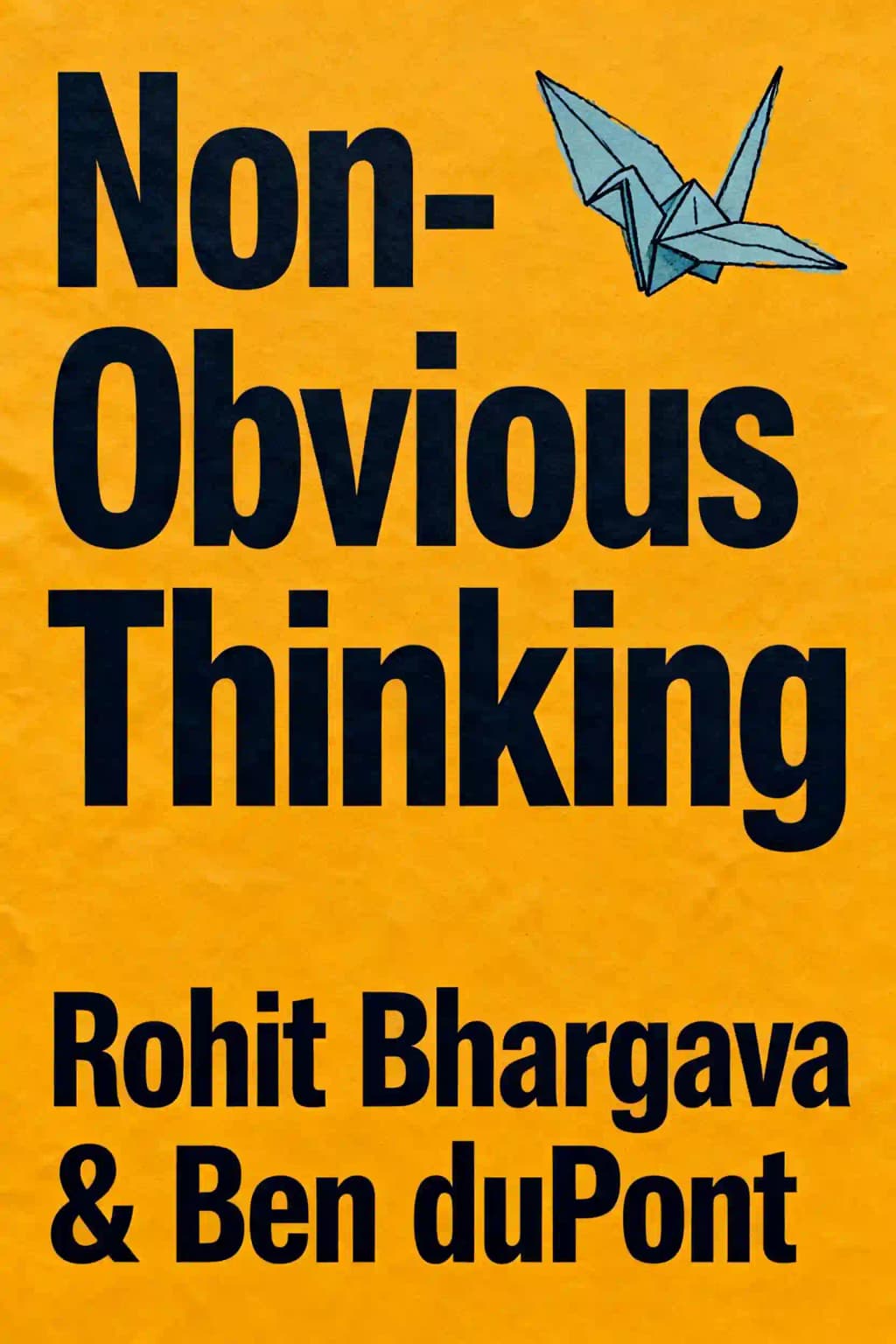
This ability to see beyond conventional wisdom is at the heart of Rohit Bhargava and Ben duPont's approach. Their book has garnered praise from thought leaders like Tony Robbins, who calls it "fuel for breakthrough thinking," and Adam Grant, who describes it as "a delightful guide to questioning old assumptions." With over a decade of bestselling trend reports and twenty years hosting Non-Obvious Dinners with diverse innovators, Bhargava and duPont have distilled the essence of what makes some thinkers see possibilities others miss-and how anyone can develop this crucial skill.
Kapitel 2
Creating Mental Space: The Foundation of Fresh Thinking
Before you can think differently, you need to create mental space. This goes far beyond Marie Kondo-style decluttering or time management techniques. Mental space requires developing cognitive flexibility and receptiveness to new insights-starting with something as fundamental as breathing.
Most of us breathe incorrectly, taking shallow, rapid breaths that limit our thinking capacity. Science journalist James Nestor discovered this while researching free divers, who weren't genetically gifted with exceptional lung capacity but had mastered specific breathing techniques. The "perfect breath" involves inhaling and exhaling for 5.5 seconds each-a rhythm that helps break the pattern of detail blindness caused by our daily routines.
Creating mental space also means ditching what the authors call "prebuttals"-the toxic habit of dismissing ideas before fully considering them. Unlike rebuttals that thoughtfully address existing arguments, prebuttals shut down dialogue before it begins. We see this in politics when pundits attack hypothetical arguments, but it happens in everyday life too: avoiding reconnecting with someone because of a past slight, judging colleagues as incompetent based on a single mistake, or deciding to hate something before trying it.
Another crucial aspect of creating space involves making "oasis moments"-brief periods to slow down and reflect. These mental breaks, like the Non-Obvious 7-Minute Meetup at South by Southwest, provide opportunities to reset and recharge. Susan Cain's research shows that while introverts and extroverts have different ideal stimulation levels, everyone eventually needs to regroup to function effectively.
Perhaps counterintuitively, embracing danger can also create mental space. The Land, an unconventional playground in North Wales, encourages children to play with fire and sharp objects with minimal supervision. Despite these hazards, it reports no more injuries than traditional playgrounds because children learn to play more carefully and become more aware of their surroundings. Similarly, adults who deliberately step outside their comfort zones-navigating without GPS, cooking without recipes, or trying new activities-heighten their awareness and create space for fresh thinking.
Kapitel 3
Uncovering Hidden Insights Through Better Observation
Once you've created mental space, the next step is developing skills to uncover insights-surprising truths that explain why things are the way they are. This begins with asking better questions and training yourself to observe more deeply than surface-level appearances.
Pulitzer Prize-winning journalist Jacqui Banaszynski teaches a powerful interview technique that avoids pre-scripted questions in favor of a dynamic approach where each question builds on the previous answer. Rather than seeking specific answers, this method elicits stories by putting people "back into the movie of their own life." For example, instead of asking "How did you feel when that happened?" she might ask "What did you see first when you walked into the room?" or "What sounds do you remember from that moment?" By asking about sensory details rather than emotions, or focusing on seemingly unimportant afterthoughts in conversations, you can uncover truths that might otherwise remain hidden. These small details often reveal deeper emotional truths that direct questioning might miss.
The Korean concept of nunchi (pronounced noon-chee) offers another powerful observation tool-the art of understanding what others think and feel without direct questioning. Similar to the Japanese practice of kuuki wo yomu ("reading the air"), nunchi recognizes that explicit words and actions don't always reflect true meanings or intentions. Practitioners of nunchi pay attention to subtle cues: how quickly someone responds to messages, their body language during meetings, or the energy shift when certain topics arise. By observing how people interact, maintain eye contact, or welcome newcomers to conversations, you can access an emotional subtext that reveals deeper insights. In Korean business culture, strong nunchi skills are considered essential for leadership success.
Hands-on experience provides another pathway to insights that observation alone cannot match. When Uber CEO Dara Khosrowshahi went undercover as a driver on his own platform, he discovered firsthand the challenges of unclear pickup locations, problematic passenger behavior, and app interface issues that weren't apparent from executive reports. Similarly, when preparing for a keynote speech to the HVAC industry, Rohit visited a repair shop and joined a technician on jobs. While he couldn't fix systems afterward, he gained crucial understanding of the daily stresses HVAC professionals face-from tight crawl spaces to complex diagnostic challenges-making his presentation more relevant and impactful.
Nature offers perhaps the richest source of insights for those willing to observe carefully. Architect Mick Pearce designed the self-ventilating Eastgate Centre in Zimbabwe after studying termite mounds, creating a building that maintains a stable temperature without conventional air conditioning. The bullet train's aerodynamic nose was modeled after the kingfisher's beak, solving the problem of sonic booms in tunnels. The water-collection capability of the Namib desert beetle has inspired more efficient fog-harvesting technologies. These examples of biomimicry-adapting natural solutions to human problems-demonstrate how mindful observation of the natural world can inspire breakthrough innovations. The key is to observe not just what something does, but how and why it works, then translate those principles to new contexts.
Kapitel 4
Focusing Your Attention: Finding Signal Amid Noise
After creating space and gathering insights, the challenge becomes focusing on what matters most. This process resembles what Isaac Asimov called becoming a "speed understander"-someone adept at quickly separating signal from noise.
A crucial first step is identifying the real problem beneath surface issues. When Elisha Otis demonstrated the first passenger-safe elevator at the 1853 World's Fair by having someone cut the supporting rope while he stood on the platform, he wasn't just showcasing a safety brake. He was solving the real problem: convincing a wary public to trust elevators with their lives. Similarly, effective pain management doctors now focus on underlying medical issues rather than merely prescribing painkillers. By asking "five whys"-repeatedly questioning why something is the way it is-you can drill down to root causes and focus your attention more effectively.
Another focusing technique involves finding common themes among seemingly disparate insights-what the authors call "discovering the water." When Rohit wrote the final Megatrends edition of his Non-Obvious Trend series, he identified "human mode" as the common element across various trends-the idea that as our world becomes increasingly digital, people seek out and value authentic, sometimes imperfect experiences delivered by humans. Physically laying out ideas-on a whiteboard, collaborative platform, or simply spreading materials across a table-can help identify these unifying themes.
In our era of overwhelming choice, learning to be what psychologist Barry Schwartz calls a "satisficer" rather than a "maximizer" is another crucial focusing skill. While maximizers "seek and accept only the best" and often feel regret despite making objectively better choices, satisficers "settle for something good enough" without worrying about missed possibilities. By developing clear criteria for decisions and committing fully to choices without dwelling on alternatives, you can focus your ideas without the paralysis that comes from endless options.
Seeing multiple perspectives simultaneously-like recognizing both the duck and rabbit in the famous optical illusion-further sharpens focus by revealing fuller truths. This ability to hold contradicting ideas in equal regard isn't about indecision but about appreciating the complexity of reality. When someone cuts you off in traffic, imagining they might be rushing to the hospital in an emergency helps you consider alternative explanations and respond with greater understanding.
Kapitel 5
Adding Constraints to Spark Creativity
Counterintuitively, adding constraints often leads to better focus and more creative solutions. This paradox has been demonstrated repeatedly across various creative fields. Dr. Seuss wrote his bestselling book "Green Eggs and Ham" using only 50 unique words after a friend challenged him to write a children's book with severe vocabulary limitations. The resulting work has sold over 8 million copies and remains one of the most beloved children's books ever written. Similarly, Henri Matisse created some of his best-known art through paper cutouts when confined to his bed due to illness, transforming a limitation into a revolutionary artistic technique that defined his later work. Nintendo composer Koji Kondo developed the iconic Super Mario Brothers soundtrack using just five repeating tones due to data storage limitations, creating music that has become instantly recognizable to millions.
Science confirms that people develop more varied and creative solutions when options are limited. Research from the University of Amsterdam found that participants given fewer resources consistently produced more innovative solutions than those with unlimited options. This phenomenon, known as "creative limitation," has been observed in fields ranging from architecture to software development. As Antoine de Saint-Exupery famously said, "A designer knows he has achieved perfection not when there is nothing left to add, but when there is nothing left to take away." By intentionally limiting development time, reducing the number of people involved in decisions, or imposing budget constraints, you force your thinking in new and interesting directions.
Even in our age of artificial intelligence, constraints remain valuable. Rather than replacing human creativity, tools like AI work best as collaboration partners that enhance creative output-what the authors call "augmented creativity." Just as Charley Douglass's "Laff Box" added perfectly timed laughter to TV shows in the 1950s, today's generative AI tools can improve sound quality, enhance photos, or refine writing while still leaving the core creative work to humans. Examples include musicians using AI to generate chord progressions within specific musical scales, photographers applying AI-powered filters within predetermined stylistic parameters, and writers using AI assistants with specific tone and style constraints.
The power of constraints extends beyond artistic pursuits into business innovation. Companies like IKEA have thrived by embracing limitations - in their case, the constraint of flat-pack shipping led to revolutionary furniture design. Twitter's original 140-character limit forced users to be concise and creative in their communication. These examples demonstrate how constraints can serve as catalysts for innovation rather than obstacles to creativity.
Kapitel 6
The Twist: Taking Ideas in Unexpected Directions
The final step in non-obvious thinking involves defining the "twist"-taking insights in unexpected directions to create something truly original. This often means challenging conventional wisdom and having the courage to turn established practices upside down. The most innovative solutions frequently emerge when we deliberately subvert expectations and question long-held assumptions about how things "should" be done.
One powerful approach is seeking "flip solutions" that deliberately do the opposite of standard practice. Teachers Aaron Sams and Jonathan Bergmann revolutionized education by "flipping" the classroom-recording lectures for students to watch at home while using class time for questions and hands-on learning. This counterintuitive approach dramatically improved student engagement and learning outcomes. Similarly, Vivek Ravisankar's company HackerRank flipped traditional hiring by replacing resumes with skills-based challenges for developers, allowing talented programmers to prove their abilities regardless of formal credentials. Other successful flips include Airbnb disrupting hospitality by turning private homes into hotels, and Dollar Shave Club upending razor sales by switching from retail to subscription delivery. By asking counterintuitive questions-Could less collaboration solve a problem? Might raising prices increase sales? Could removing features make a product better?-you can reveal overlooked approaches and spot novel solutions.
Another twist technique involves finding "Option C" solutions beyond obvious binary choices. Despite imprisonment in a Soviet gulag, Genrikh Altshuller developed the influential TRIZ method (Theory of Inventive Problem-Solving) focused on identifying contradictions and finding unexpected third options. His approach has been used to solve thousands of technical and business challenges by refusing to accept apparent either/or limitations. William Brouwer exemplified this approach with his invention of the futon-a hybrid solution combining a bed and couch to save space while maintaining comfort. Tesla similarly created a new category between luxury cars and eco-friendly vehicles. When launching the Non-Obvious Book Awards, Rohit rejected traditional categories like sales and leadership in favor of more interesting distinctions: most important, most useful, most entertaining, most shareable, and most original, demonstrating how breaking free from conventional categories can lead to fresh perspectives.
Will Shortz, the first person to earn a college degree in enigmatology (the study of puzzles), demonstrates another twist approach through his work as the New York Times puzzle editor. His "twisty" clues transform the familiar into the mysterious, making people see common things in new ways. For example, cluing "SPOT" as "Rover's name, maybe" or "CAPITAL" as "Head of state?" creates delightful moments of revelation. Like Stella Artois transforming the humble beer glass into their iconic "chalice" with a gold-plated rim, or Domino's redefining delivery tracking as "pizza theater," this approach involves assigning special meaning to seemingly trivial elements. Even simple products can be elevated through unexpected framing and presentation that challenges how people typically view them.
The most successful twists often combine multiple approaches - flipping assumptions, finding third options, and reframing the familiar - to create truly innovative solutions that wouldn't be possible through conventional thinking alone.
Kapitel 7
Standing Apart: The Power of Differentiation
Defining yourself by what you're not can create a powerful twist that sets you apart in crowded markets. Taco Bell's iconic "think outside the bun" tagline brilliantly highlighted their unique position as a non-burger fast-food chain in a burger-dominated landscape. This positioning wasn't just clever wordplay - it transformed a potential weakness into a compelling differentiator. The Hans Brinker Budget Hostel in Amsterdam took this concept to an extreme by boldly marketing itself as "the worst hotel in the world," turning their basic accommodations and no-frills service into attention-grabbing selling points. Their brutally honest advertising campaigns, featuring slogans like "It can't get any worse. But we'll do our best" and "Proudly disappointing travelers since 1970," created a cult following among budget travelers.
This "un-whatever" strategy works by deliberately positioning against established industry norms and challenging long-held assumptions. Harley-Davidson demonstrated this masterfully by questioning the deeply entrenched assumption that motorcycles were exclusively for male riders. By actively pivoting their marketing to welcome women riders, introducing specialized training programs, and designing bikes with features appealing to female motorcyclists, they became the top-selling motorcycle brand among women. This transformation proved that even seemingly permanent market dynamics can be successfully challenged through intentional repositioning. Similarly, non-dairy milk producers like Oatly have positioned traditional cow's milk as their "enemy," focusing marketing on environmental sustainability, animal welfare, and health advantages of plant-based alternatives. Their provocative campaigns directly challenge dairy industry messaging while building strong emotional connections with environmentally conscious consumers.
Finding unexpected intersections between seemingly unrelated ideas represents another powerful twist technique that can lead to breakthrough innovations. Project 523, a secret Chinese military initiative to combat chloroquine-resistant malaria, found remarkable success when scientist Tu Youyou combined modern pharmaceutical research with ancient Chinese healing traditions. After extensively studying traditional medical texts, she discovered a 1,600-year-old treatment using sweet wormwood (Artemisia annua) that became artemisinin, now the global standard for malaria treatment. This discovery, which earned her the Nobel Prize in Medicine, demonstrated how combining disparate knowledge domains can yield revolutionary solutions. In the business world, bank-owned cafes like Capital One Cafes exemplify this intersection strategy by blending coffee shop culture with financial services. These spaces meet multiple customer needs simultaneously: providing human connection, comfortable remote work environments, and accessible financial guidance. The casual, welcoming atmosphere helps demystify banking while creating natural opportunities for relationship-building between customers and financial advisors.
The success of these examples shows that differentiation often comes from deliberately challenging industry conventions and finding novel combinations of existing ideas. Whether through "anti-positioning," questioning fundamental assumptions, or creating unexpected hybrid solutions, standing apart requires the courage to deviate from established norms while delivering genuine value to customers.
Kapitel 8
The Power of Words: Creating Your Own Language
The final twist technique involves creating your own "argot"-specialized language that makes your ideas provocatively non-obvious and memorable. This linguistic innovation goes beyond mere wordplay; it's about crafting terms that capture complex ideas in uniquely resonant ways. Phil Dusenberry of BBDO transformed GE's advertising with his last-minute tagline creation: "GE... We bring good things to life." This iconic slogan served not just as an advertising campaign but as a rallying cry for employees and purpose statement for stakeholders, demonstrating how carefully chosen words can unite and inspire entire organizations.
Musicians have long understood the power of specialized language to build community and identity. Taylor Swift has Swifties, who have developed their own extensive vocabulary around album "eras" and song references. Beyonce has the Bey Hive, whose members use terms like "slay" and "formation" with specific cultural meaning. The Grateful Dead have Deadheads, who coined terms like "miracle tickets" and "spinning" to describe shared experiences. These linguistic innovations create strong bonds between artists and fans while establishing cultural touchstones that extend beyond music.
Even in business and technology, specialized language shapes perception and understanding. Apple transformed "i" into a prefix signifying personal technology with products like iPhone and iPad. Netflix coined "binge-watching" to describe a new viewing behavior, while Google became both a noun and verb. This book uses "Non-Obvious" as intentional argot to describe a thinking philosophy, demonstrating how new terminology can encapsulate complex methodologies.
Creating original argot often starts by twisting existing words to convey new ideas. Rohit coined "unperfect" rather than using "imperfect" to describe people increasingly trusting something flawed rather than something too perfect-like "ugly" fruits or the Leaning Tower of Pisa. Similar linguistic innovations include terms like "freemium" (combining free and premium) and "glamping" (glamorous camping). These portmanteaus and word modifications communicate unique nuances while making concepts more memorable and shareable.
The most effective argot creates what linguists call "sticky language"-terms that spread naturally because they fill a genuine communication need. Consider how "doomscrolling" perfectly captured a pandemic-era behavior, or how "digital nomad" defined a new way of working. When crafting new language, the goal isn't merely cleverness but rather to illuminate something true about human experience or behavior that existing vocabulary doesn't quite capture.
Kapitel 9
The Courage to See Differently
In 2012, scientists discovered that Sandy Island-marked on maps for over a century-simply didn't exist. This "undiscovery" revealed how even established facts can be wrong. The island, supposedly located between Australia and New Caledonia, appeared on Google Maps, weather maps, and marine charts since 1876. Yet when researchers arrived at its supposed coordinates, they found only open ocean. If an island believed real for 100 years could be fiction, what other entrenched mistakes about our world remain unknown? This incident serves as a powerful reminder that accepted truths deserve questioning.
Like the 400+ Scottish words for snow (including "flindrikin" for a slight shower, "skelf" for a large snowflake, "sneesl" for beginning to rain and snow together, and "spindrift" for snow blown by wind), seeing beyond our limited vocabulary takes courage. The Scots' rich snow-related lexicon demonstrates how language shapes perception - they see nuances in snow that others might miss entirely. Similarly, the Inuit people have dozens of words for different types of sea ice, each capturing subtle distinctions crucial for survival. Opening your mind to other perspectives, engaging with different people, and seeking information outside your usual sources requires bravery. This mental courage to see what others miss is what defines non-obvious thinkers.
The world desperately needs more people willing to question assumptions, see beyond the obvious, and imagine new possibilities. Consider how Uber challenged the assumption that only yellow taxis could provide reliable urban transportation, or how Airbnb reimagined the hospitality industry by seeing empty rooms as potential hotel rooms. By creating mental space through practices like meditation or walking, uncovering insights through better observation, focusing on what truly matters rather than surface-level distractions, and finding unexpected twists, anyone can develop this crucial skill. Non-obvious thinking isn't about genius-it's about paying attention to overlooked details and developing the mental flexibility to see connections others miss. It's about questioning why buildings have corners when rounded edges might be more efficient, or wondering why we still use QWERTY keyboards designed to slow typing on mechanical typewriters.
In our increasingly complex world, this might be the most valuable skill of all. Companies like SpaceX succeeded by questioning the assumption that rockets couldn't be reusable, while Netflix transformed entertainment by seeing beyond traditional TV scheduling. These breakthroughs came not from superior intelligence, but from the courage to see differently and challenge established norms.