Kapitel 1
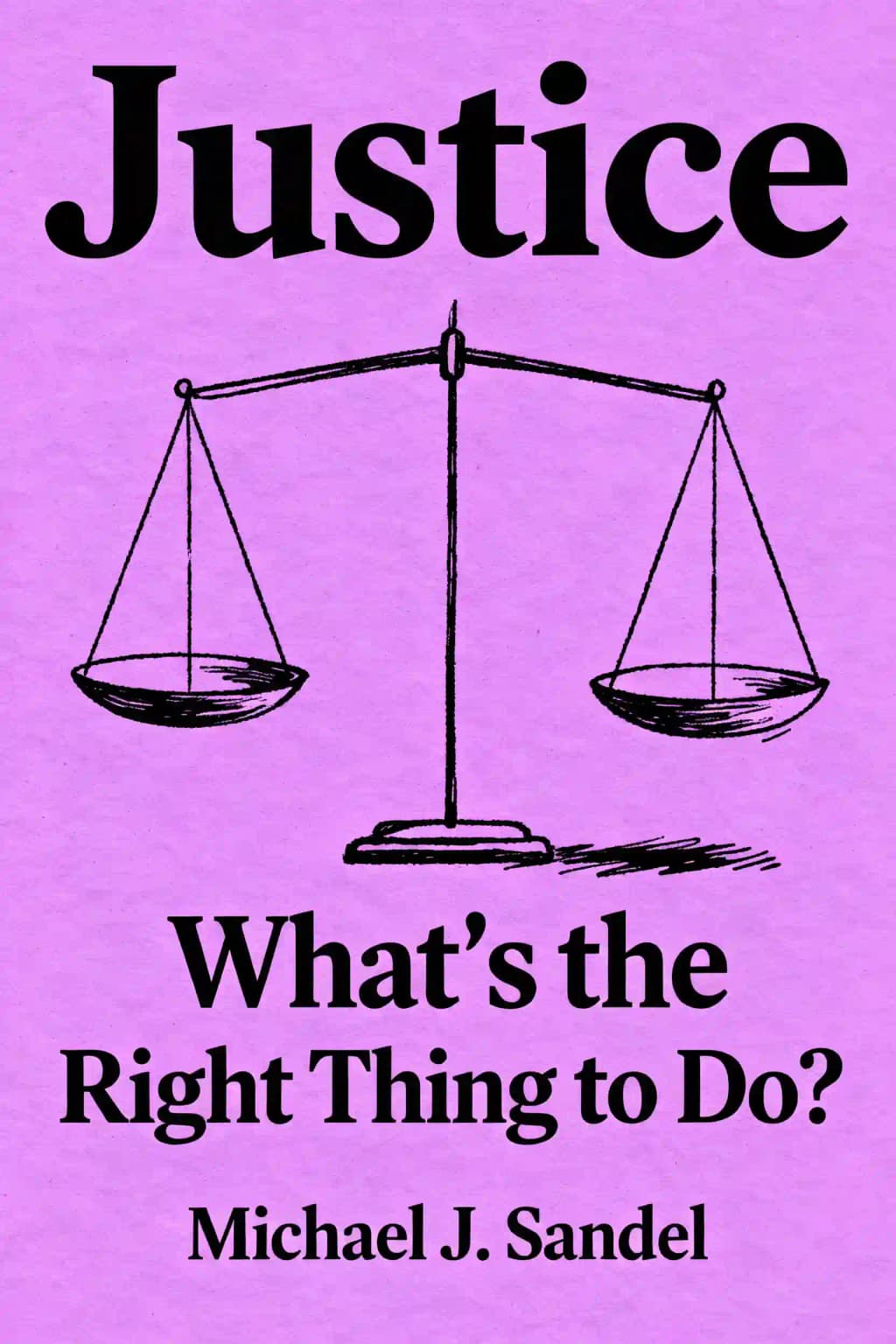
Justice Through the Lens of Philosophy: What's the Right Thing to Do?
What makes a society just? Is it maximizing happiness, protecting individual rights, or cultivating virtue? Michael Sandel's "Justice" tackles these fundamental questions through an engaging journey across philosophical traditions. This New York Times bestseller has captivated millions through its companion Harvard course, which became one of the most popular in the university's history and later a PBS series viewed by millions. Sandel's accessible approach to complex moral reasoning has earned praise from across the political spectrum, with The New York Times calling him "perhaps the most prominent college professor in America." Even celebrities like Matt Damon have cited the book as transformative in their thinking about ethics and society. Beyond academic circles, "Justice" has influenced public discourse on everything from market ethics to collective responsibility, offering a framework for addressing our most divisive moral debates.
Kapitel 2
The Moral Landscape of Justice
Justice isn't merely an abstract concept-it's embedded in our daily lives and most heated public debates. When Florida merchants charged exorbitant prices after Hurricane Charley in 2004-$10 for $2 bags of ice, $160 for $40 motel rooms-was this unjust exploitation or simply the market at work? When the Pentagon refused to award Purple Hearts to veterans suffering from post-traumatic stress disorder, what did this reveal about our conception of military valor and sacrifice? When executives who received government bailouts defended their failures as results of a "financial tsunami" beyond their control, they inadvertently raised profound questions about success as well: if systemic forces explain failure, don't they also explain success?
These controversies reveal three competing approaches to justice that will guide our exploration. The welfare approach asks what maximizes happiness or well-being for the greatest number. The freedom approach emphasizes respecting individual rights and choices. The virtue approach focuses on cultivating character and promoting conceptions of the good life. Each approach offers valuable insights but also significant limitations.
The tension between these perspectives becomes particularly clear in moral dilemmas. Consider the famous trolley problem: most people would divert a runaway trolley to kill one worker rather than five, yet would refuse to push a heavy man off a bridge to stop the trolley and save five lives. This inconsistency reveals competing moral principles at work-maximizing lives saved versus prohibitions against using people as mere means.
Real-world examples can be even more wrenching. In 2005, four Navy SEALs on a reconnaissance mission in Afghanistan encountered two Afghan goatherds who discovered their position. The soldiers faced an impossible choice: kill the civilians or release them, potentially compromising their mission. They chose to release them, a decision that led to Taliban fighters surrounding them 90 minutes later, killing three SEALs and sixteen rescue troops. The sole survivor, Marcus Luttrell, later called it "the stupidest, most southern-fried, lamebrained decision" of his life. Was this a moral failure or the right choice with tragic consequences?
These dilemmas reveal that moral reasoning isn't merely exchanging dogmatic assertions. It's a dialectical process of aligning our judgments about specific cases with broader principles, revising each in light of the other. This reflection isn't solitary but public, requiring engagement with others in what Aristotle called "the tumult of the city"-the real debates that prompt us to articulate and justify our convictions.
Kapitel 3
Utilitarianism: The Greatest Happiness Principle
In 1884, four English sailors were stranded in a lifeboat without food. After nineteen days, Captain Thomas Dudley killed the weakened cabin boy, Richard Parker, so the others could feed on his body and survive. When rescued, Dudley and first mate Edwin Stephens were arrested and tried for murder. Was killing one person to save three others justified? This case presents the stark moral calculus of utilitarianism-a philosophy that judges actions solely by their consequences.
Jeremy Bentham (1748-1832), utilitarianism's founder, dismissed natural rights as "nonsense upon stilts." He proposed a simple principle: maximize happiness by increasing pleasure and reducing pain. For Bentham, utility should guide both individuals and legislators, who should enact policies maximizing the community's overall happiness. He even designed practical applications like the Panopticon (a privately-run prison) and workhouses for beggars that would remove them from streets while making them work to pay for their maintenance-all calculated to maximize societal happiness.
However, utilitarianism faces two devastating objections. First, it fails to respect individual rights. By focusing solely on maximizing total satisfaction, it can justify violating fundamental norms when doing so produces greater overall happiness. The Roman practice of throwing Christians to lions illustrates this problem-a utilitarian might only condemn this if the collective pleasure of the cheering crowd was outweighed by negative consequences, missing the fundamental moral wrong of sacrificing innocent people for entertainment.
Second, utilitarianism attempts to translate all moral goods into a single scale of measurement, losing something essential in the process. This becomes clear in cost-benefit analyses like Philip Morris's calculation that smoking's "positive effects" on the Czech Republic's budget included $147 million in savings from smokers' premature deaths. Similarly, Ford Motor Company's infamous cost-benefit analysis concluded that fixing the Pinto's dangerous fuel tank wasn't worth the expense ($137.5 million) compared to the "benefit" of preventing 180 deaths and 180 burn injuries ($49.5 million total, valuing each life at $200,000).
John Stuart Mill (1806-1873) attempted to rescue utilitarianism from these objections. In his classic defense of individual freedom, On Liberty (1859), Mill argued that people should be free to do whatever they want provided they harm no one else: "Over himself, over his own body and mind, the individual is sovereign." Despite this strong defense of rights, Mill insisted his case rested entirely on utilitarian grounds, not abstract rights independent of utility.
Mill also distinguished between higher and lower pleasures, arguing that qualitative differences exist between pleasures. His test: if people experienced in both consistently prefer one pleasure over another, that pleasure is qualitatively superior. His famous declaration-"It is better to be a human being dissatisfied than a pig satisfied"-reveals Mill's departure from pure utilitarianism. The higher pleasures aren't superior because we prefer them; we prefer them because they engage our highest faculties and enhance our humanity.
Kapitel 4
Libertarianism: Do We Own Ourselves?
America's economic inequality raises fundamental questions about justice. The richest 1% of Americans possess over a third of the country's wealth, more than the combined wealth of the bottom 90%. From a utilitarian perspective, redistributing wealth from the extremely rich to the needy might maximize overall happiness-taking $1 million from Bill Gates to give $10,000 each to a hundred people in need would likely increase collective utility.
Libertarians reject this reasoning, arguing that only a minimal state-one that enforces contracts, protects property, and keeps peace-is morally justified. They oppose paternalism (laws protecting people from themselves), morals legislation (laws enforcing majority moral views), and redistribution of income or wealth (taxation to fund social programs). For libertarians, redistributive taxes are coercive theft, no different than a "benevolent thief" stealing from the rich to give to the homeless.
Robert Nozick's "Anarchy, State and Utopia" (1974) provides libertarianism's philosophical foundation. He rejects "patterned" theories of justice that aim for specific distributions (like equality). Instead, justice depends on two requirements: legitimate initial holdings and voluntary transfers. If you acquired your resources legitimately and exchanged them freely in the marketplace, whatever distribution results-however unequal-is just.
Nozick illustrates this with a thought experiment involving Michael Jordan. Imagine starting with whatever distribution of wealth you consider perfectly just. Then fans voluntarily pay to see Jordan play basketball, resulting in him earning millions. This new, unequal distribution arose through wholly voluntary choices-who has grounds for complaint?
At libertarianism's moral core lies the principle of self-ownership. Nozick argues that taxation is morally equivalent to forced labor-if the state claims 30% of your income, it essentially claims 30% of your labor time, making it "a part-owner of you." If we own ourselves, we must own our labor and its fruits.
Critics raise several objections: First, taxation differs from forced labor because the taxed person can choose to work less and pay lower taxes. Second, while the poor may need money more, libertarians respond that this justifies voluntary charity, not forced redistribution. Third, Jordan's success depends on teammates, coaches, and many others, but libertarians argue these people have already been compensated at market value for their services. Fourth, democratic consent doesn't justify taxation-if Jordan voted against the tax law but it passed anyway, he'd still be forced to pay. Finally, critics argue Jordan is fortunate to possess basketball talent and live in a society that rewards it richly-since he can't claim credit for his natural gifts, he isn't morally entitled to keep all the money his talents generate.
The principle of self-ownership raises troubling questions about commodification. If we truly own our bodies, shouldn't we be free to sell our kidneys or even vital organs at the cost of our lives? The case of Armin Meiwes, who killed and ate a willing victim in Germany, represents the ultimate test for libertarian self-ownership. For strict libertarians, banning such acts between consenting adults would be as unjust as redistributive taxation.
Kapitel 5
Markets and Morals: What Money Can't Buy
Many heated justice debates involve markets: Is the free market fair? Are some goods inappropriate for buying and selling? The Civil War draft allowed the wealthy to pay $300 or hire substitutes rather than serve, prompting the slogan "rich man's war and poor man's fight." Though intended as a compromise, this system sparked violent protests. This raises a fundamental question: If hiring substitutes was unjust, how different is today's volunteer army where taxpayers collectively pay others to fight?
Libertarians argue that conscription is fundamentally unjust-"slavery, plain and simple" as Ron Paul put it-because it violates individual liberty by forcing citizens to risk their lives. Utilitarians reach a similar conclusion: volunteer armies maximize happiness by allowing mutually beneficial exchanges. Those who enlist choose to do so because it maximizes their utility, while those who prefer not to serve avoid the unhappiness of forced service.
Two powerful objections challenge this market approach. First, the "free" market for military service isn't truly free. For those with limited economic options, enlistment may reflect necessity rather than preference-a form of economic conscription. The class composition of today's military supports this critique: recruits disproportionately come from low-to-middle income neighborhoods, while the most affluent 20% are significantly underrepresented.
Second, military service isn't just another job-it's a civic obligation. Like jury duty, which we don't allocate through markets, military service represents a responsibility all citizens should share. Historian David Kennedy argues that today's professional military resembles a mercenary force, not in questioning soldiers' motives, but in how it severs the connection between most citizens and those who fight in their name. With active-duty military just 4% the size of World War II forces relative to population, policymakers can wage war without broad societal consent.
The Baby M case further illustrates markets' moral limits. When Mary Beth Whitehead signed a surrogacy contract with William Stern but later couldn't part with the baby, a custody battle ensued. The trial judge upheld the contract, arguing that both parties had equal bargaining power and entered freely into the agreement. However, the New Jersey Supreme Court unanimously overturned this ruling, holding that Mary Beth's consent wasn't truly informed or voluntary, and that commercial surrogacy essentially amounts to baby-selling, which violates fundamental societal values-"There are, in a civilized society, some things that money cannot buy."
The global outsourcing of pregnancy has transformed surrogacy into an international industry. Since India legalized commercial surrogacy in 2002, cities like Anand have become centers for this practice. Indian surrogates earn $4,500-$7,500-often equivalent to fifteen years' wages-while clients pay about $25,000 total, roughly one-third the cost in America. This arrangement raises profound moral questions about exploitation, consent, and the commodification of women's bodies.
Kapitel 6
Immanuel Kant: What Matters Is the Motive
If you believe in universal human rights, you likely reject utilitarianism's willingness to sacrifice individuals for collective happiness. But what gives rights their moral foundation if not utility? Immanuel Kant (1724-1804) offers a powerful alternative account of rights based not on self-ownership or divine gift, but on human dignity derived from our rational nature.
Kant rejects utilitarianism because deriving moral principles from existing desires puts rights in jeopardy. The mere fact that something produces pleasure or is favored by the majority doesn't make it right. Morality can't be based on contingent preferences or empirical considerations like happiness, as these vary across time and circumstance.
Kant's conception of freedom is more demanding than mere absence of obstacles to fulfilling desires. When we pursue pleasure or avoid pain, we aren't truly free but are slaves to appetites we didn't choose. For Kant, genuine freedom means acting according to a law we give ourselves, not following dictates of nature or convention.
This capacity for autonomy gives human life its special dignity. Respecting human dignity means treating persons as ends in themselves, never merely as means. This explains why pushing the heavy man onto the trolley tracks is wrong-it uses him as a means, failing to respect his inherent worth.
For Kant, an action's moral worth comes not from its consequences but from the intention behind it. What matters is doing right because it's right, not for ulterior motives. A good will "shines like a jewel" regardless of outcomes, valuable in itself even when it accomplishes nothing.
Kant illustrates this with a shopkeeper who charges fair prices only to protect his reputation. Though the action is right, it lacks moral worth because it's done from self-interest rather than duty. Similarly, the Better Business Bureau's slogan "Honesty is the best policy. It's also the most profitable" appeals to prudence rather than principle.
Having established that morality means acting from duty, Kant seeks to determine what duty requires-the supreme principle of morality. He connects morality, freedom, and reason through three key contrasts: duty versus inclination (morality), autonomy versus heteronomy (freedom), and categorical versus hypothetical imperatives (reason).
Kant's first formulation of the categorical imperative states: "Act only on that maxim whereby you can at the same time will that it should become a universal law." This means we should act only on principles that could be universalized without contradiction. Making false promises fails this test-if everyone did this, promises would become meaningless and the very institution of promise-keeping would collapse.
Kant's second formulation commands: "Act in such a way that you always treat humanity, whether in your own person or in the person of any other, never simply as a means, but always at the same time as an end." This formula recognizes that rational beings have absolute, intrinsic value-dignity. Making false promises manipulates others as mere means to our ends.
Kant's moral philosophy has powerful implications for justice. He rejects utilitarianism as a basis for law and rights, arguing that a just constitution should harmonize individual freedoms rather than maximize utility. Since people have different conceptions of happiness, basing rights on utility would impose some people's values on others, failing to respect each person's right to pursue their own ends.
Kapitel 7
John Rawls: The Case for Equality
Most Americans have never explicitly consented to the Constitution or laws, with only naturalized citizens taking an actual oath of allegiance. This raises important questions about why we're obligated to obey laws we never agreed to, and how a government can truly claim to rest on the consent of the governed.
John Rawls offers an illuminating answer through his theory of justice. He proposes a thought experiment: imagine choosing principles to govern society from behind a "veil of ignorance" where no one knows their place in society-their class, gender, race, talents, or social position. In this original position of equality, rational self-interested people would reject utilitarianism (which might sacrifice minorities) and pure libertarianism (which could leave them destitute). Instead, they would choose two principles: first, equal basic liberties for all; second, allowing only those social and economic inequalities that benefit the least advantaged members of society.
Rawls's hypothetical contract gains moral force when we recognize the limits of actual contracts. Mere agreement doesn't guarantee fairness-we can always ask whether a deal is just, requiring some independent standard. Contracts derive moral weight from realizing two ideals: autonomy (as voluntary acts) and reciprocity (as instruments of mutual benefit). In practice, these ideals are imperfectly realized-some voluntary agreements aren't mutually beneficial, and sometimes we're obligated to repay benefits even without formal agreement.
Most real contracts fall short of moral ideals because parties have unequal bargaining power and knowledge. This inequality means agreements aren't necessarily fair. Rawls's hypothetical contract remedies this by imagining an agreement among identically situated parties choosing principles to govern society. The veil of ignorance ensures equality by blocking knowledge of personal circumstances, preventing anyone from exploiting advantages.
Behind this veil, we wouldn't choose utilitarianism, as we'd fear becoming oppressed minorities. Instead, we'd first secure equal basic liberties that take priority over welfare maximization. For economic inequalities, we'd adopt the "difference principle": only permitting inequalities that benefit society's least advantaged. This doesn't necessarily condemn all wealth disparities like those of Bill Gates or Michael Jordan-the question is whether such wealth exists within a system that, through progressive taxation and social programs, improves conditions for the poorest.
Rawls critiques several theories of justice based on their treatment of morally arbitrary factors. Feudal systems distribute opportunities based on birth circumstances-clearly unjust. Market societies with formal equality of opportunity improve this by opening careers to talent, but still advantage those with supportive families and good education. Fair meritocracies try correcting social disadvantages through equal educational opportunities, but still reward natural talents-which are as morally arbitrary as social privilege.
What about incentives? Rawls responds that the difference principle permits income inequalities for incentives, provided these incentives improve the situation of the least advantaged. Paying CEOs more or cutting taxes on the wealthy must generate economic growth that benefits those at the bottom-not simply increase GDP.
What about effort? Don't people who work hard deserve their rewards? Rawls argues that even effort may be the product of favorable circumstances beyond our control. "Even the willingness to make an effort, to try, and so to be deserving in the ordinary sense is itself dependent upon happy family and social circumstances."
Rawls reaches a surprising conclusion: distributive justice is not about rewarding moral desert. Instead, it concerns meeting legitimate expectations that arise once fair rules are established. Like lottery winners entitled to their winnings without deserving them, people are entitled to benefits earned under just social rules, but can't claim they morally deserve these rewards.
Kapitel 8
Aristotle: Who Deserves What?
When Callie Smartt, a wheelchair-bound cheerleader with cerebral palsy, was kicked off her high school squad because officials required gymnastic routines for tryouts, the controversy centered on defining what cheerleading essentially is-is it about gymnastics or inspiring school spirit? This case exemplifies Aristotle's theory of justice, which holds that justice is both teleological (requiring understanding a practice's purpose) and honorific (concerning which virtues deserve recognition).
Aristotle's theory of justice rests on two key ideas: justice is teleological (defining rights requires understanding the purpose of social practices) and honorific (reasoning about a practice's purpose involves determining which virtues it should honor). Unlike modern theories that separate fairness from virtue and desert, Aristotle believes justice means giving people what they deserve based on relevant merits.
Teleological reasoning still has intuitive appeal in certain contexts. When allocating tennis courts, we naturally prioritize skilled players over influential but mediocre ones because excellent players can best realize the courts' purpose. Similarly, a Stradivarius violin seems meant to be played by a virtuoso rather than displayed by a wealthy collector.
The debate over affirmative action can be recast in teleological terms: Who has a right to be admitted depends on the purpose (telos) of a university. Some argue universities exist to promote scholarly excellence, while others maintain they also serve civic purposes like developing leaders for a diverse society.
For Aristotle, distributive justice isn't primarily about wealth but about offices and honors. While modern views see politics as procedural and neutral among ends, Aristotle believes politics has a substantive purpose: forming good citizens and cultivating virtue. Political community exists partly to honor and reward civic excellence, serving the educative role of the good city.
Aristotle argues that participating in politics is essential to living a good life because it fulfills our nature as human beings. Unlike other animals, humans possess language, which exists not merely to express pleasure and pain but to discern justice and deliberate about the good. Only in political association can we exercise this distinctly human capacity.
Aristotle teaches that moral virtue comes through habit rather than abstract learning. Like writing thank-you letters eventually cultivating gratitude, being steeped in virtuous behavior helps us acquire the disposition to act virtuously. But habit alone isn't sufficient-moral virtue also requires judgment and "practical wisdom." Moral virtue consists of finding the mean between extremes, doing the right thing "to the right person, to the right extent, at the right time, with the right motive, and in the right way."
For Aristotle, politics isn't merely one calling among others but essential to the good life. First, the laws of the polis inculcate good habits and form good character. Second, citizenship enables us to exercise capacities for deliberation and practical wisdom that would otherwise lie dormant. We become good at deliberating only through active participation-weighing alternatives, arguing our case, ruling and being ruled.
Kapitel 9
Dilemmas of Loyalty: What Do We Owe One Another?
Public apologies for historic injustices have become increasingly contentious in recent decades. From Germany's Holocaust reparations to debates over Japanese "comfort women," indigenous peoples' mistreatment, and American slavery, nations struggle with acknowledging past wrongs. While apologies can honor victims, recognize persistent effects of injustice, and promote reconciliation, they raise difficult questions about collective responsibility across generations.
A principled objection to apologizing for historic wrongs argues that present generations cannot apologize for actions they didn't commit. Australian Prime Minister John Howard rejected apologizing to aborigines on these grounds, while American opponents of slavery reparations similarly argued that living citizens bear no responsibility for past injustices.
This objection stems from "moral individualism"-the powerful idea that we're responsible only for our own actions, not those of others or circumstances beyond our control. This view holds that freedom means being subject only to obligations we voluntarily accept through choice, promise, or agreement. It's liberating to think our responsibilities are limited to those we choose, assuming we're free agents unbound by prior moral ties.
This conception of freedom underpins many contemporary theories of justice, from Locke's argument that legitimate government requires consent to Kant's more demanding notion of autonomy as self-legislation independent of particular interests and attachments. Rawls adapted Kant's autonomous self for his theory of justice, arguing that we should set aside our particular interests and choose principles behind a veil of ignorance.
The idea that government should be neutral on questions of the good life marks a departure from ancient conceptions of politics. For Aristotle, politics aimed to cultivate good character and form good citizens-arguments about justice were unavoidably arguments about the good life. Today, this notion strikes many as dangerous-who decides what virtue is when people disagree?
Alasdair MacIntyre offers a powerful alternative to the voluntarist conception of personhood through his narrative conception. Human beings are storytelling creatures who live their lives as narrative quests. "I can only answer the question 'What am I to do?' if I can answer the prior question 'Of what story or stories do I find myself a part?'" These narratives have a teleological character without fixed external purposes-teleology and unpredictability coexist.
Obligations of solidarity-a third category beyond natural duties and voluntary obligations-are particular but don't require consent. Family obligations extend beyond reciprocity. While parents choose to have children, children don't choose their parents yet still have special responsibilities to them-even to neglectful ones.
The capacity for collective pride and shame connects directly to collective responsibility. Both require seeing ourselves as situated selves, claimed by unchosen moral ties and implicated in narratives that shape our identity. Paradoxically, conservatives who reject collective apologies on individualist grounds undermine the very foundation of patriotic pride, which requires a sense of belonging to a community extended across time. With belonging comes responsibility-you can't take pride in your country's past while refusing moral burdens that come with it.
Kapitel 10
Justice and the Common Good
In 1960, presidential candidate John F. Kennedy addressed concerns about his Catholicism by declaring religion a "private affair" that would have no bearing on his presidency. Forty-six years later, Barack Obama offered a starkly different vision, arguing for religion's relevance to political discourse and criticizing progressives for abandoning "religious discourse" and "effectively addressing issues in moral terms."
Kennedy's vision of religion as private reflected a broader public philosophy that would flourish in the 1960s and '70s-that government should remain neutral on moral and religious questions to preserve individual freedom of choice. Both political parties embraced neutrality differently: Republicans applied it to economic policy, arguing against market intervention as imposing state-sanctioned visions of the good; Democrats applied it to social issues, arguing against "legislating morality" on matters like abortion or sexuality.
The aspiration to neutrality fails when examining abortion and embryonic stem cell research debates. Those supporting abortion rights claim to be neutral by letting women choose, but this position implicitly rejects the Catholic teaching that personhood begins at conception. The pro-choice position isn't neutral-it presupposes an answer to when personhood begins.
Throughout our exploration of justice, we've encountered three approaches: maximizing utility, respecting freedom of choice, and cultivating virtue through reasoning about the common good. The utilitarian approach fails by reducing justice to mere calculation and flattening qualitative differences between human goods. Freedom-based theories take rights seriously but don't question our preferences or the ends we pursue.
A truly just society requires more than maximizing utility or securing freedom-it demands that we reason together about the meaning of the good life and create a public culture that accommodates inevitable disagreements. Justice is inescapably judgmental, bound up with competing notions of honor, virtue, and recognition. It concerns not just distribution but valuation-not only the right way to distribute things but the right way to value them.
While contemporary political discourse focuses primarily on welfare and freedom, a more promising approach would take moral and spiritual questions seriously. Robert F. Kennedy exemplified this vision in his 1968 campaign, arguing that justice transcends economic measures to encompass higher moral purposes. In his University of Kansas speech, Kennedy critiqued Americans' "poverty of satisfaction" and obsession with "the mere accumulation of things."
A politics of the common good would focus on rebuilding civic infrastructure-creating public schools, transportation, health clinics, parks, and cultural institutions attractive enough that both rich and poor would use them. While many consider public engagement with questions of the good life inappropriate for pluralistic societies, avoiding moral and religious disagreements often means suppressing rather than respecting differences. A more robust engagement with moral disagreements could strengthen mutual respect. Though deliberation won't guarantee agreement, a politics of moral engagement offers a more inspiring ideal and a more promising foundation for a just society than a politics of avoidance.