Kapitel 1
The Unraveling of a Political Faith
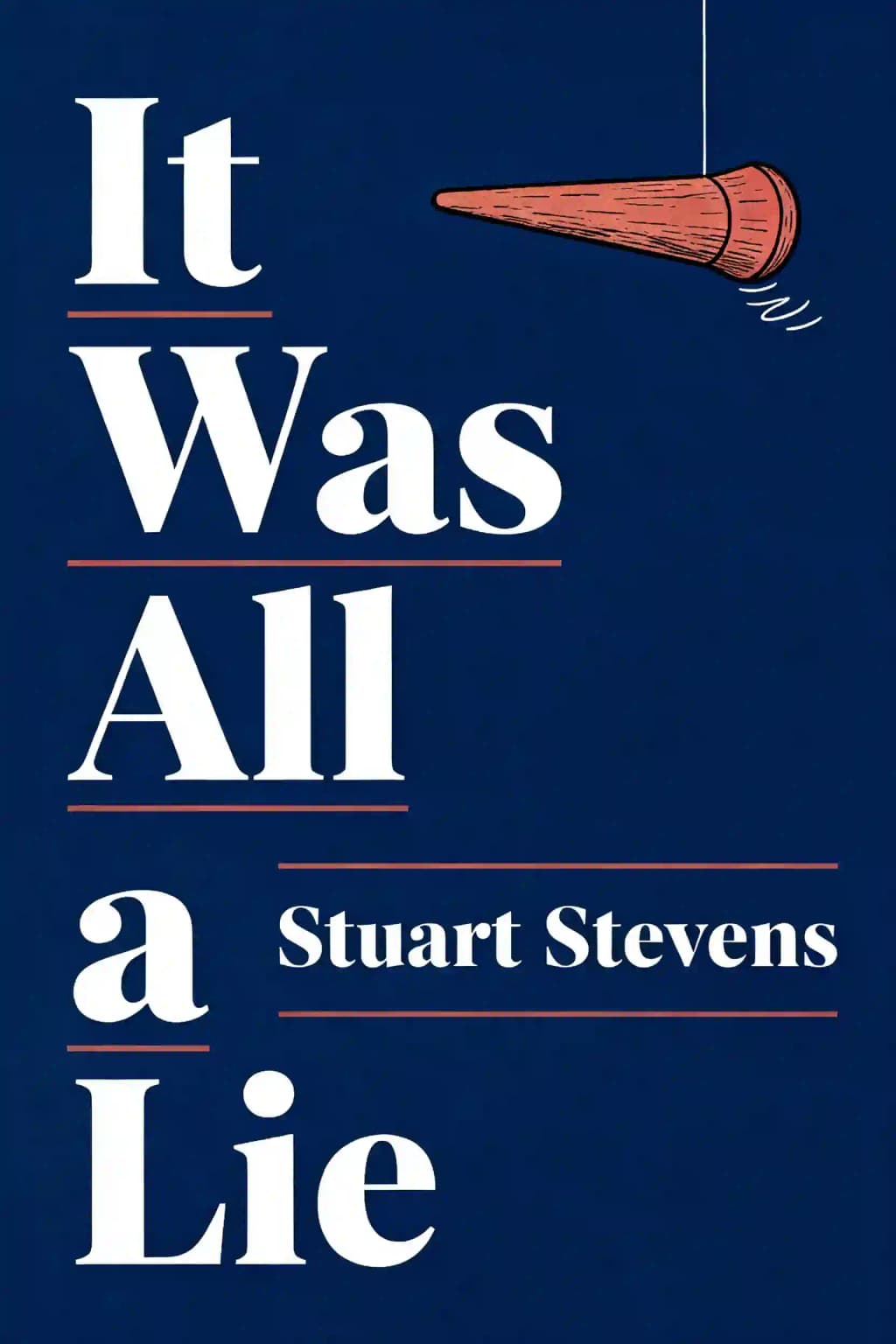
Donald Trump's presidency didn't represent a hijacking of the Republican Party-it was its inevitable conclusion. This provocative claim forms the heart of Stuart Stevens' searing political memoir "It Was All a Lie," a confession from one of the Republican Party's most successful strategists. Stevens spent decades crafting campaigns for Republican candidates, including Mitt Romney's 2012 presidential bid, only to realize the principles he thought he was fighting for were merely marketing slogans. The book became an instant sensation upon its 2020 release, with The New York Times calling it "a stunning indictment of the Republican Party from one of its own." As Stevens puts it, "Trump didn't change the Republican Party; he revealed it." Through his insider perspective, Stevens takes readers on a journey through the evolution of a political party that abandoned its principles in pursuit of power, offering a rare glimpse into how political machinery operates when divorced from its stated values.
Kapitel 2
Race: The Original Republican Sin
Before 1964, Republicans could expect significant support from Black voters-Eisenhower won 39% in 1956, and Nixon secured 32% with Jackie Robinson's endorsement. Everything changed when Barry Goldwater opposed the Civil Rights Act. Black support plummeted to 7%, and no Republican presidential candidate has broken 17% with African American voters since.
The Republican establishment's fundamental misunderstanding persists to this day: they believe their problem with Black voters is merely communication rather than policy. For decades, they've hired Black consultants to "crack the code" of talking to African Americans while ignoring that Black voters reject Republicans because of what they do once elected, not how they speak.
I witnessed this firsthand in 1982 while working on Connie Mack's congressional campaign in Florida. An African American consultant sent by the RNC held a "highly important" meeting where his profound advice was to change "good jobs" to "meaningful jobs" in our messaging. This cosmetic approach achieved nothing-Mack, like Reagan two years later, was crushed with Black voters.
Many Republicans who find Trump repulsive look back to Reagan as the standard-bearer, but there's a direct line from Reagan's genteel prejudice to Trump's white nationalism. Reagan weaponized race when he attacked "welfare queens," describing a Black woman in Chicago who allegedly used "80 names, 30 addresses" to collect $150,000 annually in benefits-a gross exaggeration of a real case where a woman used four names and defrauded $8,000 total. Despite the fact that most welfare recipients have always been white, Reagan's specificity about "a woman in Chicago" made the racial appeal unmistakable.
Reagan's 1980 Neshoba County Fair speech represents another clear example. In a Mississippi county where civil rights workers had been murdered, Reagan declared "I believe in state's rights" without acknowledging their sacrifice-a direct racist appeal to white Mississippi voters. The electoral map confirms this strategy: Carter carried Black Mississippi; Reagan carried white Mississippi.
The 2017 Alabama special Senate election served as a stark barometer of modern racial politics. Even faced with supporting an alleged child molester with a troubled history on race, 68 percent of white Alabama voters stuck with the Republican candidate. Only African American voters, particularly women, prevented his victory.
The Republican Party's racial strategy was explicitly outlined in a 1971 White House memo from Buchanan and Phillips to Haldeman titled "Dividing the Democrats." It assumed Nixon couldn't attract Black voters, so they should focus on using Black voters' support of Democrats to alienate white voters. This path of maximizing white grievance and suppressing African American votes led directly to Trump, who simply followed the same race-based politics of resentment pioneered by his Republican predecessors.
Kapitel 3
The Hollow Core of "Family Values"
The Republican "family values" platform has always been more weapon than principle. I discovered this early in my career when working with a Mississippi congressman who revealed past arrests for homosexual behavior-first at the Iwo Jima Memorial and later surviving a fire at a gay porn theater. Though we managed his reelection by preemptively addressing these incidents, he was eventually arrested in a congressional bathroom and resigned. This experience launched my career in the supposedly "family values" party.
Republicans weaponized "family values" to define a nostalgic 1950s America that never truly existed. This idealized version appears in Brett Kavanaugh's testimony, describing a hermetically sealed suburban world where church attendance was "automatic" and teenage life involved sports, friends, and deliberate sexual inexperience. The Republican ethos built on the fantasy that sex barely existed-liberals had too much of it, while conservatives maintained proper roles. This political strategy wasn't about morality but rather establishing conservatives as "normal" and everyone else as dangerous "others."
The Christian right operated more as a political super PAC for white America than as Christ's political arm. Its leadership featured numerous hypocritical figures who preached family values while living contradictory lives. The National Conservative Political Action Committee (NCPAC), an early conservative PAC, was notably led by gay men like Terry Dolan who paradoxically supported politicians sponsoring anti-gay legislation. Like Roy Cohn's famous denial of his homosexuality, these leaders compartmentalized their identities to maintain power.
Republican candidates frequently claim divine endorsement of their political ambitions. Ted Cruz's father described a two-hour prayer session where "a cloud of the Holy Spirit" gave Ted the "green light" to run. Rick Perry claimed God called him to "ministry" in politics and even proclaimed official prayer days to end Texas droughts.
Despite evangelicals' overwhelming support for Trump (81%), his character stands in stark contrast to previous Republican nominees like Bush and Romney-devout men whose decency, kindness, humility, and compassion now have no value in today's Republican Party. As Peter Wehner observed, Trump has convinced the party that these Christian virtues are weaknesses. Evangelicals who once claimed moral high ground have provided "religious cover for moral squalor," as Michael Gerson puts it, "winking at trashy behavior and encouraging the unraveling of social restraints."
The Trump era has exposed what lurked beneath the surface of the Christian right-anger, racism, and fear-now validated at the highest levels. The movement's embrace of Trump despite his moral contradictions reveals that its true priorities were always power and white identity politics rather than Christian values.
Kapitel 4
The Fiscal Responsibility Fraud
The Republican Party has been running a decades-long scam on American voters similar to Trump's business fraud. While claiming fiscal responsibility in their platforms-attacking Obama's "huge increase in the national debt" and promising "firm caps on future debt"-Republicans have consistently done the opposite when in power. Under Republican control from 2017-2019, the federal debt increased from $20 trillion to $22 trillion in less than 2.5 years. Trump promised to eliminate the national debt in eight years but instead increased it by $2 trillion.
This hypocrisy isn't new-historically, Republican presidents have contributed far more to the deficit than Democrats. Despite Republicans' fiscal rhetoric, they unanimously opposed Clinton's 1993 budget that combined tax increases and spending cuts. Republican leaders like Newt Gingrich predicted economic disaster, with Christopher Cox calling it "the Dr. Kevorkian plan for our economy." These attacks helped Republicans gain control of Congress in 1994.
Yet instead of economic collapse, Clinton's plan launched one of the longest periods of economic growth in U.S. history, creating 23 million jobs, reducing poverty, and achieving the first budget surpluses since 1969. The debt-to-GDP ratio fell from 47.7% to 33.6% under Clinton, while it has only worsened under Republican leadership.
Despite their rhetoric against government spending, the most conservative "red" states are paradoxically the most dependent on federal aid. Mississippi receives over $3 for every dollar paid in federal taxes, with 40% of its budget coming from Washington. West Virginia, which Trump won by forty points, gets more than $2 back for every tax dollar. These states are subsidized by "evil" blue states like California and New York, whose citizens pay more in taxes than they receive in federal benefits.
The 2014 Mississippi Senate race between incumbent Thad Cochran and challenger Chris McDaniel revealed Republican voters' contradictory attitudes toward spending. Despite McDaniel's anti-spending platform backed by $7 million from outside conservative groups, Cochran won by emphasizing the federal dollars he'd brought to Mississippi. Rather than promising cuts, Cochran's campaign highlighted specific benefits from federal funding-schools, roads, military installations-proving that even in America's most conservative state, voters ultimately preferred the candidate who delivered more government money to their communities.
Farm subsidies exemplify Republican hypocrisy on government spending. Despite agreement across the political spectrum that most farm subsidies are wasteful, with about half going to farmers with household incomes over $150,000, Republicans continue supporting them while making it harder for poor Americans to qualify for food stamps. This corporate welfare extends beyond agriculture-tech giants like Tesla ($3.5 billion), Google ($766 million), and Apple ($693 million) receive massive public subsidies while billionaire sports team owners extract hundreds of millions in taxpayer money for stadiums.
The Republican Party's obsession with tax cuts represents another fundamental misconception. George H.W. Bush accurately called Reagan's tax plan "voodoo economics"-the impossible promise of cutting taxes while increasing spending without affecting the deficit. When Reagan took office, national debt was $934 billion; when he left, $2.7 trillion. For many in Reagan's circle, tax cuts weren't merely economic policy but something "spiritual," connected to an Ayn Randian vision of strong individuals fighting government oppression.
Being against "out-of-control federal spending" is Republican catechism, but no one truly believes in it anymore. The Trump presidency shattered any pretense that Republicans would focus on the deficit if given complete control.
Kapitel 5
The Intellectual Collapse of Conservatism
While serious intellectual works form the foundation of center-right thinking in America (Hayek, Kirk, Burke, Weaver), the American conservative movement evolved in contradictory directions after World War II. William Schlamm, who encouraged William Buckley to found National Review, noted that America lacks a true conservative historical tradition because it was built by Europeans tired of Europe's ancient commitments and determined on a "new beginning." This presented an opportunity to craft a new American conservatism based on "moral and aesthetic superiority" rather than historical tradition.
While many anti-Trump conservatives look back fondly at National Review as everything Trump is not (clever, erudite, principled), they forget it began as essentially a well-educated-racist publication. In 1957, Buckley defended segregation, arguing the white South was "entitled to prevail" as "the advanced race." In his 1965 Cambridge Union debate with James Baldwin, Buckley insisted race was irrelevant to Baldwin's arguments, claiming the "fact that your skin is black is utterly irrelevant"-a precursor to today's "colorblind" Republican rhetoric that ignores racial reality. By 2004, Buckley admitted, "I once believed we could evolve our way up from Jim Crow. I was wrong."
In 2000, George W. Bush attempted to redefine conservatism through "compassionate conservatism," acknowledging that merely opposing government wasn't sufficient. The campaign drew heavily from Myron Magnet's book "The Dream and the Nightmare," with speechwriter Michael Gerson crafting powerful phrases like "the soft bigotry of low expectations." Many Bush campaign staffers (Gerson, Wallace, Schmidt, Dowd, McKinnon) have become vocal Trump critics, seeing Trump's embrace by Republicans as repudiation of everything they claimed to believe.
Rereading Magnet's "The Dream and the Nightmare" reveals it as an articulate, erudite version of Trump's worldview. Magnet argued the 1960s caused America to lose its cultural moorings, claiming culture-not racism or economics-created the underclass. Despite acknowledging slavery's legacy, he insisted institutional barriers for blacks had been removed because a black middle class existed. This thinking provides intellectual justification for the grievance industry dominating today's GOP while ignoring stark economic disparities: black workers earn $11,000 less annually than whites, black Americans' median wealth is $17,600 compared to whites' $171,000, and homeownership rates show similar gaps.
Today's Republican Party has lost any unifying theory of government and functions more like sports fans than political participants. They don't care about principles-only about beating the opposing team. Without governing philosophy, the party defaults to those who shout loudest, with talk radio and Fox News as their forum. Intelligent Republicans now embrace anti-intellectualism-Stanford/Yale-educated Josh Hawley rails against "unelected progressive elites," while Princeton/Harvard-educated Ted Cruz attacks "coastal elites" despite his Goldman Sachs executive wife.
Trump embodies the Republican embrace of conspiracy theories: the Deep State, massive voter fraud, Hillary's debate drugs, Cruz's father's link to JFK's assassination, Justice Scalia's murder, Obama's African birth, windmills causing cancer. Unlike traditional conspiracy theories from political losers, today's conspiracism is "the first resort of winners"-Trump refuses to accept even his own victory's legitimacy.
Kapitel 6
The Machinery of Alternative Facts
The Republican Party has evolved into an ecosystem disconnected from objective reality, cultivated over decades through alternative media sources. The authors of "Network Propaganda" found clear evidence that "the right-wing media ecosystem represents a radicalization of roughly a third of the American media system" with no symmetry to other media. This challenges the foundation of shared reality essential to civil society.
Fox News represents the culmination of decades of conservative media activism that began in the late 1940s. The roots of "fair and balanced" partisan media trace back to Human Events, a right-wing newsweekly founded in 1944 by Felix Morley and Frank Hanighen, pacifists who opposed World War II. This newsletter became the foundation for conservative media, with Henry Regnery providing funding that launched Regnery Publishing, still a dominant conservative publisher today.
The conservative media ecosystem expanded through radio shows like the Manion Forum, which spread conspiracy theories and isolationist views. The 1987 FCC decision to stop enforcing the fairness doctrine transformed conservative media into a billion-dollar industry unconcerned with journalistic standards. Unlike mainstream media that strives to report facts and correct errors, conservative media primarily exists to confirm not just opinions but feelings, as seen in the birther movement against Obama.
This ecosystem routinely denies reality, as when Trump claimed he never called Meghan Markle "nasty" despite recorded evidence to the contrary. The conservative media functions as a machinery of deception that takes fragments of truth and twists them into larger lies, embracing conspiracy theories while ignoring actual threats like Russian election interference.
The Roy Moore Alabama Senate race served as a perfect test of Republican moral standards. Despite multiple allegations of molesting an underage girl and sexual harassment of teenage girls, Moore won the Republican nomination and received Trump's endorsement. On election day, Moore captured 67% of white voters, only losing because of record black voter turnout. This demonstrated how conservative voters can exist in a self-reinforcing bubble divorced from objective truth, whether about sexual harassment allegations or climate science.
Kapitel 7
The Politics of Fear and Cowardice
The most distinguishing characteristic of the current Republican Party is cowardice. The base price of admission is willingness to accept that an unstable, pathological liar leads it and pretend otherwise. This demands dishonesty as a trait of membership. The vast majority of Republican officials know Trump is unfit to be president yet pretend otherwise.
Special interest groups test for weakness and exploit fear. Over half a century, the kooks and social misfits of conservative ideology discovered they could force reasonable people to support unreasonable positions through fear. The NRA's transformation exemplifies this-evolving from a gun-safety organization to a thuggish gang that rewards leaders with millions for muscling elected officials.
Today's Republican Party follows Trump in attacking law enforcement institutions, abandoning its "law-and-order" identity to take positions similar to criminals who claim innocence while attacking government officials. The precedent was established decades ago when NRA head Wayne LaPierre attacked federal agents as "jack-booted government thugs" with "power to take away our constitutional rights," language resembling terrorist groups. This rhetoric was so extreme it prompted President George H.W. Bush to resign his lifetime NRA membership in fury, defending the honor of fallen agents like Al Whicher and Steve Willis.
The Republican Party of today bears little resemblance to the one that existed in 1994, when 38 Republicans, including Minority Leader Bob Michel and conservative Henry Hyde, voted for the assault weapons ban. Tom Ridge exemplified this earlier Republican ethos when, as a Pennsylvania congressman running for governor, he voted for the ban despite polling showing it would hurt his primary chances, saying "I'm voting for it. If I lose, I lose. Screw 'em." Ridge won both the primary and general election.
The rise of Newt Gingrich-a "deeply damaged psychological cripple" with Trump-like insecurities and grandiosity-marked the beginning of extreme polarization. Political scientists note that Republicans have moved much further right than Democrats have moved left, with each new cohort of Republican legislators taking more extreme positions than their predecessors. The 38 Republicans who once stood up to the NRA belonged to a party that no longer exists-one that included pro-choice members, environmental advocates, and civil rights supporters who now have no place in today's GOP.
Kapitel 8
The Betrayal of Patriotism
The 2016 election was shaped by the inability to imagine Donald Trump winning. During the Republican primary, candidates competed to be the last one standing against Trump, assuming that the party would never nominate a bankrupt casino owner with a history of supporting Democrats. Similarly, in the general election, Hillary Clinton's perceived inevitability worked against her, with FBI Director James Comey later admitting his infamous letter was influenced by the assumption she would win.
Trump's profound ignorance about nuclear weapons policy persisted throughout the campaign, giving contradictory answers about first-strike capabilities while showing no interest in learning the fundamentals of national security. This represented a stunning departure for a party once defined by seriousness in international affairs.
In spring 2016, I secretly approached several high-profile conservatives about running as third-party candidates to block Trump's path to victory. Each sympathized but argued Trump would lose anyway and it would be better for him to lose on his own merits than because of vote-splitting. This same denial persists in discussions of a "post-Trump" conservative movement, with Republicans desperately wanting Trump's benefits without responsibility for supporting him.
The infamous "Flight 93 Election" essay author Michael Anton revealed the core fear driving Trumpism through his dismissal of Muslim Americans with "blah, blah, blah, etc." His writing characterized Muslims merely as potential "labor" in language reminiscent of Nazi Germany's Untermensch concept. Despite his education, Anton provided intellectual cover for white nationalism, breaking what Abraham Lincoln called "the legacy bequeathed to us."
The Republican establishment's failure represents a fundamental breach of civic duty-treating democracy as disposable rather than precious. Like indolent heirs squandering inherited wealth, they assumed civil society would endure regardless of their actions, ignoring the warnings in "How Democracies Die" about the responsibility to isolate extremists through gatekeeping, distancing, and forming united fronts against authoritarian figures.
Kapitel 9
The Last Stand of White Political Power
The Republican Party under Trump violated all four warning signs of authoritarianism: rejecting democratic rules, denying opponents' legitimacy, encouraging violence, and curtailing civil liberties. Trump obstructed justice, used the presidency for personal profit, attacked justice institutions, encouraged lawbreaking, and denied election legitimacy. He promoted violence at rallies, promising to pay legal fees for supporters who "beat the crap out of" protesters, while threatening opponents with retribution from "tough people" like bikers and police.
The party now operates on a "life-support system of lies," with members prioritizing reelection over country, potentially destroying center-right governance for generations. The party's existential fear of demographic change drives its desperate reactions as America's electorate rapidly diversifies.
By 2020, nonwhites will comprise one-third of eligible voters, up from a quarter in 2000, with the white electorate declining from 77% in 2004 to 68%. Rather than expanding appeal beyond white voters, Republicans have chosen voter suppression tactics reminiscent of Jim Crow strategies. Pete Wilson's anti-immigrant campaign in 1994 contrasts with George W. Bush's successful Hispanic outreach in Texas, where he won nearly 50% of the Hispanic vote in his 1998 reelection. By 2018, Hispanic support for Republicans in Texas dropped to 35% for Ted Cruz, still above the sub-30% that Romney and Trump received, but a warning sign as Texas becomes increasingly Hispanic.
Kapitel 10
When the Lies Finally End
Watching the Republican Party is like watching a friend drink himself to death-a mix of sadness and anger tinged with sympathy. But while alcoholism is a disease, political cowardice is just weakness and opportunism mixed with fear and self-loathing. Most Republican officials privately wish another 2016 candidate had won, whispering this to each other and journalists off the record, making them look even more compromised.
Whether Trump wins or loses in 2020, the Republican Party's embrace of a racist, unprepared president with deep psychological problems will have lasting consequences. The party that once stood for fiscal sanity, free trade, strength against Russia, personal responsibility, and the Constitution now stands for little beyond "owning the libs." Republican leaders abandoned their principles at the threat of a tweet, proving themselves unworthy of respect.
Change will only come through defeat and desperation. Appeals to country over party have proven ineffective because Republicans genuinely like being the voice of white America. The party will only change when its desire to indulge its worst instincts is challenged by fear of losing power. Though there will be a role for a white party in America, it won't be able to win national elections, which may eventually force adaptation.
Trump didn't change the Republican Party so much as give it permission to reveal its true self. While Republican governors in Democratic states like Vermont, Massachusetts, and Maryland demonstrate socially moderate, fiscally conservative governance, it's difficult to see how their approach can coexist with Trump's influence or impact the national party.
Without moral legitimacy, a center-right party becomes merely "a souffle of grievances and anger"-a cartel existing only to elect Republicans with no coherent purpose beyond power. The Republican Party needs America more than America needs it, and that America is increasingly diverse. The author concludes that believing the party could rise to that challenge "would be a lie, and there have been too many lies for too long."