Kapitel 1
A Nation Reborn: The Extraordinary Journey of Modern Israel
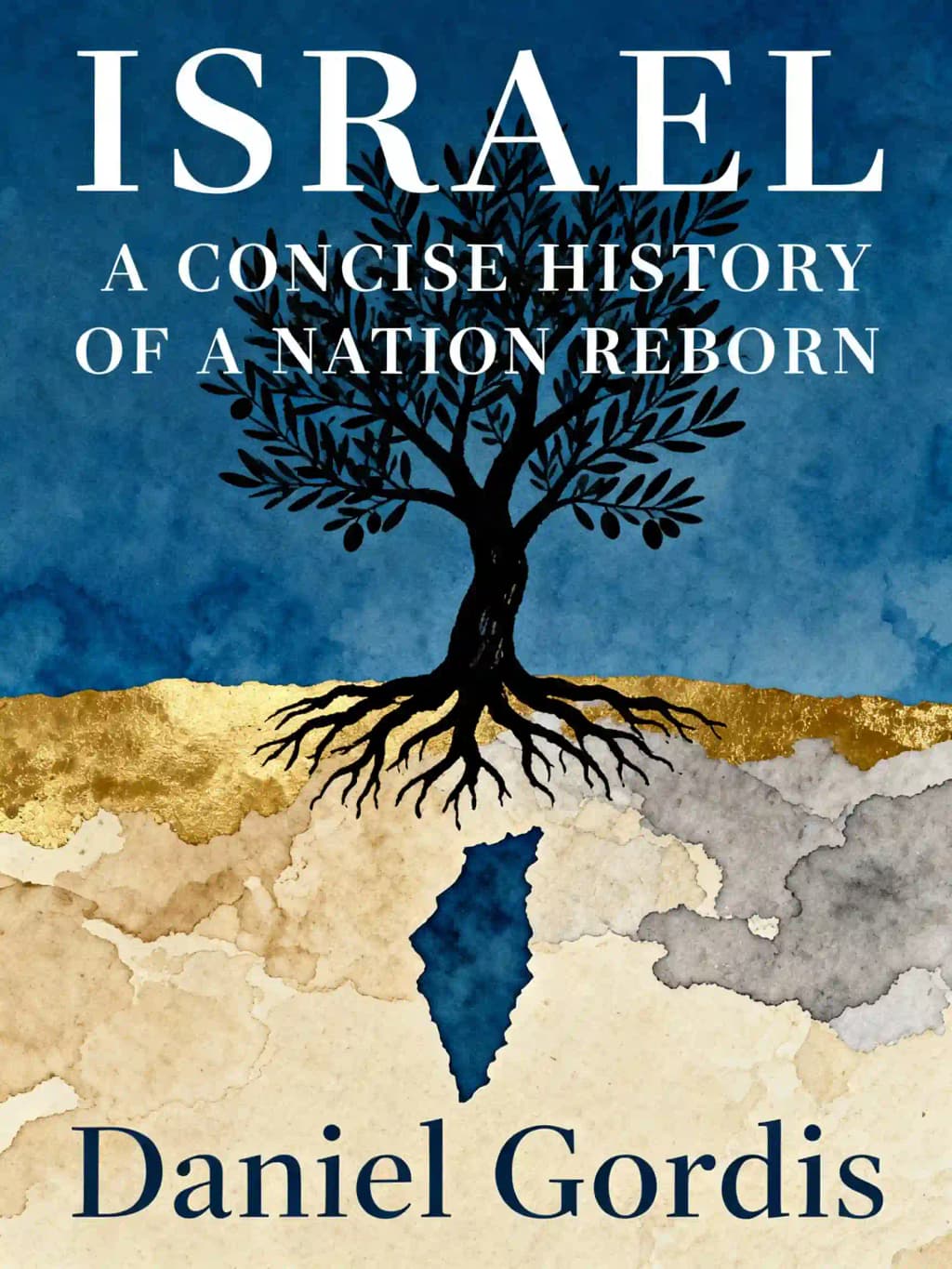
In the heart of the Middle East stands a nation whose very existence defies historical probability. Israel, a country smaller than New Jersey, represents one of humanity's most remarkable stories of national rebirth. When Daniel Gordis's "Israel: A Concise History of a Nation Reborn" was published in 2016, it quickly became Barack Obama's favorite read on the subject, praised for its balanced approach to a complex history. The book chronicles how a scattered people maintained their connection to an ancestral homeland for two millennia before transforming it from dream to reality. What makes this narrative so compelling is not just the improbable triumph against overwhelming odds, but how a nation forged in the shadow of the Holocaust managed to build a vibrant democracy and technological powerhouse while surrounded by hostility. As we explore this extraordinary journey, we discover not merely the story of a country, but a profound testament to human resilience and the enduring power of collective memory.
Kapitel 2
The Ancient Bond: A People's Connection to Their Homeland
The story of modern Israel cannot be understood without recognizing the ancient bond between the Jewish people and their ancestral land. As George Eliot wrote, "A human life should be well rooted in some spot of a native land... where the definiteness of early memories may be inwrought with affection." For Jews, this connection dates to their very origins when God told Abraham, "Go forth from your native land... to the place that I will show you," promising, "I will assign this land to your offspring."
The Bible served as both divine revelation and national diary, chronicling the Israelites' journey from slavery in Egypt to establishing a kingdom under David and Solomon. Jerusalem became their capital, with the Temple Mount as its sacred center. This golden age proved short-lived, however. After Solomon's death, the kingdom split into northern Israel and southern Judea. This disunity-a recurring theme in Jewish history-left them vulnerable to powerful neighbors.
When Babylonia conquered Judea in 586 BCE, destroying the First Temple and exiling its population, Jewish leaders transformed catastrophe into hope. The prophet Jeremiah urged the exiles to maintain their identity while awaiting eventual return. Though exile lasted only decades, with Cyrus of Persia permitting Jews to rebuild their Temple, the pattern of conquest and resilience was established.
Under subsequent Greek rule, the Maccabees successfully revolted in 164 BCE, creating a brief period of Jewish sovereignty. Roman rule followed, growing increasingly oppressive until the Jews rebelled in 66 CE. The Romans crushed this uprising, destroying the Second Temple in 70 CE and scattering the Jewish population. A final rebellion led by Bar Kokhba in 132 CE briefly established Jewish autonomy before Rome's devastating response ended Jewish sovereignty for nearly two millennia.
Remarkably, through 1,762 years of exile, Jews sustained their connection to their homeland through religious practices that kept Zion central to their identity. When praying, they faced Jerusalem. They fasted on the ninth of Av to commemorate the Temple's destruction. At Passover Seders worldwide, they concluded with "Next year in Jerusalem." Even at weddings, breaking a glass reminded celebrants of Jerusalem's destruction.
This genius of Jewish tradition-cyclically reliving historical moments through ritual-kept the Land of Israel their central focus despite physical separation. When Europe turned against Jews in the late nineteenth century, they instinctively knew they had a home elsewhere. Theodor Herzl's political Zionism spread rapidly precisely because it wasn't entirely new-he was reviving an ancient dream Jews had harbored for centuries.
Kapitel 3
The Birth of Modern Zionism: Herzl's Vision Takes Shape
At the close of the nineteenth century, Jewish life in eastern Europe had grown increasingly desperate. Jews faced violent pogroms and systematic discrimination, confined to the Pale of Settlement in Russia with limited access to education and constant harassment. Between 1882 and 1914, approximately 2.5 million Jews fled eastern Europe, with most going to America while a small fraction chose Palestine.
Into this atmosphere of despair came Theodor Herzl, a Budapest-born journalist who had witnessed Europe's persistent antisemitism despite Jewish assimilation. His encounter with respected intellectual Eugen Karl Duhring's antisemitic work deeply disturbed him-not just for its content but because it came from educated society. Throughout his university years and career as a writer for the Neue Freie Presse, Herzl encountered antisemitism at every turn.
These experiences culminated in his 1896 publication of "The Jewish State," a revolutionary work arguing that the Jewish question required a political solution through the creation of a sovereign Jewish state. In August 1897, Herzl convened the First Zionist Congress in Basel, Switzerland, where 197 Jewish delegates gathered to "lay the foundation stone of the house which is to shelter the Jewish nation." For the first time in nearly two thousand years, Jews assembled to take their history into their own hands.
Though Herzl launched Zionism as a political movement, others had expressed similar ideas decades earlier. Moses Hess's 1862 work "Rome and Jerusalem" argued Jews would "always remain strangers among the nations" and should return to Palestine. Leon Pinsker, radicalized by the Odessa pogroms, wrote "Auto-Emancipation" in 1882, urging Jews toward national rebirth and independence.
The First Zionist Congress established the movement's administrative bodies and adopted "Hatikvah" ("The Hope") as their anthem. Herzl left euphoric, writing in his diary: "At Basel I founded the Jewish state... Perhaps in five years, and certainly in fifty, everyone will admit it." His utopian novel "Altneuland" later envisioned a transformed Palestine with modern cities, blooming deserts, and harmony among all faiths-a compelling vision summarized by his motto: "If you will it, it is no dream."
As Herzl worked to secure international support, different visions of Zionism emerged. Ahad Ha'am believed Jews needed not sovereignty but a spiritual center in Palestine, arguing that "a political ideal which does not rest on national culture is apt to seduce us from our loyalty to spiritual greatness." Max Nordau advocated creating "Muskeljuden" (muscle-Jews) to populate the new state. Vladimir Ze'ev Jabotinsky founded Revisionist Zionism, which differed from mainstream Zionism primarily in its willingness to use force to achieve Jewish statehood. A.D. Gordon became the philosopher of Labor Zionism, insisting Jews needed to work the land with their bare hands.
These competing dreams-about statehood versus cultural revival, religion versus secularism, pacifism versus military strength-would shape Israel's fractious political life for generations to come.
Kapitel 4
From Dream to Reality: The First Waves of Settlement
While Herzl pursued diplomatic recognition, small groups of Jews began moving to Ottoman-controlled Palestine, driven by rising European antisemitism and nationalist ideals. The First Aliyah (1882-1903) saw the emergence of critical organizations like Hovevei Zion ("Lovers of Zion") and Bilu, a small but legendary group of university students who helped establish the settlement of Gedera.
Life for these pioneers proved extraordinarily difficult. Despite Baron Rothschild's financial support, many settlers became disillusioned by the harsh realities that contrasted with their idealized visions. Between 60-90 percent eventually left Palestine. Nevertheless, these early pioneers succeeded in establishing communities that would become Israeli villages and cities, laying crucial groundwork for future waves of immigration.
The Second Aliyah (1904-1914) brought approximately forty thousand Jewish immigrants to Palestine, mostly from eastern Europe. This wave established the first kibbutz, Degania, the first Jewish self-defense organization, and the suburb of Jaffa that would become Tel Aviv. These immigrants would produce leaders who later became pivotal political and military figures in the early state.
The kibbutz movement embodied strong socialist ideals with an emphasis on collective responsibility and working the land. Everything was shared-food, profits, protection responsibilities-and even the nuclear family was secondary, with children raised communally. Though kibbutzim never comprised more than 7 percent of the Yishuv's population, their impact on Israeli society was enormous, producing much of Israel's early leadership and becoming symbols of the pioneering ethos.
While many immigrants embraced rural socialist communities, others longed for urban environments. Finding existing Arab cities uncomfortably Middle Eastern, sixty modest professionals created the first "Jewish suburb" north of Jaffa in 1909. They named it Tel Aviv, after the Hebrew translation of Herzl's utopian novel Altneuland. The city quickly became a European-style metropolis where highbrow Zionist culture flourished-"a Palestinian Odessa" or "Vienna on the Mediterranean."
Among the most significant achievements of this period was Eliezer Ben-Yehuda's revival of Hebrew as a living language. Despite opposition from religious Jews who considered Hebrew too sacred for everyday use, Ben-Yehuda persisted in creating a modern Hebrew lexicon. When he died in 1922, thirty thousand people attended his funeral, and the Yishuv observed three official days of mourning.
For the first time in millennia, Jews were building not just infrastructure for political independence but experiencing what a Jewish society might actually be-with its own language, literature, and distinct way of life. After nearly two thousand years of exile, Zionism was providing Jews a tangible sense of what a renewed Jewish people might become.
Kapitel 5
The Balfour Declaration: International Recognition
As World War I engulfed Europe, the Ottoman Empire's control over Palestine was weakening. Zionist leaders debated whether to court Ottoman favor or align with Britain. When Djemal Pasha, Ottoman commander of the Egyptian front, made his anti-Zionist stance clear by disbanding Jewish defense organizations and declaring all Zionists enemies of Turkey liable to death, the movement split on strategy.
Ze'ev Jabotinsky insisted from the outset that aligning with Britain was essential, convinced that continued Ottoman rule would make creating a Jewish state impossible. Working with Lieutenant Colonel John Henry Patterson, Jabotinsky and Joseph Trumpeldor formed the Zion Mule Corps-the first organized Jewish fighting force under a Jewish flag since Bar Kokhba's revolt against Rome eighteen centuries earlier.
Meanwhile, Chaim Weizmann worked tirelessly to advance Zionism in British corridors of power. Born in 1874 near Pinsk in the Russian Empire, Weizmann became a senior lecturer at Manchester University where he met Arthur Balfour in 1906 and gradually drew him toward the Zionist cause. When Weizmann became director of British Admiralty laboratories in 1916, his development of acetone, crucial for naval explosives, earned him access to influential British figures.
Seizing this opportunity, Weizmann cultivated relationships with Prime Minister Lloyd George, Balfour, and Mark Sykes. His persistence paid off on November 2, 1917, when Foreign Secretary Arthur James Balfour wrote to Lord Walter Rothschild expressing His Majesty's Government's support for "the establishment in Palestine of a national home for the Jewish people."
Despite its historic importance, the declaration was remarkably ambiguous. It mentioned a "national home" but not a state, provided no timetable, offered no maps defining "Palestine," and didn't address how Jewish settlement could avoid impacting Arab rights. Nevertheless, British leaders apparently intended a state in areas with Jewish majorities.
Within six weeks of the declaration, General Edmund Allenby's forces captured Jerusalem from the Ottomans. Britain would control Palestine for the next thirty-one years, during which the Yishuv continued developing its institutions and infrastructure. In 1918, thousands gathered for the cornerstone laying of Hebrew University on Mount Scopus, demonstrating the centrality of intellectual life to the emerging Jewish society.
On April 19, 1920, the Yishuv held elections for the Asefat Hanivharim (Assembly of Representatives), establishing a parliamentary tradition that would continue into statehood. This democratic impulse emerged despite most immigrants coming from non-democratic countries and Jewish tradition lacking democratic precedents. The roots traced back to the diaspora experience, where Jews had built communal structures from scratch, establishing a 350-year tradition of democratic self-governance.
That same day, the San Remo Conference in Italy saw Britain, France, Italy, and Japan officially recognize the Balfour Declaration, elevating the Jewish national home from British policy to the express position of World War I's victors. Palestinian Arabs responded with violence, accelerating the development of Jewish defense organizations like Hashomer ("The Watchman") and later the Haganah ("The Defense").
Kapitel 6
The Growing Shadow: Europe's Descent and Jewish Desperation
As Jews in the Yishuv strengthened their defenses, European Jews faced increasing peril. When Hitler became chancellor in 1933, Ben-Gurion foresaw Jews becoming the first victims of rising national hatred and dictatorship.
The Yishuv's response to Nazism was divided between those favoring economic boycotts and others supporting direct negotiations. This led to the controversial Transfer Agreement (Ha'avarah), allowing German Jews to leave with some assets.
Immigration to Palestine surged during the Fifth Aliyah (1932-1936), particularly after the Nuremberg Laws. Palestine's Jewish population grew from 234,967 to 384,078, reaching nearly one-third of the total population.
This Jewish growth sparked Arab resistance, leading to the 1936-1939 revolt. The British Peel Commission proposed partitioning Palestine, offering Jews 20% of the territory. While Zionist leaders like Weizmann and Ben-Gurion supported this plan, Arabs rejected it entirely.
The British responded with the 1939 White Paper, severely limiting Jewish immigration. When World War II began, Ben-Gurion declared they would fight alongside Britain against Hitler while opposing the White Paper's restrictions.
Jewish refugees faced increasing tragedy. The St. Louis was turned away by multiple countries, forcing 937 passengers back to Europe. The British denied entry to 1,730 German refugees aboard the SS Atlantic. Most devastating was the Struma incident, where 768 of 769 Jewish refugees perished after being abandoned in the Black Sea.
The Nazi's systematic extermination of Jews, formalized at the 1942 Wannsee Conference, would claim one-third of world Jewry, including 90 percent of Polish Jews. This genocide united the Zionist movement, culminating in the 1942 Biltmore Conference's explicit call for a Jewish Commonwealth in Palestine.
Kapitel 7
The Path to Statehood: Resistance and Partition
On November 22, 1942, the Jewish Agency held its first meeting focused entirely on European Jewry's fate, officially acknowledging the Nazi's systematic extermination of Jews. Shortly after, a group of young men in the Yishuv gathered to discuss possible responses. At this meeting, a newcomer named Menachem Begin made a bold proposal: the British would never open Palestine to Jewish refugees unless forced by violence. The Jewish revolt against British rule was about to begin.
Begin became head of the Irgun and launched "The Revolt" against British rule. Even more extreme was the Lechi (derisively called the "Stern Gang"), which saw the British as a greater enemy than the Nazis and conducted small-scale operations, particularly assassinations of British officials.
On June 26, 1945, Ben-Gurion declared that if British immigration restrictions continued, the Yishuv would respond with "constant and brutal force." The Haganah, Irgun, and Lechi joined to form the United Resistance Movement. Their most successful attack came on June 16-17, 1946, when eleven coordinated strikes destroyed bridges and damaged Haifa's railway system. The British retaliated with Operation Agatha (or "Black Sabbath"), placing major cities under lockdown and arresting 2,700 Jews.
After learning that incriminating documents seized during Black Sabbath were stored at the King David Hotel, the Irgun bombed the building's southern wing, which housed British administrative headquarters. Despite warning calls twenty minutes before detonation, the explosion killed 91 people-28 British, 42 Arabs, 17 Jews, and 4 others. The attack drew international condemnation, and the United Resistance Movement effectively collapsed in the aftermath.
On January 22, 1947, exhausted by the conflict, Britain announced it would turn Palestine's fate over to the United Nations. The UN created the United Nations Special Committee on Palestine (UNSCOP) to find a solution. On September 1, 1947, UNSCOP proposed partitioning Palestine into Jewish and Arab states, with Jerusalem under international control. The Jewish state would receive 55% of the territory (much of it desert).
Despite CIA warnings that a Jewish state couldn't defend itself and would last "no longer than two years," President Truman supported partition against State Department advice. The Soviet Union also backed Jewish independence. Resolution 181 passed on November 29, 1947, by a vote of 33-13 with 10 abstentions, fulfilling Herzl's fifty-year-old prediction that a Jewish state would emerge.
Jews worldwide celebrated with overwhelming emotion. In Palestine, synagogues opened at night for thanksgiving prayers, and thousands danced in the streets. Not everyone celebrated, however. Menachem Begin and David Ben-Gurion both abstained from dancing, knowing war was imminent. Ben-Gurion later recalled, "I could not dance. I knew that we faced war and that in it we would lose the best of our youth."
War began immediately after the UN vote. The first phase, from November 1947 until Israel's independence in May 1948, resembled a civil war between the Yishuv and local Arab fighters joined by irregular forces from neighboring countries. By May 1948, some 300,000 Arabs had left Palestine, beginning the Palestinian refugee problem that remains unresolved today.
Kapitel 8
Independence and War: The State Is Born
On May 14, 1948, as the British departed, the People's Assembly gathered at the Tel Aviv Museum for the historic declaration ceremony. At precisely 4 PM, with photographers' flashes illuminating the scene, the assembly stood and sang "Hatikva." Then Ben-Gurion, standing beneath Theodor Herzl's portrait, read the declaration establishing "a Jewish State in the Land of Israel, to be known as the State of Israel." The proceedings lasted just thirty-two minutes, but marked the end of two millennia of exile.
Israel's Declaration of Independence was distinctly secular and historical rather than theological. Unlike America's declaration, it made no explicit mention of God, using only the ambiguous phrase "Rock of Israel" as a compromise between religious and secular factions. The document promised the state would be "based on freedom, justice and peace as envisaged by the prophets" and offered "complete equality of social and political rights to all inhabitants irrespective of religion, race or sex."
The war's second phase began immediately, with five Arab armies invading the newborn state. The tragic culmination saw Jerusalem's Jewish Quarter fall to Jordan's Arab Legion, beginning a nineteen-year period when Jews could not access the Western Wall. Despite being outgunned, Israel improvised solutions like the "Burma Road"-an alternate supply route built under Jordanian shelling to supply besieged Jerusalem.
A crucial moment came with the Altalena affair, when Begin's Irgun attempted to bring weapons into Israel independently. Ben-Gurion ordered the ship sunk, insisting that a legitimate state requires all military force be subject to political authority. Begin refused to fight back, imploring his followers: "Do not raise a hand against a brother" and "There must not be a civil war with the enemy at our gates!" In Israeli mythos, the Altalena came to represent the principle that a legitimate state requires unified military command.
The war ended with armistice agreements in 1949. Israel had lost 6,000 lives-1% of its Jewish population-while 700,000 Palestinian Arabs were displaced, creating what they called the Nakba ("Catastrophe").
Israel's first national elections on January 25, 1949 carried profound symbolic weight after two millennia without Jewish sovereignty. Nearly 87% of eligible voters participated, with Ben-Gurion's Mapai party winning 36% of votes. Months later, Theodor Herzl's remains were brought to Jerusalem, with a quarter of Israel's population paying respects along the route. The Knesset soon passed the Law of Return, granting every Jew worldwide the right to immigrate and receive immediate citizenship.
Between May 1948 and late 1951, nearly 687,000 Jews from 70 countries arrived, doubling Israel's Jewish population in just three years. The absorption of these immigrants created enormous challenges, with new arrivals initially housed in temporary camps surrounded by barbed wire with inadequate facilities. Cultural clashes emerged immediately-Hungarian girls sunbathing in bikinis shocked Moroccan men from conservative societies. European immigrants who ran the country often displayed cultural elitism, with Ben-Gurion himself referring to the newcomers as "human dust lacking language, education, roots, tradition or national dreams."
Kapitel 9
From Survival to Sovereignty: Israel Enters the World Stage
By 1953, Israel faced numerous border infiltrations by Palestinian fedayeen from Jordan and Egypt. The IDF's Unit 101, led by Ariel Sharon, conducted retaliatory strikes, including the controversial Qibya operation that killed dozens of villagers. This sparked internal Israeli debate about military response proportionality.
Under new IDF Chief Moshe Dayan, Israel maintained an assertive defense policy. Meanwhile, Egypt's Gamal Abdel Nasser emerged as a primary antagonist, viewing Israel as both a colonial outpost and a rallying point for Arab unity. The 1956 Sinai Campaign, launched in secret alliance with Britain and France, established Israel as a regional military power and brought a decade of relative calm.
A pivotal moment came in 1960 with Adolf Eichmann's capture and subsequent trial in Israel. The proceedings, which placed the Holocaust in Jewish historical context through survivor testimony, transformed Israeli society's relationship with Holocaust survivors and resulted in the only civil court execution in Israel's history.
By 1967, Israel had absorbed over a million immigrants and gained international standing, though Jerusalem remained divided. Tensions escalated when the Soviets falsely warned Egypt and Syria of Israeli military buildups. During the tense "waiting period," Egypt deployed forces to Sinai and closed the Straits of Tiran, threatening Israel's eastern trade routes.
On June 5, Israel launched a preemptive strike, destroying the Egyptian air force within hours. The Six-Day War's 132 hours reshaped the region dramatically. Israel tripled in size, gaining control of the Gaza Strip, Sinai Peninsula, West Bank (including East Jerusalem), and Golan Heights. While reunifying Jerusalem, this victory also placed 1.25 million Palestinians under Israeli control, creating complex demographic challenges that would define future conflicts.
Kapitel 10
The Burden of Victory: Occupation and Its Discontents
In the aftermath of the Six-Day War, Israel quickly transformed the Western Wall area by clearing the adjacent Mughrabi Quarter, displacing 135 Arab families to create a plaza that could accommodate thousands of Jewish worshippers. This hasty decision exemplified Israel's approach to the newly captured territories-quick actions without national conversation about long-term implications.
The Six-Day War victory unleashed passionate responses across Israeli society. Religious Jews saw divine intervention, with some believing the Messianic age was beginning. Meanwhile, secular Zionists embraced territorial expansion, insisting "Israel must give up nothing, particularly not 'the cradle of this nation.'" Not all religious Jews embraced territorial expansion, however. Orthodox professor Yeshayahu Leibowitz advocated immediate withdrawal from territories inhabited by 1.25 million Arabs-not for peace, but to save Israel's Jewish character.
Twenty-four-year-old Hanan Porat, a paratrooper who helped liberate the Old City, became the driving force behind Jewish resettlement in the West Bank. Born on Kfar Etzion, a religious kibbutz overrun by Arabs in 1948 (where many fathers were massacred), Porat's mission was deeply personal-he was literally returning to his birthplace. The movement grew rapidly-by 1973, seventeen settlements existed in the West Bank, and by 1977, thirty-six.
Even some IDF leaders recognized the burden of occupation. Yitzhak Rabin noted they could have taken Cairo, Amman, and Damascus but hadn't gone to war to acquire territories. Ben-Gurion, speaking from retirement, advocated keeping only Jerusalem and the Golan. Veterans began expressing misgivings in unprecedented ways. The book "Soldiers Talk" featuring interviews with kibbutz members who fought in the war sold 100,000 copies, as soldiers shared their pain, anger, and shame at what they had experienced.
The Six-Day War united the Palestinian community even as it divided Israelis. Israel's victory dealt a fatal blow to Nasser's pan-Arabism and revealed how little Arab leaders had done for Palestinians. Yasser Arafat, who had founded Fatah in 1959, rose to prominence as the movement joined the PLO. After the 1967 defeat, Arafat became PLO chairman and effectively the Palestinian political leader.
By 1973, Israel had developed what became known as the "conception" (conceptzia)-a deep-seated belief in the IDF's military superiority and the assumption that neither Egypt nor Syria would dare attack Israel. This mindset represented a dramatic shift from the pre-Six-Day War anxiety to a sense of invulnerability.
On Yom Kippur 1973, this illusion was shattered when Egypt and Syria launched a surprise attack. Despite warnings from intelligence sources, Israel's leadership remained complacent. Within the first fifteen minutes, 240 Egyptian fighter jets crossed the canal as 2,000 Egyptian soldiers fired 10,000 shells at Israeli positions. In the north, 1,400 Syrian tanks advanced down the Golan Heights toward Israel's Galilee.
Though Israel ultimately prevailed militarily, the human cost was devastating. The war shattered Israeli assumptions about security and peace. As footage of Israeli POWs, burned-out tanks, and dead soldiers circulated, the nation confronted unprecedented grief. The war transformed Yom Kippur itself from a day of religious atonement into an annual remembrance of incompetence and shattered illusions.
Kapitel 11
Revolution Within the Revolution: Israel's Changing Identity
In 1970s Israel, Ashkenazi Jews dominated the cultural landscape, from music to the political establishment. Mizrachi Jews-those from North Africa and Middle Eastern countries-found themselves relegated to Israel's geographic and social periphery. Having fled Arab persecution, often without their assets, many Mizrachim arrived to find themselves placed in distant ma'abarot (transit camps) that offered basic necessities but limited opportunity.
After twenty-nine years in political opposition, Menachem Begin seized his moment in 1977. The perfect storm had arrived: the Yom Kippur War's aftermath, Meir's resignation following the Agranat Commission, Rabin's financial scandal, and the Mizrachi population's simmering frustrations. Despite his Polish background, Begin had cultivated strong relationships with Mizrachi Jews, regularly visiting ma'abarot transit camps and addressing residents as "my brothers and sisters."
On Election Day in May 1977, Begin's Likud won 43 seats while the Alignment (Ben-Gurion's reconfigured Mapai) secured only 32-a decrease of more than a third. The victory, dubbed the "Mahapach" (Reversal), sent Mizrachi voters jubilantly into the streets chanting "Begin! Begin!" while the Ashkenazi elite stood stunned, unable to comprehend how anyone could reject the party that had built the state.
Begin's administration quickly focused on peace rather than domestic issues. Following Egyptian President Anwar Sadat's stunning announcement in November 1977 that he was willing to go "to the Knesset itself" to prevent further bloodshed, Begin invited him to address the Israeli parliament. Despite acrimonious negotiations at Camp David with President Jimmy Carter mediating, an agreement was eventually reached. Begin sacrificed the Sinai but kept the West Bank. On September 28, 1978, the Knesset approved the Camp David peace agreement by 84 votes to 19. Ironically, it was Israel's first right-wing prime minister who agreed to withdraw from territory.
Though Likud was not a religious party, its leadership felt natural kinship with Gush Emunim, the religious-nationalist settlement movement. Begin was deeply committed to settlement expansion, visiting Elon Moreh just days after his election and declaring "Soon there will be many more Elon Morehs." Under Begin, settlements doubled, though contrary to international perception, the settlement movement had begun under Labor governments.
After the PLO established bases in civil war-torn Lebanon, launching terrorist attacks against Israel, Begin launched Operation Peace for Galilee in June 1982, declaring "We will be nobody's cowering Jew." Though Israel successfully forced Arafat and 9,000 PLO fighters to evacuate to Tunisia, the operation soon unraveled as Defense Minister Sharon pushed troops far beyond the approved 40-kilometer line to besiege Beirut.
The Lebanon operation's darkest moment came after Bashir Gemayel's assassination in September 1982, when Sharon ordered the securing of Palestinian refugee camps, allowing Christian Phalangists to enter Sabra and Shatila camps. The Phalangists massacred 700-800 Palestinian civilians while Israeli forces secured the perimeter. This atrocity triggered massive protests in Israel, with hundreds of thousands demanding a judicial inquiry. The Kahan Commission determined that while Israelis weren't directly responsible, Sharon bore "personal responsibility" for disregarding the danger.
Kapitel 12
From Oslo to Intifada: The Elusive Search for Peace
By the early 1990s, with the Israeli-Palestinian conflict grinding on without decisive victory for either side, many Israelis concluded that negotiation was necessary. In October 1991, under Likud Prime Minister Yitzhak Shamir, Israel participated in the Madrid Conference, sitting with Syrian, Lebanese, and Jordanian delegations.
In 1992, Israelis elected Yitzhak Rabin, believing the battle-tested general understood their security needs and could deliver peace. After Israel repealed the law forbidding PLO negotiations, secret talks began in Oslo, Norway, resulting in the Oslo Accords. The agreement created the Palestinian Authority to administer territories from which Israeli forces would withdraw, with the PLO recognizing Israel and pledging to abandon violence.
Instead of peace, the accords triggered intensified Palestinian violence, with Hamas and other extremist groups launching deadly suicide bombings against Israeli civilians. More Israelis died in terror attacks between 1994-1996 than ever before in such a short period, while Arafat rarely denounced the perpetrators.
As Israel's religious and political Far Right grew increasingly hostile toward Rabin, protesters displayed images of Rabin dressed as Hitler, and some extremist rabbis labeled him a rodef and boged (categories in Jewish law meriting death). Despite warnings about dangerous incitement, Rabin held a massive pro-peace rally in Tel Aviv on November 4, 1995. After addressing 150,000 supporters and joining them in singing "Shir La-Shalom" (Song to Peace), Rabin was assassinated by Yigal Amir, a 25-year-old religious law student.
Following Rabin's assassination, Shimon Peres became acting prime minister and continued pursuing Rabin's peace vision. But Palestinian attacks intensified rather than subsiding. After a series of devastating terrorist attacks killed nearly sixty Israelis within nine days, security-conscious voters elected Benjamin Netanyahu in 1996.
In 2000, Prime Minister Ehud Barak offered Arafat 92 percent of the West Bank and sections of Jerusalem for a Palestinian state. To everyone's surprise, Arafat refused to even consider the offer or make a counter-proposal. American diplomat Dennis Ross later concluded that while Barak and Clinton were prepared to take necessary risks for peace, Arafat was not.
The peace process collapsed into violence in September 2000 when opposition leader Ariel Sharon visited the Temple Mount. Though within his legal rights, his visit became the spark for what would become the Second Intifada. Unlike the first intifada, this uprising featured armed Palestinian security forces and suicide bombers, making it far deadlier.
With peace hopes dashed and Palestinian attacks intensifying, Israelis turned decisively rightward, electing Ariel Sharon in February 2001. The Second Intifada's brutality shocked Israeli society-over a hundred Israelis died from suicide bombings in 2001 alone. In response, Sharon launched Operation Defensive Shield in 2002 and began constructing a separation barrier that ultimately reduced suicide attacks by 84 percent.
The intifada's most lasting casualty may have been the Israeli peace movement. The Left's decades-old "land for peace" principle collapsed when Arafat rejected Barak's generous offer and responded with violence. As Yossi Klein Halevi later observed, most Israelis became centrists during this period-agreeing with the Left that a Palestinian state was necessary to avoid ruling over millions of Palestinians, but agreeing with the Right that such a state would endanger Israel's security.
Kapitel 13
A Nation Reborn: Looking Forward While Honoring the Past
In early 2013, Ruth Calderon's inaugural Knesset address highlighted a growing recognition: while Zionism had succeeded in creating a new Jewish identity, it had left many Israelis disconnected from their traditions. This void sparked a movement where secular and religious Israelis began studying texts together, understanding that Jewish statehood needed deeper meaning beyond nationality.
This spiritual renaissance spread through Israeli culture, from music to cinema, with religious themes explored thoughtfully rather than dismissively. The Gavison-Medan Covenant proposed practical compromises between secular and religious life, acknowledging Israel's need for substantive Jewish content.
A century post-Balfour Declaration, Israel houses the world's largest Jewish population. Despite immense sacrifices-including losing one percent of its citizens in the War of Independence-the country has transformed from vulnerable settlements into a thriving nation of eight million. As Barbara Tuchman noted, Jews alone among ancient peoples maintain their original language, location, and religion.
While some Zionist dreams, like Herzl's hope that a Jewish state would end anti-Semitism, proved optimistic, others exceeded expectations. Hebrew has been revived beyond imagination, with Israeli literature gaining global recognition. The country has planted 250 million trees, developed one of the world's strongest military forces, and become a leader in technology and innovation.
Israel stands as one of the few post-World War II nations to maintain continuous democracy. It has fulfilled many of Herzl's visions: technological advancement, global humanitarian aid, and world-class universities. Though challenges remain, most Israelis believe in their ability to overcome them, recognizing that their state's survival is crucial not just for them but for the future of the Jewish people.