Kapitel 1
The New Rules of Wealth: Breaking Free from Traditional Business Constraints
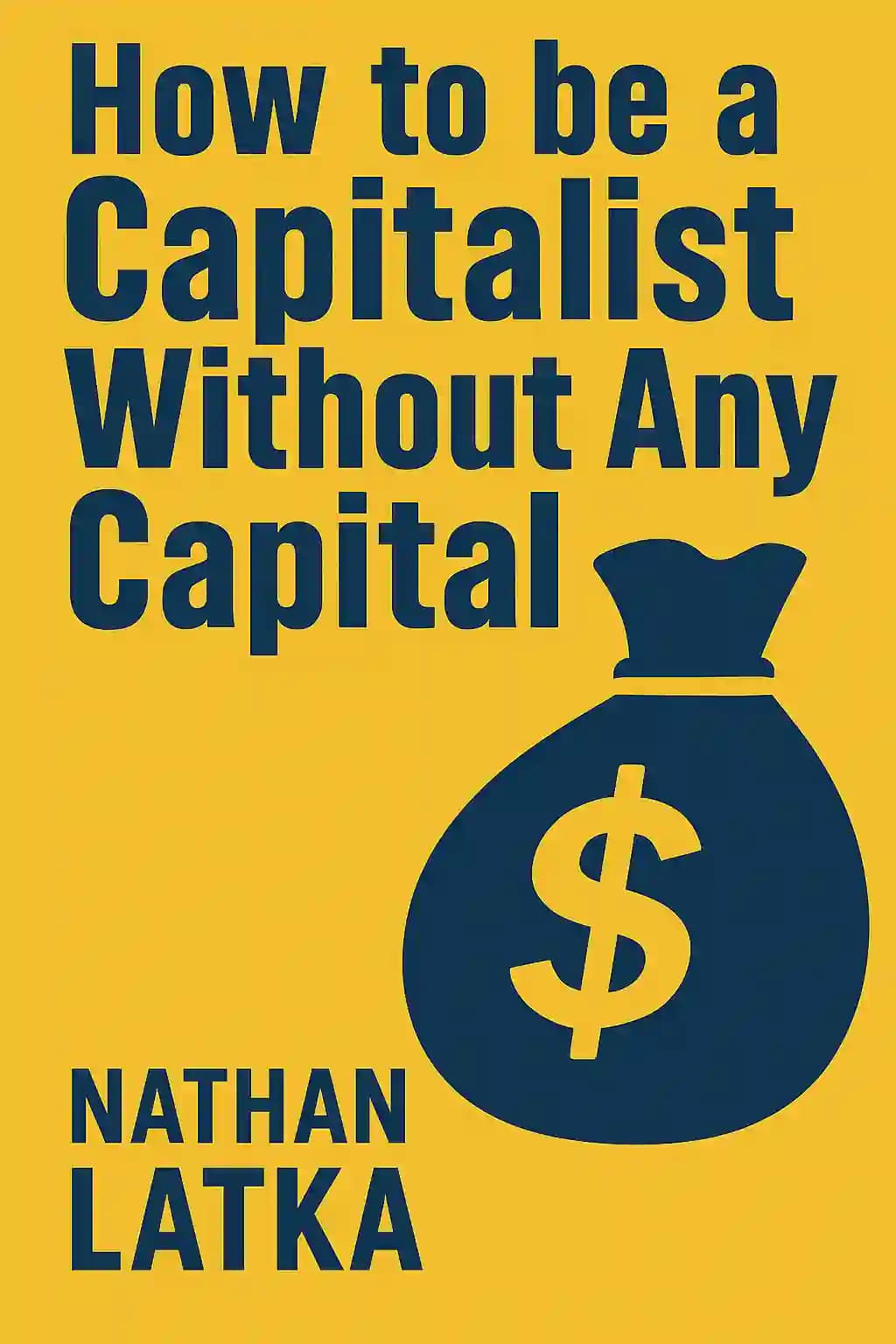
In a world where traditional business advice seems to keep most people trapped in mediocrity, Nathan Latka offers a refreshing counterpoint. His book "How to Be a Capitalist Without Any Capital" has become a phenomenon among aspiring entrepreneurs and those looking to escape the 9-to-5 grind. With over 100,000 copies sold in its first year and endorsements from tech luminaries like Tim Ferriss and Eric Ries, Latka's approach has struck a chord with a generation seeking financial freedom without massive upfront investment. What makes this book particularly compelling is Latka's own journey-from a college dropout who turned down a $6.5 million acquisition offer at age 22 to becoming a successful entrepreneur, investor, and podcast host whose advice has helped thousands create multiple income streams. Unlike many business gurus who speak in vague platitudes, Latka shares actual numbers, tax returns, and email negotiations, making his strategies feel tangible and achievable for the average person looking to join what he calls "the New Rich."
Kapitel 2
Reject the One-Focus Myth and Embrace Multiple Ventures
The conventional wisdom that you should focus on becoming an expert at one thing is perhaps the most dangerous advice for those seeking wealth. This single-focus approach creates a massive vulnerability-if your one venture fails, you're left with nothing. Even if you become the top expert in your field, you can always be replaced in today's mobile job market.
Success depends largely on timing and luck, which you can't control directly. The only way to position yourself to capture both is by taking more chances-which means pursuing multiple ventures simultaneously. Multiple projects allow you to multiply your income through pattern recognition and cross-promotion, which is far more powerful than simply adding income streams.
My podcast, The Top Entrepreneurs, illustrates this perfectly. What began with a single $6,400 sponsorship deal evolved into a multi-million dollar revenue stream when I discovered I could leverage my other company, The Top Inbox (a Gmail productivity tool), to multiply podcast revenue. By placing pop-ups on the software interface to drive traffic to podcast sponsors, I created tremendous value for sponsors who now pay $150K-$180K annually.
This cross-promotion opportunity wouldn't exist if either the podcast or The Top Inbox were my only project. The ability to find these overlaps has become a key factor I look for when acquiring companies. Similar pattern recognition exists everywhere-look at how Elon Musk capitalizes on connections between his ventures in electric cars, solar energy, batteries, and space exploration.
To make this approach work effectively, I follow the Three-Focus Rule: spend 80% of your time on your biggest potential earner and split the remaining 20% between two other ventures. In a five-day workweek, this translates to about three days on your primary project and the remaining time on secondary projects that might be more passive in nature.
This rule lets you test ideas (swing, miss, learn), multiply them (find patterns to capitalize on), and use that knowledge to launch new ventures. Your current businesses contain potential for new income streams, whether from repurposing materials or identifying new customer needs. The key is strategic time allocation-not multitasking to burnout.
Kapitel 3
Copy Your Competitors Shamelessly and Effectively
You must copy your competitors aggressively, quickly, and cost-effectively to succeed. Every successful entrepreneur has copied, even if they won't admit it-they've just taken someone else's idea and adapted it for a different industry.
Wealthfront CEO Andy Rachleff openly admitted that their successful customer acquisition model-where new investors get their first $10K managed free and earn another $10K managed free for each friend they invite-was directly copied from Dropbox's storage referral system. This blatant copying harmed no one but created a major win for Wealthfront, with 15% of customer invites converting to new users.
Finding patterns that link successful businesses is like decoding the secrets behind their wins. When you copy, you're essentially getting a free business lesson instead of paying to learn those lessons yourself. For side hustles, opportunities for strategic copying are abundant:
With Airbnb rentals, study top-rated listings to identify patterns in headlines, photos, and descriptions. Notice how successful hosts highlight location, charm, and amenities to attract guests.
On Etsy, analyze bestselling products to spot trends. Popular women's tanks featuring cheeky sayings about tacos, coffee, wine, cats, or yoga reveal clear patterns in both content and style.
Freelance platforms offer valuable insights for consultants. Study top-rated professionals on sites like Fiverr, Upwork, and Toptal to understand how they present services, set pricing, and make guarantees.
For physical products, crowdfunding sites like Kickstarter and Indiegogo showcase what's succeeding and why-sometimes it's the product, but often it's the creator's compelling story.
Digital creators should study Patreon, which reveals exactly how much creators earn through monthly pledges and what they offer to attract paying customers. You can see how top-grossing podcasters communicate with fans, structure payment tiers, and determine what content to make exclusive versus free.
Kapitel 4
Quit Setting Goals and Build Systems Instead
The biggest mistake when building wealth is setting achievable goals. If your goals feel remotely attainable in your lifetime, they're actually holding you back. The problem isn't that you need to work harder-you're likely already working too hard.
The rich focus on systems rather than goals. Like the goose that laid golden eggs, there are two types of people: those obsessed with golden eggs (goals) and those obsessed with optimizing the goose's health (systems) to produce bigger, better eggs more frequently.
Systems can generate goals at increasing speed with minimal input from you. While advertising's purpose is to make you want something-a golden egg-it distracts you from building the goose that could produce a new luxury item every month.
Instead of pursuing small goals that seem doable, set audacious goals, then forget them and focus on creating systems that produce your desired outcomes repeatedly. This is how the New Rich improve performance and results while freeing themselves to achieve even more ambitious things.
To master systems, you must first get laser-focused on the minutiae. Obsessing over details initially is the only way you can eventually forget about them. Understanding the precise elements of a process allows you to create systems that automate those details, giving you flow and routines.
My entrepreneurial journey began with "Fan Page Factory," selling custom Facebook pages for $700 each. I personally built each page, handling design and coding. Eventually, I realized the power of systems-instead of coding new pages monthly, I could develop software that customers could use themselves. Though difficult initially, the recurring revenue model eventually had thousands paying $30-$300 monthly-vastly superior to one-time $700 payments.
Build systems around what consumes most of your time. Spend a week documenting everything you do to gain awareness and intentionality. For each recurring task, create detailed documentation so thorough that someone else could execute it perfectly without your help. To test if your system documentation is truly comprehensive, try my Starbucks Process: Print your instructions, go to a coffee shop, and offer strangers a free coffee to follow your documented steps. Watch where they get confused while reading the instructions aloud.
New Rich Systems consist of four key elements: Inputs (what feeds your system), Outputs (what your system produces), Feedback Loops (how outputs can improve inputs), and Stocks (assets that accumulate within your system to generate outputs). Setting up this system framework is more important than setting arbitrary income goals.
Kapitel 5
Sell Pickaxes to Gold Miners
Rather than creating brand-new business ideas, the counterintuitive approach to wealth is selling into markets others have already built. During the California Gold Rush, people like Levi Strauss and Samuel Brannan made fortunes not by mining gold themselves, but by selling supplies to miners.
This strategy works in both B2B and consumer markets. While everyone chases fidget spinners, you sell Fidget Spinner Sticker Kits. While Amazon profits from third-party sellers, you create inventory-tracking software for those sellers. The challenge is resisting the temptation to join the gold rush yourself.
I identified venture capital as a "gold mine" everyone wants to enter, with data being the perfect "pickax" to sell to VCs. Instead of directly asking CEOs about their financials, I invite them on my podcast where they willingly share revenue figures and business metrics. VCs pay $5K-15K monthly to access my CEO interview data because it's straight from the source-more accurate than competitors who scrape websites for metrics. In just three months, this database generated $100K.
Don't waste time asking consumers what they want-they'll just point you toward big, sexy ideas already being worked on. Instead, identify what successful businesses depend on and build that. Seven places to find your next profitable idea:
1. Sell add-ons for popular items (like iPhone cases)
2. Read news headlines differently-spot trends and build tools for those markets
3. Study marketplaces like Salesforce AppExchange to identify successful apps you can support with services
4. Leverage online learning platforms to spot hot topics
5. Eavesdrop on influencers to identify luxury markets
6. Monitor trending Kickstarter campaigns for market signals
7. Scan Patreon to see which digital products generate significant income
Apply successful business patterns from history to today's hot markets. DroneDeploy did this by selling drone software, essentially following what app developers did a decade ago-creating software for the hottest new gadgets. They've raised $30M and reached $1M in annual revenue.
If you lack expertise, platforms like Toptal can connect you with specialists. Even with zero experience, hiring freelancers teaches you the industry while they complete your project, compounding your knowledge for future ventures.
Kapitel 6
Mastering the Psychology of Persuasion and Negotiation
I target one thing in persuasion: fear-our strongest emotion. When we fear something, we'll do anything to fix the worry, which is why selling solutions to fears is incredibly profitable.
I've identified seven fear principles that drive sales: Fear of Missing Out (limited-time offers), Fear of the Unknown (insurance), Fear for Your Life (safety devices), Fear for Your Health (vitamins), Fear of Losing Freedom (productivity tools), Fear of Loneliness (dating apps), and Fear of Failure (coaching services).
The most effective products tap into multiple fears simultaneously. While this may sound manipulative, you can ethically profit from fear by selling genuinely helpful products that address real concerns. Fear is free to create, making it exceptionally profitable.
One reason people lose negotiations is fearing they'll lose. The best strategy is to negotiate when you don't have to. By approaching negotiations from a position of having already decided to move on, you create leverage. This principle applies to everyday expenses too-even when you have money for rent, sending a simple "Money Troubles" email to your landlord can create doubt about your ability to pay, potentially leading to discounts since landlords want to avoid turnover costs.
The New Rich maximize productivity by batching time into focused blocks of at least three hours dedicated to single tasks or themes, eliminating the productivity loss from task-switching (which costs 5-10 minutes per switch). Jack Dorsey exemplifies this approach by theming his days: Mondays for management, Tuesdays for product, Wednesdays for marketing, and so on.
Kapitel 7
Transform Your Expenses into Income Streams
The key to financial freedom isn't just spending less-it's turning liabilities into assets. Unlike what traditional financial authors taught, today's sharing economy lets you transform almost anything you own into a cash machine. This approach keeps expenses low while generating passive income, giving you patience to build better products without chasing desperate money.
I use Airbnb to not only cover my $2,700 monthly mortgage but make an extra $500-600 by renting my house 20 days a month. To maximize Airbnb earnings: decrease your nightly rate but increase cleaning fees (since fees don't affect search rankings), negotiate bulk discounts with cleaners, and invest in professional photography.
Beyond housing, platforms like Turo.com, HyreCar.com and GetAround.com let you rent your car while it sits unused during work hours. You can even monetize office space through Breather.com, hotel rooms via Recharge.co, and digital content using Patreon, where I quickly built to $2,300+ monthly from 29 patrons.
There's easy money available if you know where to find it. Use ClaimCompass.eu or AirHelp.com to get compensated for flight delays (averaging $400 per claim). Launch guaranteed-successful Kickstarter campaigns through FundedToday.com, which markets to their existing donor lists. Make quick profits by finding items cheaper on Amazon than their eBay listings, then buying and reselling them.
Kapitel 8
Live Like a King Without Ownership
To build wealth, you must act wealthy-but not by going broke buying luxuries like fools do. The New Rich secret is getting luxury items for free while keeping the money you make. This approach works because perception of success attracts more success.
I traveled first-class to Bangkok for 45 days virtually free by maximizing credit card points and using Flightfox.com to optimize their value. While I found a business-class ticket requiring $1K out-of-pocket, Flightfox experts used my same points to get me a luxury first-class experience for just $120.
Those Instagram influencers flaunting luxury lifestyles aren't wealthy-they're smart traders. Companies need product exposure, and influencers trade their clout for free luxury experiences. I stayed 15 nights in five-star Bali villas for free by trading Instagram posts and reviews. Even without a large following, you can leverage quality connections or create value through content creation.
Instead of building social media followings from scratch, buy small companies that already have large social accounts. I purchased My Good Travel for $3K, which included an Instagram account with 100,000+ followers. I recouped my investment after selling just ten sponsored posts, and used the account to negotiate free luxury hotel stays.
Use "Elephant Hunting" to score luxury Airbnbs at deep discounts. I negotiated a $799/night San Francisco penthouse down to $333/night by proposing to host CEO dinners there, offering the owner networking opportunities and exposure to potential future renters.
I wore a $4,500 Balmain biker jacket for free without even asking for it. My stylist offered to let me "try it for the weekend" after I'd purchased a suit from him. For regular access to designer clothes without ownership, use rental services like Rent the Runway, StyleLend.com, and DesignerShare.com.
I got a $350K Rolls-Royce Ghost for free by simply asking. My administrator emailed Auto Exotic Rental in Austin, offering an Instagram post from me in exchange for a free day with the car. They immediately agreed, saving me the $2,000 daily rental fee. The key is finding something to trade that the other person wants-whether it's social media exposure, connections to high-net-worth individuals, or other value.
Kapitel 9
Real Estate: The Passive Income Machine
Real estate investing is like finding a malfunctioning ATM spitting out $20 bills every minute. I bought my first property while still in college, approaching a house near Virginia Tech and connecting with the charity that owned it. My two properties generate significant passive income with minimal effort-209 Otey produces $661 in monthly free cash flow, while 710 Roanoke brings in $1,000 monthly. I spend only 10-15 minutes monthly reviewing statements, plus 10 minutes annually forwarding them to my tax attorney.
Door knocking is my secret weapon for finding deals before they hit public listings. This approach gets me better prices and reveals details that online listings miss-neighborhood quality, tenant types, property care, and rental demand. I focus on properties within ten miles of colleges because student rental markets remain nearly recession-proof.
Everyone who owns real estate is a potential seller. After researching an area, I'd dress like a college student and knock on doors asking about vacancies. If they said no (indicating strong rental demand), I'd request the owner's contact information, claiming I wanted to rent there in the future. Then I'd invite the owner to coffee to discuss selling, offering 100 times the monthly rent as purchase price. My rule of thumb: rental income should be 1% of the property's total cost-if a unit generates $2K monthly, I'd offer $200K.
Contrary to conventional wisdom that requires 20% down payment, you can buy real estate with little or no money down. Banks typically require 25% down for investment properties but only 5% if you'll live there. You can minimize your down payment by buying a multi-family house, living in one unit while renting others.
To buy without money down, you can: 1) Partner with a family member who has savings (offer them better interest than their bank), 2) Ask the seller to loan you money after closing, or 3) Ask your property management company for a loan in exchange for guaranteed business.
Kapitel 10
Buying Businesses with Little to No Money
Contrary to popular belief, buying businesses isn't just for wealthy, experienced investors. The New Rich understand you can buy companies with no money down, negotiate with basic emails, and acquire businesses with simple infrastructures that run themselves.
By age 28, I'd bought three tech companies despite knowing nothing about coding. I acquired SndLatr for just $1,000 through a simple email exchange with no lawyers involved, gaining both a working Chrome extension and a 75,000-person email list worth $20-30K alone. The deal closed in just four days with straightforward terms: $500 upfront and $500 after transferring admin rights, user data, and source code.
You don't need a million dollars to buy a million-dollar company. In fact, you legitimately don't need any cash to buy a company. While you don't need cash for acquisition, you do need some money for setup costs-perhaps $65/hour for a developer to improve an app or freelancers to enhance a website. These costs are minimal compared to launching from scratch.
When buying companies, simplicity is key. I only pursue businesses with natural unfair advantages: digital over brick-and-mortar (no rent or inventory costs), no employees (using freelancers instead), established user bases, and monopolies over free distribution channels. Free apps and web extensions are perfect for beginners because they meet these criteria and can often be purchased cheaply from owners who created them as side projects.
My diverse income sources demonstrate how momentum builds wealth. I started with small investments that now generate significant monthly revenue: real estate ($1,600), GetLatka.com database ($50K+), eTools ($10K), TopInbox/SndLatr ($6K), Airbnb ($2K), software company consulting retainers ($50K+), hostel dividends ($800), food truck royalties ($800), meal prep service royalties ($800), podcast sponsorships ($50K+), and a Facebook reality show ($20K+).
I seek companies with monopolies over distribution channels-not necessarily market dominators like Google, but businesses with strong positions in specific channels. The Top Inbox (formerly Mail2Cloud) and SndLatr exemplify this strategy-both were Chrome extensions helping with Gmail efficiency that I acquired separately. By buying two similar tools, I could run them on the same code base, cutting developer costs while eliminating competition.
When acquiring companies, I follow a typical process: inquiry, offer and negotiations, letter of intent (LOI), and due diligence. During due diligence, I'm hunting for red flags that might make the business a nightmare to run. I look for sale prices less than half of the last twelve months' revenue-these are generally good deals if I can identify and fix the underlying problems.
You don't need tech expertise to buy a tech company-you just need to ask the right questions. The most revealing detail is development time. If they spend only an hour weekly maintaining the product, it's likely simple and inexpensive to maintain. If they have ten full-time developers, walk away-it'll be costly to operate.
You truly don't need cash to buy a company-it's all in the payment terms. Deal size and payment structure are completely different things. For example, you can buy a $1M company with no upfront cash by offering the seller 50% of revenue until they've received the full amount.
Kapitel 11
Unconventional Investing for Extraordinary Returns
"Fortune sides with he who dares." - Virgil
In May 2017, I livestreamed myself walking around Austin's food truck hub with checkbook in hand, determined to make an investment deal on the spot. While 1.2 million viewers watched, I approached Ming, owner of Yummy Thai Food Truck, ordered Pad Thai, and struck a $6K investment deal within twenty minutes. The arrangement: I'd receive $0.75 per meal until recouping my investment, then $0.10 per meal in perpetuity.
One of my most profitable investments came from simply complaining about not finding good places to invest my money. During a meet-up at Firehouse Hostel in Austin, I met Collin, one of the owners, who mentioned they were raising capital. After visiting their uniquely appealing bar hidden behind a bookcase door, I invested $11K. This earns me approximately $1,200 quarterly, or $4,800 annually-almost a 40% cash-on-cash return.
While I occasionally make quick investment decisions like with Ming's food truck, I'm not reckless. For larger investments, I require 3-4 years of financial history and ongoing monthly reporting. Small "judgment-call investments" can be efficient when the due diligence time isn't worth the investment amount.
Even with limited funds, you can start building investment capital. One zero-cost strategy is becoming an email broker-connecting people with large email lists to those willing to pay for access to their audience. Simply reach out to list owners offering to sell placement for a cut, then find potential advertisers (podcast sponsors and Google advertisers are good targets).
Kapitel 12
Multiply Your Business for Exponential Growth
The real money isn't just in media exposure but in the hidden income streams happening behind the scenes. Multiplying is about finding patterns that connect different projects and leveraging those connections to create additional revenue-making 1 + 1 = 3.
The simplest way to uncover new revenue opportunities is asking customers one question immediately after checkout: "What other tools have you bought to help you X?" (where X is your problem space). Unlike asking what customers want, this reveals what they're actually willing to pay for.
The key to growth isn't acquiring more customers but extracting more value from existing ones-go deeper, not wider. Whether you have 5 customers paying $16,600 monthly or 100,000 customers paying $0.80 monthly, both reach $1M annual revenue. For GetLatka.com, I deliberately limit my customer base to around fifty people in venture capital, creating scarcity and allowing white-glove service.
To multiply your business effectively, use three key tactics together. First, increase "wallet share" by maximizing customer time in your ecosystem. Second, regularly negotiate discounts on your biggest expenses by threatening to cancel services. Finally, multiply your biggest revenue streams together, like how I combined my podcast with my software skills to create GetLatka.com, turning podcast data into a $2,000/month subscription service for clients.
I started by preselling a simple Google spreadsheet filled with data points from my podcast guests. As listeners wanted easier access to this information, I developed it into GetLatka.com, transforming from a basic spreadsheet into premium software that clients now pay $24,000 annually to access.
Kapitel 13
The Strategic Art of Selling Your Business
Selling a business is as strategic for wealth building as launching or buying one. Three key indicators tell you when to sell: a packed schedule (if it's consuming your time, it's not passive income), flat or declining growth numbers, and favorable market timing when your industry is being overvalued.
To attract buyers without appearing desperate, I use this simple approach: email competitors saying "I really need to sell the business to take care of some personal stuff. Want to chat?" This creates urgency that gets potential buyers engaged and selling the idea to their teams.
When selling your business, look beyond direct competitors to find buyers. Start with competitors who would benefit from absorbing your operation, then consider complementary businesses in your market ecosystem-like selling a football company to an air pump manufacturer. Also target your distribution channels as potential buyers; companies that already sell your products might want to acquire you entirely.
I learned about market timing the hard way with Heyo.com. In 2012, I turned down a $6.5M offer from iContact, inflated by ego after seeing competitors exit with nine-figure deals. It was one of my biggest mistakes. By 2016, I could only get $300K for part of the company's assets. Never underestimate market timing-when your industry is hot and acquisitions are happening all around you, that's when you should consider selling.
When deciding whether to sell your business, use this simple math: if selling will get you money now that would otherwise take three or more years to earn through salary, take the deal. For example, if you own 50% of a company making $500K annually and pay yourself $80K with no dividends, selling for 1x revenue puts $250K in your pocket immediately. Use that momentum and capital to start something new.
Throughout history, the wealthiest people capitalized on knowledge before the masses caught on, like Henry Kravis creating the leveraged buyout industry in 1976 or early Bitcoin investors buying at under $3,000 before it spiked to over $19,000. When the masses discover these strategies, they stop working because the top 1% "destroy the ladder" by selling you rules that keep you working for them: focus on one thing, don't copy, set goals, and ask customers what they want. Now you have the keys to the New Rich vault. Execute before everyone else catches on.