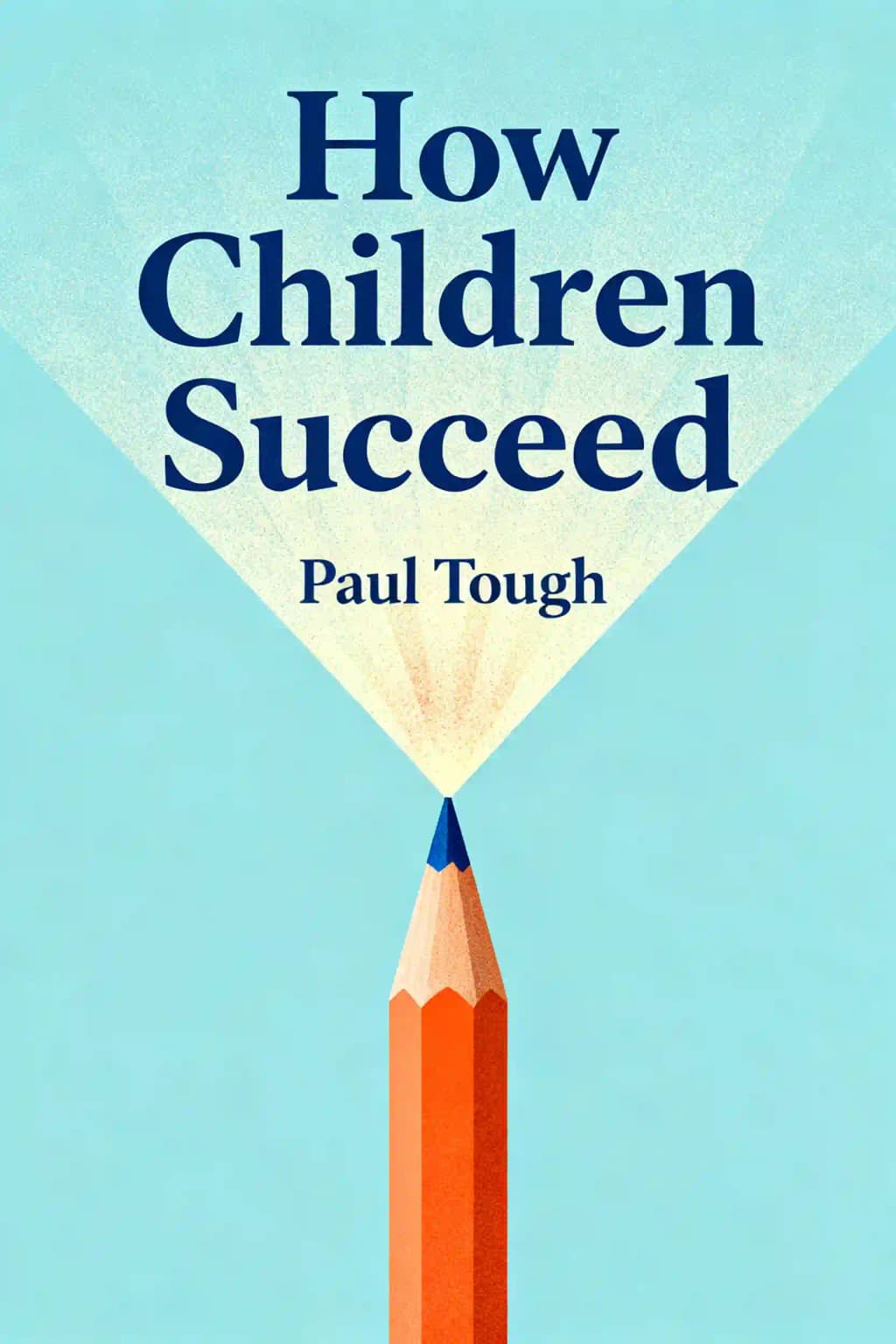
Paul Tough's groundbreaking bestseller challenges conventional wisdom: grit and character - not just IQ - determine success. Translated into 27 languages, it's transformed educational policies worldwide by revealing how adversity shapes resilience. What childhood experience is secretly determining your future?
Paul Tough is the New York Times bestselling author of How Children Succeed: Grit, Curiosity, and the Hidden Power of Character, a groundbreaking exploration of non-cognitive skills in education and child development. A Canadian-American journalist and former editor at Harper’s Magazine and The New York Times Magazine, Tough combines decades of reporting on poverty, parenting, and education reform with insights from neuroscience and psychology.
His earlier work, Whatever It Takes: Geoffrey Canada’s Quest to Change Harlem and America, chronicles innovative approaches to closing the achievement gap, while his later book The Inequality Machine examines systemic barriers in higher education.
Tough’s expertise is frequently showcased in high-profile platforms, including MSNBC’s Morning Joe, the Aspen Ideas Festival, and NPR’s This American Life, where he served as a senior editor. His research-driven yet accessible style has made How Children Succeed a global phenomenon, translated into 27 languages and widely cited by educators and policymakers. Based in Austin, Texas, Tough continues to advocate for equity in education through his writing and speaking engagements.
How Children Succeed by Paul Tough challenges the traditional focus on cognitive skills like test scores, arguing that character traits such as grit, curiosity, and resilience are better predictors of long-term success. The book combines neuroscience, economics, and real-world examples to show how overcoming adversity and fostering noncognitive skills shape achievement.
Parents, educators, and policymakers seeking evidence-based strategies to support child development will benefit from this book. It’s particularly relevant for those interested in poverty, education reform, or the science of resilience and character-building.
Yes, for its groundbreaking insights into noncognitive skills and actionable research on fostering resilience. Critics praise its blend of storytelling and data, though some note its narrow focus on academic success over broader life outcomes.
Paul Tough emphasizes grit (perseverance), self-control, curiosity, optimism, and social intelligence. These traits, developed through adversity and mentorship, are shown to outperform IQ in predicting academic and life success.
Early adversity (e.g., poverty, trauma) can hinder development, but supportive relationships and character-building interventions help children reframe challenges into growth opportunities. Tough cites studies linking “managed stress” to improved resilience and problem-solving.
Both stress the importance of growth-oriented attitudes, but Tough focuses on systemic factors like poverty and trauma, while Dweck emphasizes individual mindset shifts. The books complement each other on fostering resilience.
These highlight the book’s focus on perseverance and experiential learning.
Some argue it overemphasizes school-based success metrics and underestimates systemic barriers like underfunded schools. Others note limited practical guidance for implementing character education at scale.
Schools like KIPP and Ascend integrate character report cards, mindfulness practices, and community service to build traits like responsibility and empathy. Tough argues these environments level the playing field for disadvantaged students.
Paul Tough is a journalist specializing in education, poverty, and child development. His work for The New York Times Magazine and books like Helping Children Succeed cement his expertise in evidence-based policy and pedagogy.
Erlebe das Buch durch die Stimme des Autors
Verwandle Wissen in fesselnde, beispielreiche Erkenntnisse
Erfasse Schlüsselideen blitzschnell für effektives Lernen
Genieße das Buch auf unterhaltsame und ansprechende Weise
Character might be the missing ingredient in America's recipe for success.
The GED had inadvertently become, "a test that separates bright but nonpersistent and undisciplined dropouts from other dropouts."
The problem isn't stress itself but the body's reaction to it.
Zerlegen Sie die Kernideen von How Children Succeed in leicht verständliche Punkte, um zu verstehen, wie innovative Teams kreieren, zusammenarbeiten und wachsen.
Destillieren Sie How Children Succeed in schnelle Gedächtnisstützen, die die Schlüsselprinzipien von Offenheit, Teamarbeit und kreativer Resilienz hervorheben.

Erleben Sie How Children Succeed durch lebhafte Erzählungen, die Innovationslektionen in unvergessliche und anwendbare Momente verwandeln.
Fragen Sie alles, wählen Sie die Stimme und erschaffen Sie gemeinsam Erkenntnisse, die wirklich bei Ihnen ankommen.

Von Columbia University Alumni in San Francisco entwickelt
"Instead of endless scrolling, I just hit play on BeFreed. It saves me so much time."
"I never knew where to start with nonfiction—BeFreed’s book lists turned into podcasts gave me a clear path."
"Perfect balance between learning and entertainment. Finished ‘Thinking, Fast and Slow’ on my commute this week."
"Crazy how much I learned while walking the dog. BeFreed = small habits → big gains."
"Reading used to feel like a chore. Now it’s just part of my lifestyle."
"Feels effortless compared to reading. I’ve finished 6 books this month already."
"BeFreed turned my guilty doomscrolling into something that feels productive and inspiring."
"BeFreed turned my commute into learning time. 20-min podcasts are perfect for finishing books I never had time for."
"BeFreed replaced my podcast queue. Imagine Spotify for books — that’s it. 🙌"
"It is great for me to learn something from the book without reading it."
"The themed book list podcasts help me connect ideas across authors—like a guided audio journey."
"Makes me feel smarter every time before going to work"
Von Columbia University Alumni in San Francisco entwickelt

Erhalten Sie die How Children Succeed-Zusammenfassung als kostenloses PDF oder EPUB. Drucken Sie es aus oder lesen Sie es jederzeit offline.
Picture a prekindergarten classroom in New Jersey where something extraordinary is happening. No teacher is barking commands. No children are acting out. Instead, four-year-olds are calmly organizing their thoughts, controlling their impulses, and staying focused on tasks - all without traditional discipline. This isn't magic. It's the Tools of the Mind curriculum, designed to develop self-regulation rather than drill ABCs and 123s. When Paul Tough witnessed this scene shortly after his son's birth, it shattered his assumptions about early childhood education. America has spent decades obsessing over the "cognitive hypothesis" - the belief that success depends primarily on measurable intelligence. We've built entire industries around "brain-building" products, shaped education policy around test scores, and convinced ourselves that stuffing information into young minds is the path to prosperity. But what if we've been wrong all along? What if the secret ingredient isn't cognitive horsepower but something far more fundamental - character? Nobel laureate James Heckman stumbled upon a paradox that would revolutionize our understanding of success. In the late 1990s, he examined the GED program, which by 2001 was producing nearly one in five new high school "graduates." The logic seemed airtight: if someone could pass a comprehensive equivalency test, they should be academically equal to traditional graduates. But Heckman's data told a different story - a disturbing one. GED recipients demonstrated cognitive abilities matching high school graduates on standardized tests, yet their life trajectories looked nothing alike. At age twenty-two, only 3 percent of GED holders were enrolled in four-year universities compared to 46 percent of traditional graduates. More troubling still, GED holders showed patterns eerily similar to high school dropouts - comparable unemployment rates, similar incomes, equivalent divorce rates, and parallel substance abuse patterns - despite being demonstrably smarter. The missing element? Psychological traits that enabled persistence: delaying gratification, maintaining focus on long-term goals, following through on commitments, adapting to social environments, and managing stress.