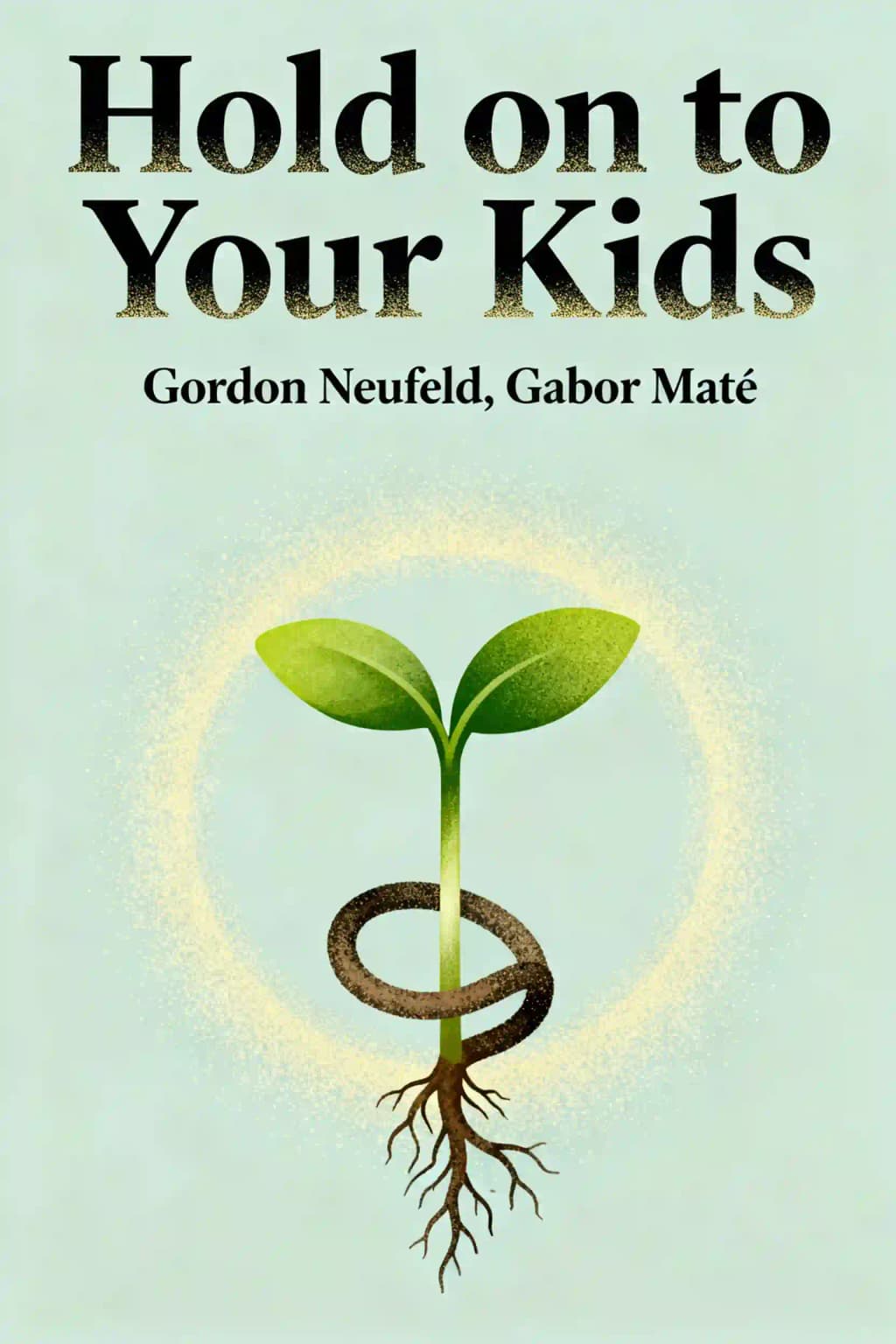
In "Hold On to Your Kids," renowned doctors Neufeld and Mate reveal why children's peer orientation threatens healthy development. Winner of the National Parenting Gold Award, this revolutionary book - endorsed by Dr. Mary Pipher - shows how reclaiming parental influence can transform your child's emotional wellbeing.
Gordon Neufeld, Ph.D., is a Vancouver-based developmental and clinical psychologist and co-author of the parenting classic Hold On to Your Kids: Why Parents Need to Matter More Than Peers.
A pioneer in attachment theory, Neufeld founded the Neufeld Institute to advance his relational developmental approach to child rearing. His 50+ years of clinical work and academic research inform the book’s exploration of peer orientation’s dangers and parental attachment’s neurological foundations. The work has been endorsed by thought leaders like poet Robert Bly, who called it “a brilliant book on the level of Paul Goodman’s Growing Up Absurd.”
Gabor Maté, M.D., is a Hungarian-Canadian physician and bestselling co-author of Hold On to Your Kids, known for his trauma-informed approach to human behavior. His body of work—including In the Realm of Hungry Ghosts (winner of the Hubert Evans Prize) and The Myth of Normal—bridges medicine, psychology, and social critique.
As a palliative care specialist and columnist for The Globe and Mail, Maté brings clinical insights about stress and childhood development to this parenting manifesto. Translated into 15+ languages, their collaborative work remains a foundational text recommended by mental health professionals worldwide.
Hold On to Your Kids by Gordon Neufeld and Gabor Maté explores how peer orientation—children prioritizing peer relationships over parental bonds—undermines healthy development. It emphasizes restoring parent-child attachment to foster emotional security, counteracting modern challenges like technology and peer-driven culture. The book provides strategies to reclaim parental influence through connection rather than behavior control.
This book is essential for parents, caregivers, and educators navigating challenges like screen addiction, disrespectful behavior, or emotional detachment in children. It’s particularly valuable for those seeking science-backed methods to strengthen family bonds and address the root causes of peer-oriented behavior.
Yes. The book offers timeless insights into restoring parental authority in an age where peers and technology dominate children’s lives. Its blend of developmental psychology, real-world examples, and actionable strategies makes it a critical resource for fostering resilient, emotionally secure kids.
Peer orientation occurs when children prioritize relationships with peers over parental attachments, leading to aggression, emotional detachment, and reduced teachability. The authors link this trend to societal shifts like digital saturation and loss of community, urging parents to rebuild attachment bonds to counteract its effects.
The book advocates "attachment villages"—networks of trusted adults—to supplement parental bonds. It also advises prioritizing connection over correction, avoiding punitive measures like time-outs, and offering unconditional acceptance even during conflicts.
Counterwill is a child’s instinctive resistance to control, often triggered by peer orientation. The book explains how understanding this response helps parents reduce power struggles by focusing on relationship-building rather than enforcing compliance.
These quotes underscore the book’s focus on preserving connection during conflicts, rather than prioritizing discipline.
While not anti-technology, the book highlights how screens accelerate peer orientation by displacing family time. It encourages intentional tech boundaries to protect parent-child interactions and emotional availability.
Some note the book leans heavily on theory over step-by-step solutions. However, its principles are widely praised for reframing behavioral issues as attachment opportunities, offering a foundational approach adaptable to individual families.
Unlike behavior-focused guides (e.g., 1-2-3 Magic), Neufeld and Maté prioritize relational depth over quick fixes. It aligns with attachment parenting philosophies but uniquely addresses modern peer culture’s systemic impact.
Rising screen time, social media use, and fragmented family structures make peer orientation more prevalent. The 2024 updated edition includes fresh strategies for digital-age challenges, reinforcing its urgency for today’s parents.
Yes. The principles apply to any age—repairing strained relationships requires restoring trust and emotional availability. The book advises parents to lead reattachment efforts, even if children initially resist.
Erlebe das Buch durch die Stimme des Autors
Verwandle Wissen in fesselnde, beispielreiche Erkenntnisse
Erfasse Schlüsselideen blitzschnell für effektives Lernen
Genieße das Buch auf unterhaltsame und ansprechende Weise
Parents matter more than ever precisely because culture no longer guides children toward genuine maturity.
For the first time in history, young people are turning for guidance not to parents...but to other immature children.
Without this psychological umbilical cord, parenting skills and even love cannot get through.
Children cannot simultaneously orient to both adults and peers when their values conflict.
Our society no longer serves children's developmental needs.
Zerlegen Sie die Kernideen von Hold on to Your Kids in leicht verständliche Punkte, um zu verstehen, wie innovative Teams kreieren, zusammenarbeiten und wachsen.
Erleben Sie Hold on to Your Kids durch lebhafte Erzählungen, die Innovationslektionen in unvergessliche und anwendbare Momente verwandeln.
Fragen Sie alles, wählen Sie Ihren Lernstil und gestalten Sie Erkenntnisse, die wirklich zu Ihnen passen.

Von Columbia University Alumni in San Francisco entwickelt
"Instead of endless scrolling, I just hit play on BeFreed. It saves me so much time."
"I never knew where to start with nonfiction—BeFreed’s book lists turned into podcasts gave me a clear path."
"Perfect balance between learning and entertainment. Finished ‘Thinking, Fast and Slow’ on my commute this week."
"Crazy how much I learned while walking the dog. BeFreed = small habits → big gains."
"Reading used to feel like a chore. Now it’s just part of my lifestyle."
"Feels effortless compared to reading. I’ve finished 6 books this month already."
"BeFreed turned my guilty doomscrolling into something that feels productive and inspiring."
"BeFreed turned my commute into learning time. 20-min podcasts are perfect for finishing books I never had time for."
"BeFreed replaced my podcast queue. Imagine Spotify for books — that’s it. 🙌"
"It is great for me to learn something from the book without reading it."
"The themed book list podcasts help me connect ideas across authors—like a guided audio journey."
"Makes me feel smarter every time before going to work"
Von Columbia University Alumni in San Francisco entwickelt

Erhalten Sie die Hold on to Your Kids-Zusammenfassung als kostenloses PDF oder EPUB. Drucken Sie es aus oder lesen Sie es jederzeit offline.
Something has shifted in the landscape of childhood, and most of us sense it without quite understanding what's changed. Parents who love their children deeply find themselves locked in daily battles over homework, screen time, and basic respect. Teachers watch students tune out their guidance while obsessing over what their friends think. We've blamed technology, permissive parenting, or some mysterious character flaw in modern youth. But the real culprit is far more fundamental: children are raising each other. For the first time in human history, young people are turning to other young people-not parents, teachers, or caring adults-as their primary source of orientation, values, and identity. This phenomenon, called peer orientation, has quietly eroded the natural attachment bonds that made parenting work for millennia. It's not that we love our children less or know less about parenting techniques. The ground itself has shifted beneath our feet. Think about twelve-year-old Jeremy, locked in daily combat with his father over computer time, choosing online chats with friends over homework and family dinners. His parents feel helpless, their guidance bouncing off him like rain off glass. What's happening here isn't a discipline problem or a phase-it's an attachment crisis. Children come into the world with an orienting instinct as powerful as a duckling's imprint. They need someone to follow, someone to show them how the world works. When that someone is a mature, caring adult, development unfolds naturally. But children's attachment systems don't discriminate between adults and peers. They'll orient to whoever is most present, most emotionally available, most compelling. The brain can only follow one compass at a time. When peers become that compass, everything changes.
Attachment unfolds through six distinct levels, each revealing why peer relationships consume children yet remain inadequate. First comes proximity-seeking-the endless hangouts that feel essential but lack substance. Second is sameness-the drive to look alike, talk alike, dress alike. When fourteen-year-old Cynthia suddenly adopted her friends' speech patterns and fashion while rejecting her parents' values, she wasn't being difficult. She was maintaining psychological closeness through imitation. Third comes belonging and loyalty-the fierce possessiveness over "best friends" and secret-keeping that excludes adults. Fourth is significance-the desperate need to matter, making peer-oriented children devastatingly vulnerable to rejection. Fifth is emotional intimacy, though peer-oriented kids typically defend against this because peers can't provide the safety true vulnerability requires. Sixth is being known-sharing one's authentic self, a depth peer-oriented children rarely reach despite constant communication. When peers become primary attachments, these mechanisms that should connect children to wise adults instead chain them to other immature beings. Throughout human evolution, culture flowed vertically from generation to generation. Today, culture flows horizontally among age-mates-the blind leading the blind.
This attachment crisis stems from massive cultural breakdown, not individual parental failure. Economic pressures push both parents into full-time work, placing children in institutional settings where they spend more waking hours with peers than caring adults. Extended families have vanished, eliminating grandparents who once provided unconditional acceptance. Mobility uproots families from communities. The average working parent today has less than half the free time their 1935 counterpart enjoyed. Most devastatingly, we've lost cultural customs that naturally wove children into relationships with caring adults. Traditional societies had built-in mechanisms - multi-generational gatherings, apprenticeships, community rituals - that kept children oriented toward maturity. These have been replaced by commercially packaged entertainment broadcast directly to youth, bypassing adults entirely. Consider the village of Rognes in Provence, where children and adults still greet each other, where festivals bring generations together. This isn't conscious parenting philosophy - it's culture doing its job. We've lost that protective fabric, leaving each family to fight peer orientation alone. The ultimate ethic of peer culture is "cool" - complete emotional detachment projected as eerie invulnerability.
When seven-year-old Kirsten transformed from affectionate daughter to defiant child overnight, her parents tried threats, punishments, time-outs, and reward charts. Nothing worked. Here's what they missed: parenting isn't supposed to require force. Parenting power flows from the child's dependence specifically on us. When children transfer their dependency to peers, parents lose the invisible authority that made parenting manageable. What looks like independence is actually dependence redirected - the peer-oriented child remains just as dependent, but now on other children who lack the maturity, wisdom, or commitment to guide them safely. Peer-oriented parents also face counterwill - the instinctive resistance to being controlled. This force explains why pressure reduces compliance, why homework requests trigger defiance, why reasonable expectations feel intolerable. When children feel connected to us, counterwill softens. Our expectations seem reasonable because they come from someone they trust. But when attachment breaks, every directive feels like coercion. Peer-oriented children define themselves by "not letting anyone push us around" - especially not parents.
When peers replace parents as attachment figures, children lose their natural shield against emotional wounds. Attachment divides the world into those who can hurt you and those who can't. When peers become primary attachments, every careless comment lands with devastating force. The problem: children interact carelessly by nature, lacking the developmental capacity for empathy that makes relationships safe. Research shows peer rejection as shattering, but the real culprit isn't rejection itself - it's the attachment void that makes children catastrophically vulnerable to it. In peer groups, vulnerability gets attacked by those already emotionally hardened. Tears invite ridicule, fear provokes taunts, tenderness results in teasing. When vulnerability becomes the enemy, children shut down their capacity to feel, sacrificing emotional aliveness to survive peer culture. This explains the epidemic of "cool" - defensive detachment masquerading as confidence - and rising youth substance abuse: drugs serve as emotional anesthesia for the unbearably vulnerable and artificial stimulation for the emotionally dead. Some children merely hide vulnerability, but others have genuinely lost access to their feelings - an emotional shutdown resembling trauma victims. Since this book's publication, the digital revolution has turbocharged peer orientation. The typical teen now sends thousands of texts monthly and spends ten hours daily with technology. Digital devices were designed for information and business, but humans are wired for connection.
To reclaim our role, we must actively "collect" our children-drawing them close through warm engagement: eye contact, smiles, and physical proximity. This ritual should happen multiple times daily, especially after separations. When we greet children with genuine delight, we signal they belong with us, not their peers. Modern life fragments families through schedules, activities, and devices. We must intentionally create connection rituals: family meals without screens, bedtime routines with undivided attention, weekend traditions prioritizing togetherness. These moments are essential for maintaining children's orientation toward us. When peer attachment has taken hold, restoration requires patience. We can't demand attention-we must become more compelling than peers. This means one-on-one time doing activities they enjoy, showing interest in their world without judgment, and being emotionally available when they're ready. As we consistently demonstrate we're their safe harbor, children naturally reorient toward us-not through force, but because attachment seeks the most nurturing relationship available.
Natural discipline follows a simple principle: connection before direction. Collect the child emotionally before providing guidance. When problems occur, work the relationship, not the incident. During upsets, children are dysregulated and parents reactive - the worst teaching moment. Stop harmful behavior if necessary, then preserve attachment. When things aren't working, draw out tears of futility rather than lecturing. Life lessons come through adaptation when children realize something won't work and can't be changed. Be both agent of futility, presenting unchangeable reality firmly, and angel of comfort, helping them move from frustration to sadness to acceptance. Solicit good intentions instead of demanding good behavior - put children's hands on their own steering wheel. Self-control comes from conflicting impulses canceling each other out, not forced restraint. Create rituals that collect children's eyes, smiles, and nods - before school, after school, during meals, before bed. Protect digital-free zones: mealtimes, family times, evenings, bedtimes. In a world engineered to separate children from parents, holding onto our kids requires fierce intentionality. When we hold onto them with connection, not control, we give them the one thing that makes everything else possible: a safe base from which to grow.