Kapitel 1
The Illusion We Cannot Abandon
Imagine waking up tomorrow to discover that your most cherished belief about yourself is scientifically proven false. Not just questionable-completely, irrefutably wrong. This is precisely what neuroscientist Sam Harris argues has already happened with free will. The notion that we author our own thoughts and actions-that cornerstone of human identity-is, according to Harris, nothing but a persistent illusion. His slim yet profound book "Free Will" has become something of a philosophical hand grenade since its publication, with figures from Robert Sapolsky to Yuval Noah Harari citing its influence on their thinking. Despite being just 66 pages, it has sparked heated debates in academic circles and beyond, challenging our most fundamental assumptions about choice, morality, and human agency. What makes Harris's argument so compelling-and disturbing-is how it forces us to confront the uncomfortable reality that the conscious self we identify with is more passenger than driver in the journey of our lives.
Kapitel 2
The Ghost Behind Our Actions
What does it mean to have free will? Most of us intuitively believe we are the conscious authors of our thoughts and actions-that when we deliberate and choose, we could genuinely have chosen otherwise. This cherished notion permeates everything distinctly human: our moral judgments, legal systems, political ideologies, religious beliefs, personal relationships, and sense of achievement. From criminal justice to personal accountability, the assumption of free will forms the bedrock of how we structure society and understand human behavior.
Consider your last significant decision. Perhaps you deliberated between job offers, weighed the salary, location, and growth potential of each position. Or maybe it was something simpler, like choosing what to eat for breakfast this morning - weighing the health benefits of oatmeal against the immediate pleasure of pancakes. You likely felt you were carefully evaluating options, considering consequences, and ultimately making a choice that originated within your conscious mind. This experience feels so compelling that most people refuse to abandon it, even when confronted with evidence to the contrary. The sensation of agency is so fundamental to our experience that questioning it feels like questioning reality itself.
But Harris asks us to look deeper, beyond this intuitive sense of authorship. Where did your thoughts about those options come from? Did you choose to have these specific considerations rather than others? Did you consciously decide to care more about salary than location, or health than taste? Did you create the desires that influenced your decision? When we examine our experience closely, we discover something unsettling: thoughts simply appear in consciousness, like actors walking onto a stage. We don't know what we'll think next until the thought arrives, fully formed in our awareness.
Take this simple exercise: think of a city anywhere in the world. Got one? Now ask yourself: why that particular city? Perhaps associations come to mind-you vacationed there, saw it in a movie, or read about it recently. Some cities might feel more familiar due to media exposure, others might connect to emotional memories or future aspirations. But did you consciously create those associations? Did you choose to have them influence your thinking? Did you select which memories would surface? The honest answer is no. The city emerged in your consciousness through neural processes you neither initiated nor controlled.
This pattern holds for all thoughts, from the mundane to the profound. Whether we're choosing lunch, making career decisions, or contemplating philosophical questions, we don't author our thoughts; we witness them arising in consciousness. And if we don't create our thoughts - if they simply appear based on factors outside our conscious control - how can we claim authorship of the actions that flow from them? As Harris puts it: "You can do what you decide to do-but you cannot decide what you will decide to do." This insight challenges our fundamental assumptions about human agency and raises profound questions about responsibility, morality, and the nature of consciousness itself.
Kapitel 3
The Science of Predetermined Choices
The scientific evidence against free will is compelling and grows stronger each year, supported by multiple groundbreaking studies across different methodologies. In the 1980s, neurophysiologist Benjamin Libet conducted pioneering experiments showing that brain activity associated with movement (the "readiness potential") began approximately 300 milliseconds before subjects became consciously aware of their decision to move. This discovery was revolutionary, as it was the first empirical demonstration that neural activity preceded conscious awareness of decisions.
More recent fMRI studies by John-Dylan Haynes and colleagues have extended this timeline dramatically, finding that certain brain regions contain information about which button a person will press 7-10 seconds before they become consciously aware of their decision. Their research utilized advanced pattern recognition algorithms to analyze brain activity in the frontopolar cortex, precuneus, and other regions, demonstrating that decision-making processes begin far earlier than previously thought.
Even more striking, Itzhak Fried and his team at UCLA used direct recordings from single neurons to predict with 80% accuracy which button subjects would press nearly a full second before they consciously decided. These findings were particularly significant because they used invasive recordings from electrodes implanted in epilepsy patients, providing unprecedented precision in measuring neural activity. The team identified specific neurons in the supplementary motor area and anterior cingulate that became active before conscious awareness emerged.
Consider what this means in everyday life: When you "decide" to reach for your coffee cup, pick up your phone, or respond to an email, your brain has already set these actions in motion before you become aware of your intention. Your conscious experience of choosing is more like receiving a memo about a decision that's already been made than actually making the decision. This applies not just to simple motor actions but to more complex decisions as well.
Harris proposes a thought experiment to illustrate this point: Imagine neuroscientists developed perfect brain imaging technology that allowed them to predict your every thought and action before you experienced them. They could tell you what you'll think and do next, consistently proving correct. Even in this scenario, you would still feel the subjective sense of freedom in each moment-you would still feel like you were making choices. This reveals that our feeling of free will persists even when demonstrably illusory.
Recent studies in cognitive neuroscience have further reinforced these findings. Research using transcranial magnetic stimulation has shown that disrupting activity in certain brain regions can alter decision-making processes before conscious awareness, while studies of split-brain patients reveal how the mind constructs post-hoc rationalizations for actions initiated unconsciously.
The uncomfortable truth is that we are not the conscious authors of our actions that we believe ourselves to be. Our thoughts and intentions emerge from background causes of which we are unaware and over which we exert no conscious control. The freedom we think we have is, in Harris's words, "actually the freedom to do what we want, not the freedom to want what we want." This distinction is crucial: while we can act according to our desires, we don't choose the desires themselves or the neural processes that give rise to them.
Kapitel 4
The Philosophical Quagmire
Philosophers have wrestled with the free will problem for centuries, generally falling into three camps: determinists, libertarians, and compatibilists. Determinists accept that all events, including human decisions, result from prior causes. Libertarians (not the political position) argue that humans possess some form of metaphysical agency that transcends causation-often invoking souls or other supernatural entities. Compatibilists maintain that free will and determinism can coexist by redefining what "free will" means.
Today, compatibilism represents the most philosophically respectable defense of free will, since determinism is demonstrably true regarding human behavior. But Harris argues that the "free will" compatibilists defend bears little resemblance to what most people believe they possess.
Compatibilists define freedom as acting according to one's desires without external constraint. If you want ice cream and no one stops you from having it, your eating ice cream demonstrates free will. But this definition sidesteps the deeper question: Where did your desire for ice cream come from? Did you choose to want ice cream rather than cake? Did you create the neural circuitry that generates your preferences?
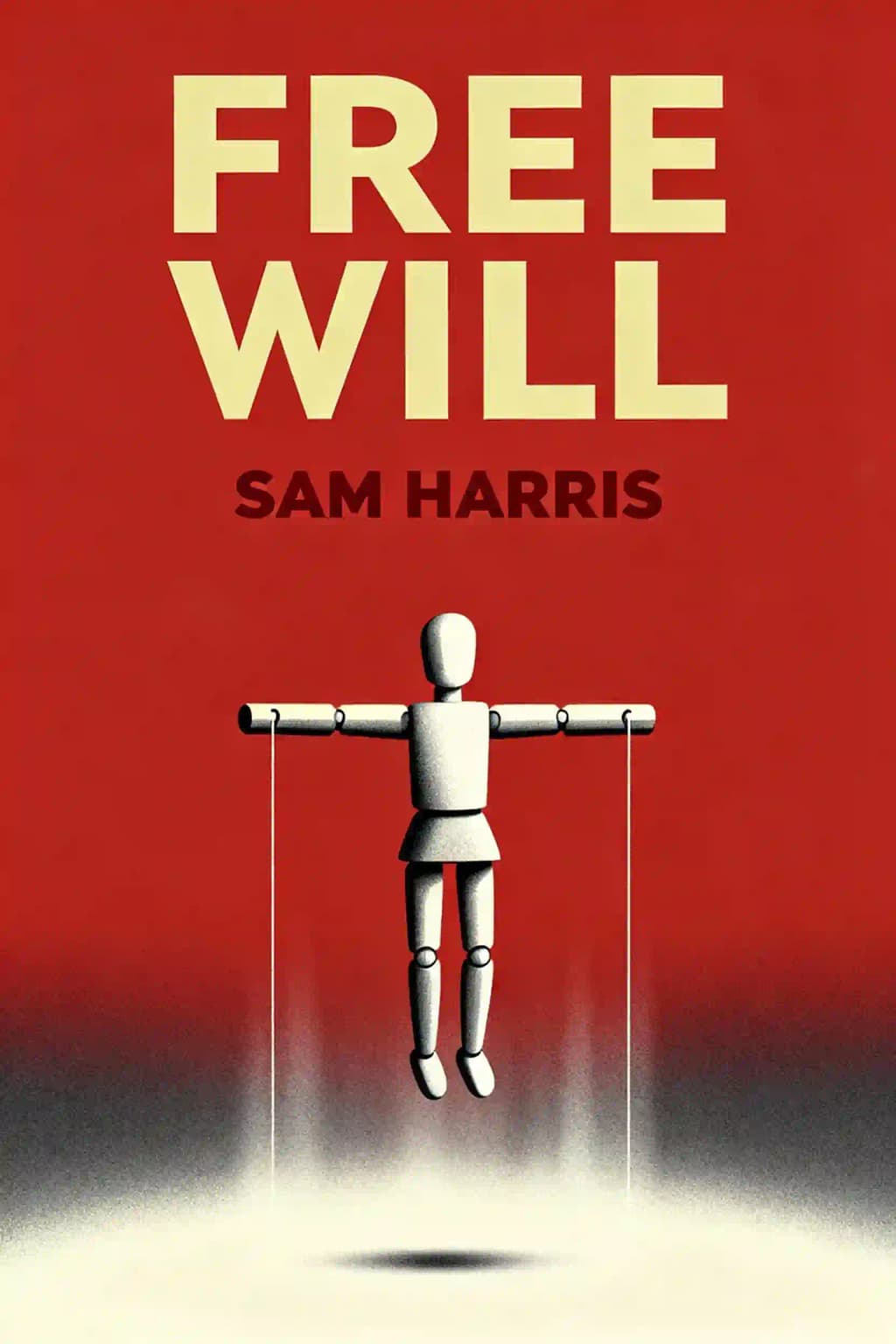
Harris uses a powerful analogy to illustrate the problem with compatibilism: "A puppet is free as long as he loves his strings." If your desires, thoughts, and intentions arise from causes beyond your control-your genes, neurophysiology, childhood experiences, cultural conditioning-then claiming you act "freely" when following these predetermined desires is a semantic sleight of hand.
Daniel Dennett and other compatibilists counter that our unconsciously caused thoughts are still our thoughts-our neurophysiology is as much "us" as our conscious awareness. But Harris identifies this as a bait-and-switch. People identify with the conscious stream of information in their minds, not with unconscious processes. We don't feel responsible for producing red blood cells or hosting gut bacteria, though these processes occur within our bodies. The psychological truth that drives our moral intuitions is the feeling of conscious authorship-precisely what science shows to be illusory.
Even more troubling, experiments demonstrate how easily this sense of agency can be manipulated. People can be led to believe they intentionally performed actions they didn't control, revealing our attribution of agency can be gravely mistaken. Our intuitions about free will don't just conflict with science-they're internally incoherent.
Kapitel 5
The Quantum Escape Hatch
Some scientists and philosophers hope quantum indeterminacy might create room for free will by introducing genuine randomness into brain function. If quantum effects influence neural activity, perhaps our decisions aren't entirely predetermined by prior causes. This quantum interpretation has attracted notable physicists like Roger Penrose and philosophers seeking to reconcile free will with modern physics. However, Harris systematically dismantles this proposed escape route from determinism.
Imagine your decision to order coffee instead of tea resulted from random quantum fluctuations triggering certain neurotransmitter releases. How could this indeterminacy represent freedom? Random events are precisely those for which you can claim no responsibility. A mind governed entirely by random "self-generated" events would be incoherent-you'd be merely "blown about by an internal wind." If quantum randomness determined whether you helped someone in need or walked away, how could you be morally responsible for that choice? The randomness would make the decision less free, not more.
Moreover, quantum effects, while possibly relevant to evolution through point mutations, are unlikely to be biologically significant in normal brain function. The warm, wet environment of the brain causes quantum decoherence, meaning quantum indeterminacy gets amplified into classical, deterministic physics at the cellular level. Neuroscientists have found that neurons operate primarily through classical mechanisms - ion channels, action potentials, and neurotransmitter release - that don't require quantum effects to explain their function. Even if quantum events occasionally influence neural firing, these would be rare exceptions rather than the basis for decision-making.
The dilemma is inescapable: Either our decisions are determined by prior causes we didn't create, or they involve an element of chance we also didn't create. Neither option provides the kind of freedom people believe they possess. Whether through strict determinism or quantum indeterminacy, there's no combination of physical truths compatible with the popular notion of free will. Adding randomness to a deterministic system doesn't create genuine agency or moral responsibility - it merely makes behavior less predictable and less connected to our conscious intentions.
This quantum "escape hatch" ultimately fails because it misunderstands what we mean by free will. People want their decisions to flow from their conscious reasoning and authentic values, not from random physical events beyond their control. The quantum proposal replaces casual determination with chance, but neither provides the kind of self-authored choice that free will requires.
Kapitel 6
The Moral Landscape Without Free Will
If free will is illusory, what happens to morality? Many worry that abandoning belief in free will could undermine our ethical foundations. Indeed, studies show that reading arguments against free will makes people more likely to cheat and behave aggressively in laboratory settings. But Harris argues that recognizing the truth about free will should enhance our ethics, not diminish them.
Consider two cases: In the first, a four-year-old accidentally shoots someone while playing with a gun. In the second, an adult with a brain tumor kills someone "for fun." In the third, a neurologically typical adult commits murder during a robbery. Our moral intuitions treat these cases differently-but why? The causal chain remains the same in all three cases: a brain caused movements that resulted in death. What changes is our understanding of the mind behind the actions.
We condemn conscious intention to harm because it reflects dangerous properties of a person's mind. Even without free will, we can recognize that some individuals pose threats while acknowledging they're ultimately victims of biology and circumstance-unlucky in their genes, upbringing, or environment.
This perspective transforms how we view both praise and blame. The brilliant musician didn't choose her perfect pitch or disciplined mind that enabled thousands of hours of practice. The violent criminal didn't choose his impulsivity, lack of empathy, or abusive childhood. Both are products of causes they didn't create or control.
Harris suggests this understanding should shift our justice system from retribution toward rehabilitation and protection. We can hold people responsible-in the sense that their actions reflect their mental states-without holding them ultimately responsible for being who they are. A justice system without free will would focus on deterrence, rehabilitation, and protecting society rather than punishment based on metaphysical desert.
Paradoxically, Harris reports that losing his belief in free will increased his compassion and decreased feelings of hatred and resentment. When we recognize that people's actions flow from a vast causal web beyond their control, it becomes impossible to hate them in quite the same way. We can condemn harmful behaviors while understanding that, given identical circumstances, we would have acted identically.
Kapitel 7
The Political Dimension of Determinism
The illusion of free will has profound political implications that shape contemporary policy debates and social attitudes. Conservatives often emphasize personal responsibility and individual choice, viewing success or failure as direct results of personal decisions. In contrast, liberals typically recognize the role of luck and circumstance in shaping lives, advocating for systemic solutions to social problems. These different perspectives inform policy debates about everything from taxation and welfare programs to criminal justice reform and educational funding.
Every "self-made" person depends on background conditions they didn't choose-their genome, birthplace, and prevailing socioeconomic circumstances. A successful entrepreneur might credit their work ethic, but that very drive stems from genetic predispositions and environmental influences. Even the capacity for hard work is an inheritance, not a choice. Laziness and diligence are neurological conditions shaped by genetics, upbringing, and circumstances, not moral achievements. The executive who works 80-hour weeks may have inherited genes predisposing them to high energy and ambition, while growing up in an environment that reinforced these traits.
Consider two children: one born to wealthy parents who prioritize education, provide enrichment activities, and live in a safe neighborhood with excellent schools. The other born to impoverished, drug-addicted parents in a violent neighborhood with underfunded schools and few positive role models. Both will make "choices" throughout their lives, but these choices emerge from brains shaped by radically different environments. The privileged child doesn't deserve credit for her fortunate circumstances any more than the disadvantaged child deserves blame for his. Their divergent paths reflect luck in the cosmic lottery of birth rather than moral merit.
This deterministic view doesn't mean we should abandon incentives or personal responsibility. Society can acknowledge that people respond to rewards and punishments while recognizing these responses are determined by factors beyond their control. A criminal justice system, for instance, can focus on deterrence and rehabilitation rather than retributive punishment. We can hold people accountable precisely to the degree it proves useful for shaping behavior and protecting society, not because they "deserve" praise or blame in some metaphysical sense.
Harris argues that abandoning the illusion of free will should lead to more compassionate and pragmatic social policies. If success and failure result largely from luck rather than metaphysical choice, extreme inequality becomes harder to justify morally. A society that recognizes the role of fortune in human affairs might invest more in early childhood education, mental health services, and poverty reduction programs. This perspective suggests creating conditions where everyone has genuine opportunities to flourish, rather than simply blaming individuals for their circumstances. Progressive taxation, universal healthcare, and other social programs become easier to justify when we acknowledge the arbitrary nature of our starting positions in life.
Kapitel 8
Living Without the Illusion
What would it mean to live without the illusion of free will? Many fear such awareness would be paralyzing-if everything is determined, why do anything? But this confuses determinism with fatalism. Your choices still matter tremendously as causal states of the brain leading to specific behaviors and outcomes. Harris's decision to write his book was unquestionably why it exists. These choices arise from prior causes that the conscious witness did not create, but they remain causally effective. For instance, your decision to exercise, though determined by various factors like upbringing and knowledge about health, still directly impacts your wellbeing.
Harris suggests that recognizing the illusory nature of free will can be liberating. When we stop identifying so strongly with our thoughts-seeing them as things that happen to us rather than things we author-we create psychological distance from negative mental states. Realizing that an angry thought simply appeared in consciousness makes it easier to let it go rather than acting on it. Consider road rage: rather than getting caught up in anger at another driver, you can observe the emotion arise and dissipate without letting it control your actions.
This perspective aligns with contemplative traditions that emphasize mindfulness and non-identification with thoughts. Buddhist meditation practices, for instance, train practitioners to observe thoughts arising and passing without attachment-an empirical recognition that we don't create our thoughts but merely witness them. The Vipassana tradition specifically teaches practitioners to observe sensations and thoughts as passing phenomena, much like watching clouds move across the sky. This detachment from thoughts reduces suffering and enables clearer decision-making.
Paradoxically, this awareness can increase our sense of control. Understanding the background causes of our mental states-like realizing irritability stems from low blood sugar-allows us to exercise more creative influence over our lives. We remain biochemical puppets, but with awareness, we can grab hold of some of our strings. For example, knowing that lack of sleep affects your judgment might lead you to postpone important decisions until you're well-rested, or understanding that social media triggers anxiety might prompt you to limit your exposure.
The truth about free will doesn't undermine the distinction between voluntary and involuntary actions. Some mental states arise automatically while others involve deliberation. When a leaf blower sounds outside your window, the perception simply happens to you, but you can redirect your attention elsewhere. This act of directing feels different-like something you're doing rather than something happening to you. These different experiences reflect different brain systems at work, creating the feeling of a conscious self with freedom of will. Consider how you can't choose to not hear the leaf blower, but you can choose to focus on your work instead, or how you can't prevent thoughts of food when hungry but can decide whether to act on those impulses.
This understanding can lead to greater compassion, both for ourselves and others. Recognizing that people's actions arise from countless prior causes beyond their control - their genes, upbringing, circumstances - helps reduce blame and hatred while maintaining accountability and the necessity of practical consequences for harmful actions.
Kapitel 9
The Illusion of an Illusion
Harris concludes with a striking claim: "The illusion of free will is itself an illusion." It's not merely that free will doesn't exist-our experience itself doesn't support the concept when examined closely. The problem isn't just that free will makes no sense objectively; it makes no sense subjectively either.
Try this experiment: Sit quietly for a few minutes and pay close attention to the next thought that arises in your mind. Where did it come from? Did you create it? Did you know what it would be before it appeared? The honest answer is no-thoughts simply emerge in consciousness like bubbles in a pot of boiling water.
This observation applies to all mental events, including our most consequential decisions. Why do we stop deliberating at precisely the moment we do? Why does one consideration suddenly seem more compelling than another? Why do certain options occur to us while others don't? We cannot answer these questions through introspection because the processes that generate our thoughts remain hidden from consciousness.
Harris illustrates this with his own writing process: "I can write whatever I want, choosing my words freely. I can put a rabbit in a sentence if I please." But examining his stream of consciousness reveals this notion of freedom doesn't reach deep. Why a rabbit and not an elephant? He cannot know the cause of either choice. Both are compatible with being governed by natural laws or chance, but neither feels like freedom upon close inspection.
This recognition doesn't diminish the importance of consciousness or human choice. Conscious deliberation serves vital purposes-while you might unconsciously shift in your seat, consciously deciding to see a physical therapist about back pain requires awareness. However, becoming aware of pain and thinking about remedies still results from unconscious processes. The pain and thoughts about it simply appear in consciousness.
The truth about free will invites us to reconsider our relationship with ourselves and others. We are not the authors of our thoughts and actions that we believe ourselves to be, but neither are we mere passive observers. We are the totality of these processes-conscious and unconscious-unfolding in each moment. Recognizing this truth doesn't diminish human dignity or moral responsibility; it transforms them into something more compassionate, more honest, and ultimately more humane.