Kapitel 1
When Feedback Becomes a Dirty Word
Have you ever felt your stomach drop at the words "I have some feedback for you"? You're not alone. In boardrooms and break rooms across the world, feedback has become a universally dreaded experience-one that triggers our fight-or-flight response faster than an approaching predator. Yet ironically, studies show that 62% of employees want more feedback from colleagues, not less. This paradox lies at the heart of M. Tamra Chandler's transformative work, which has garnered attention from organizations like Microsoft, Nordstrom, and Nike. As founder and CEO of PeopleFirm (recognized by Forbes as one of "America's Best Management Consulting Firms"), Chandler has witnessed firsthand how our collective mishandling of feedback has turned a potentially powerful tool for growth into something we actively avoid. Her book represents a movement-not just to improve feedback techniques but to fundamentally reimagine what feedback can be: a positive force that helps people thrive rather than a weapon that causes harm.
Kapitel 2
The Damaged Brand of Feedback
Feedback has developed a terrible reputation, built one lousy experience at a time. We've mishandled it for centuries-using it to punish, shame, or manipulate; saving it for overwhelming dumps during annual reviews; letting biases influence our perspectives; and delivering it at inappropriate times or through passive-aggressive channels.
Our troubled relationship with feedback begins early. From childhood, we learn feedback habits from those around us-parents who criticized rather than guided, playground peers who mocked rather than supported, and early bosses who focused on flaws rather than growth. These formative experiences teach us to view feedback as inherently negative and fear-inducing. The conditioning becomes so strong that even when feedback is positive or constructive, we may not recognize it as feedback at all.
The annual performance review perfectly exemplifies everything wrong with feedback. These dreaded sessions position feedback as an ominous event laden with hidden intentions-something that happens behind closed doors where managers tally your wins and losses, assess your worth compared to peers, and determine your compensation. These sessions typically feature monologues rather than dialogues, are easily biased by recency effects, and require participants to mentally "suit up" for battle. The power dynamic prevents relaxed collaboration, and afterward, we obsess about criticism while forgetting positive takeaways.
This creates what Chandler calls the "feedback paradox": despite feedback's damaged reputation, the most common complaint is "I don't get enough." Studies show 83% of employees appreciate feedback whether positive or negative. We want more feedback, yet few actively seek or extend it. Feedback generates more feedback, but someone needs to initiate this virtuous cycle. Perhaps that someone could be you.
Kapitel 3
The Case for a Feedback Revolution
To transform feedback from something feared to something valued, we need more than technique adjustments-we need a fundamental philosophical shift. This movement begins with two declarations: first, feedback should be a good thing that promotes growth and improvement; second, making feedback positive requires changing how we approach it.
Research strongly supports this change. Organizations with strong Performance Feedback Cultures achieve financial results double those of companies with weak feedback cultures. At the individual level, "thriving employees" demonstrate 16-27% better performance, 125% less burnout, 32% more organizational commitment, and 46% higher job satisfaction. Two factors drive this thriving: vitality (feeling alive and passionate) and learning (gaining knowledge and skills)-both directly connected to healthy feedback practices.
Leadership quality directly impacts this equation. Zenger and Folkman's research of 22,719 leaders revealed that leaders in the bottom 10% for giving honest feedback had teams 25% lower in engagement, while those in the top 10% had teams in the top quartile for engagement. Many leaders mistakenly equate honest feedback with only pointing out flaws-a limiting belief rooted in outdated management thinking. Effective leaders actually demonstrate a preference for positive feedback, which proves to be the best tool for developing people.
Another study of over 50,000 leaders found those ranking in the top 10% for asking for feedback were in the 86th percentile for overall leadership effectiveness, while those in the bottom 10% for asking languished at the 15th percentile. Leaders who prioritize feedback drive team performance through several mechanisms: insights that foster growth, identifying obstacles that impede work, and building trusted relationships through meaningful conversation.
Beyond performance metrics, feedback creates meaning in our professional journeys. The most treasured moments in a career often come when someone takes the time to share how your words or actions made a difference in their life. These connections-whether through a special lunch, handwritten note, or casual conversation-can become career turning points. What's most striking is the profound influence our words can have. They possess the power to inspire, unlock potential, and elevate rather than diminish-the essence of what makes feedback truly transformative.
Kapitel 4
The Science Behind Our Feedback Fears
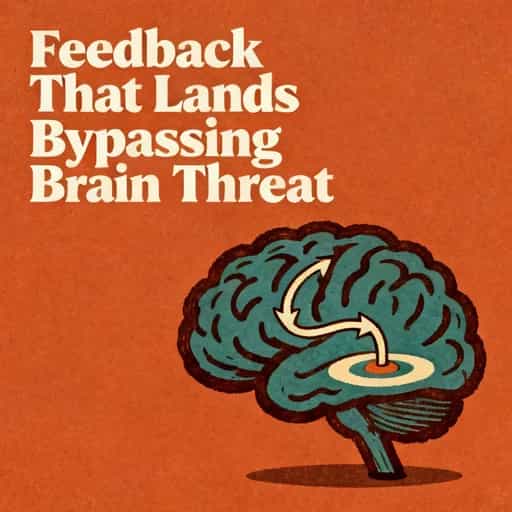
When someone says "I have feedback for you," our bodies immediately go into alarm mode-racing heart, sweating palms, and a flood of negative thoughts. This powerful fear response triggers our amygdala (the "primitive brain"), activating our sympathetic nervous system and releasing stress hormones that put our bodies into hyperdrive. This evolutionary adaptation, essential when facing predators, becomes problematic in modern workplace interactions.
The physical response is dramatic: blood diverts to limbs, muscles tense, heartbeat accelerates, and tunnel vision sets in-creating a hyperaware, reactive state. Our brains haven't evolved as quickly as society has, so emotional threats trigger the same response as physical ones. When our primitive brains prioritize physical survival over reason, we lash out, run away, shut down, or become pleasers to relieve emotional discomfort.
At the heart of our feedback anxiety lies not a life-or-death threat but something equally powerful: fear for our identity and social connections. What truly frightens us is the prospect of isolation, ostracism, and abandonment. While physical isolation meant death for our ancestors, today the threat is psychological-yet our primitive brains still respond as if our survival depends on group acceptance.
This self-protective behavior affects both sides of feedback. As the feedback giver, we face our own fears-delaying conversations as long as possible despite knowing they would help. We want to maintain our status as smart, likable people while fulfilling our obligations. As the meeting approaches, negative thoughts escalate: Is the feedback fair? Will they get angry or quit? Am I even good at this?
Our brains are also wired to prioritize negative information-processing it faster, giving it more influence in evaluations, and remembering it longer than positive information. This negativity bias explains why we react more dramatically to losses than equivalent gains, spend more time processing criticism than praise, form negative opinions quickly but release them slowly, and generally find that "bad is stronger than good."
Consider receiving a perfect performance review score but fixating on one minor criticism. Despite the highest rating and pay increase, that single negative comment dominates your thoughts. This is negativity bias impairing your ability to accurately assess feedback and appreciate the positive.
Kapitel 5
Mindset: The Game Changer
Dr. Carol Dweck's groundbreaking research reveals how our mindset fundamentally shapes our approach to feedback and growth. She identifies two primary mindsets: fixed and growth.
Those with a fixed mindset believe their intelligence and talents are innate, unchangeable traits. They spend energy documenting rather than developing their abilities and see talent alone as the key to success. In contrast, those with a growth mindset view their abilities as developable through dedication and hard work, seeing innate talents merely as starting points. This perspective fosters resilience and a love of learning essential for achievement.
The differences are stark: while fixed-mindset individuals avoid challenges, give up easily when facing obstacles, see effort as fruitless, ignore useful criticism, and feel threatened by others' success, growth-mindset individuals embrace challenges, persist through setbacks, view effort as the path to mastery, actively seek feedback, and find inspiration in others' achievements.
Mindset isn't black and white-we all have a mixture of both growth and fixed mindsets that evolve based on our experiences. We might have fixed views in one area ("I can't do small talk") while maintaining growth perspectives in others. These self-perceptions are shaped by our life histories: messages from parents, teachers, and friends, influential experiences, and stereotypes we've internalized.
The good news is we can shift from predominantly fixed to predominantly growth mindsets, though it requires focused effort and repetition. The key is continuously monitoring our inner voice and evaluating our language when facing challenges, consciously switching fixed mindset messages to growth-oriented ones.
Fixed mindset statements like "I can't do this. I'm a failure" become growth-oriented thoughts like "I don't know how to do this yet. I wonder how I might learn more about it?" Similarly, "I've never been good at details" transforms into "Up until now, I haven't been good at details. I wonder what I might discover to improve?"
This mindset shift extends to how we perceive others. When we hold fixed mindsets about others' abilities, we unconsciously limit them, potentially denying them challenging assignments and learning opportunities. By shifting from "Jim will never be good at this" to "Jim's not good at this yet, but he's learned new things before," we open doors rather than closing them.
Our worst moments often come when we're trying to prove something to others or ourselves-being right, smart, talented, or funny-rather than being open to others' needs and perspectives. Though this tendency persists throughout life, greater awareness allows us to catch ourselves in "prove" mode and intentionally switch to "improve" mode, embracing a growth mindset.
Kapitel 6
Redefining Feedback for a New Era
Having armed ourselves with scientific understanding of our dysfunctional relationship with traditional feedback, we can now create a shared vision for rebooting feedback. The Oxford Dictionary's definition of feedback as "information about reactions to a product, a person's performance of a task, etc., which is used as a basis for improvement" is inadequate for our movement. It's too narrow, focused solely on performance and tasks, with "reactions" feeling somewhat aggressive.
Instead, we need a new definition: "Clear and specific information that's sought or extended with the sole intention of helping individuals or groups improve, grow, or advance."
This carefully crafted definition emphasizes several key elements: information must be clear and specific enough to inspire action; feedback involves both soliciting and offering information; the sole intention must be to help others thrive; and the ultimate goals include improvement (changing behaviors or approaches that hinder success), growth (developing in the broadest sense), and advancement (moving forward in one's career or role).
To clarify this new definition, we can contrast what feedback is versus what it isn't:
Feedback is a tool, not a weapon; communication, not accusation; grounded in trust, not suspicion. It's observation offered with context, not judgment passed without it. Feedback is offered to help someone move toward something better, not to demonstrate power.
True feedback is thoughtful and concise, not scattered and verbose. It draws upon shared experience to provide insights, rather than showcasing the giver's wisdom. It's constructive, not destructive; an offering, not a punishment; an invitation to self-reflection, not a demand for self-blame. Ultimately, feedback is a way to help people, not fix them.
There's a phantom word that floats in front of feedback: negative. Most of us mentally insert this dark word when we hear "I have some feedback for you." But this is a misconception. While improvement feedback serves an important function when someone is truly off track, positive feedback is where we have the most power and influence. Positive feedback tells people to keep doing the good stuff, do it more frequently, and hone their strengths. It's inspirational, elevating, and creates focused energy that drives improvement and greater impact.
In feedback conversations, we play three distinct roles: Seekers (individuals who proactively request feedback for self-development), Receivers (recipients of feedback-sought or unsought, wanted or unwanted), and Extenders (those who give feedback to others, either proactively or by request). Since we frequently switch between these roles, understanding the unique challenges of each is essential for effective feedback exchanges.
Kapitel 7
Building the Foundations for Effective Feedback
For feedback to work effectively, we need strong foundations built on trust, connection, and consistent practices that create safety and openness.
Trust is the vital ingredient that makes feedback work. Without it, feedback goes straight into the mental round file or triggers the "fight, flight, or freeze" response. Trust isn't handed out freely-it's built one interaction at a time through experiences that knit us together. To build trust, we need a track record of engaging in feedback conversations that help, not hurt. While we can't force others to trust us, we can take actions that make it easier: be human (admit mistakes, be authentic, get personal), do what you say you'll do (keep promises, be consistent), be kind (encourage others, speak without criticism), and connect (spend focused time, seek win-wins, consider others' viewpoints).
Connections drive trust, and trust drives feedback, so fixing feedback must start with building human connections. The 5:1 ratio from Dr. John Gottman's research provides a foundational concept for developing trusted connections. His studies found that stable relationships maintain at least five positive interactions for every negative one. In the workplace, this doesn't mean inventing five insincere positives to sugarcoat criticism. Rather, it means increasing positive connections-participating in social events, showing genuine interest, sharing recognition, working together on challenges, or simply lending an ear.
Our feedback movement stands on three foundational principles: Fairness, Focus, and Frequency. Research shows that fair, accurate descriptive feedback from managers who frequently observe and report specific examples without evaluation can increase performance by up to 39%. When combined, these three Fs create a safe environment for feedback to flourish.
Fairness is inextricably linked with trust. When fairness is absent, feedback won't work-we retreat into protection mode, rejecting potentially valuable information. Cognitive bias unavoidably affects all feedback exchanges. We must recognize we're all biased, from negativity bias to confirmation bias, recency bias, and even bias blind spot (believing we're less biased than others). To achieve fairness despite our biases: accept that we are biased and work to enhance awareness; extend feedback without judgment; make feedback an exploratory conversation; and seek multiple sources to combat our brain's natural bias wiring.
Focus makes feedback specific, targeted, and brief-big ideas delivered in small bites. Too much feedback overwhelms the brain, causing shutdown. Think of focused feedback as "snacking on positivity and possibilities," not gorging on performance reviews. As Seth Godin says, "Snacking is learning." Feedback works best in concentrated form-concise, specific, and actionable morsels of information.
If fairness and focus fuel the feedback engine, frequency is the accelerator. Connecting frequently says "I'm paying attention, what you do matters, and you are a priority." This builds goodwill while sharing knowledge and strengthening connections. Research shows performance increases by 30% when managers are knowledgeable about their reports' work. The secret is informal, spontaneous delivery-quick observations have more impact than formal conversations.
Kapitel 8
The CONNECT Conversation Framework
Implementing these feedback concepts can feel overwhelming-keeping commitments to noticing, maintaining fairness, focus, and frequency, checking biases, finding the right words, and delivering authentically. The CONNECT conversation guide helps script and prepare for feedback exchanges of all types. Originally designed for Extenders, it's also useful for Seekers and Receivers when dealing with less skilled feedback providers, helping stem the urge to fight, flee, freeze, or appease.
The CONNECT framework works like this:
Context: Begin by establishing the appropriate setting and timing for feedback. For example, "Do you have a few minutes to discuss the client presentation from yesterday?"
One Thing: Focus on a single, specific behavior or outcome rather than multiple issues that might overwhelm the receiver.
Notice: Share your observations without judgment, sticking to facts and specific behaviors you've witnessed directly.
Effect: Explain the impact of the behavior-how it affected results, relationships, or other important outcomes.
Conversation: Open the discussion to hear the receiver's perspective, making feedback a two-way exchange rather than a one-way delivery.
Trust: Throughout the conversation, maintain a focus on building or preserving trust through your approach.
When April wants to share positive feedback with Manuel about his illustrations, she establishes context by asking if it's a good time to share client feedback. She focuses on one thing (the training material illustrations), then notices specific behaviors without judgment (the illustrations rated as "customer delighters"). She explains the effect (top ratings leading to more work Manuel is passionate about), opens the conversation for Manuel's response, and builds trust through their exchange.
Similarly, when Max needs to address missed deadlines with Charlene, he establishes context about the issue, focuses on one specific incident (being four hours behind schedule), and explains the effects (metrics hits and penalties). When Charlene feels safe to explain what happened ("cutting it close" with "a last-minute snafu"), she takes accountability ("I should have let you know the risk sooner") and participates in creating a solution. They establish an early warning system for future deadline risks, preserving their working relationship while addressing the performance issue directly.
Kapitel 9
Becoming an Effective Feedback Seeker
Seeking feedback is the most important role in fixing feedback culture. Organizations that shift from giving to asking for feedback drive performance improvement, growth mindset, and stronger teams. Seeking demonstrates humility, generates trust, provides greater autonomy, and ensures you're more likely to act on what you learn. As a Seeker, you control the timing, focus, and application of feedback, building connections that help you grow.
Research shows leadership is the top factor in driving change. Leaders at any level must go beyond merely endorsing feedback-they must model the behaviors they want to see. When leaders consistently ask for feedback first, they build trust, lessen others' fears, normalize imperfection, create psychological safety, and ultimately boost their own leadership effectiveness.
Creating safety for both Seekers and Extenders leads to better conversations. Take time to consider what makes you feel safe when receiving feedback and capture these thoughts on a Feedback Guide template. Share this guide with those you seek insights from so they understand your preferences. This transparency helps others feel comfortable with what you're asking and creates the conditions for more authentic exchanges.
Focusing your feedback request serves two critical purposes: it reduces the fear response in potential Extenders (compared to broad questions like "How am I doing?"), and it ensures you get valuable, relevant information. Specific requests like "Could you monitor my eye contact during today's presentation?" give clear direction and lower stress.
Gathering feedback from multiple sources provides a more accurate picture of your performance than relying on a single perspective. Include people who have challenged your thinking or been critical of your work to step outside your comfort zone. Peer feedback is particularly valuable because colleagues know you best, seeing you at both your strongest and weakest moments. A culture of peer-to-peer feedback is 36% more likely to positively impact financial results than manager-only recognition.
Don't shy away from the good stuff. Shore up your strengths, hone the crafts you love and excel at, and find your superpowers. Playing to your strengths is the secret to a happy and meaningful life. Remember Marcus Buckingham's wisdom: your strengths are activities that make you feel strong, not just what you're good at. And you'll grow most in these areas of strength-they're your true opportunities for growth and investment.
One of the very first lessons we get in driver's ed is to watch out for blind spots, the sections on either side of the road behind us that aren't visible in our side-view mirrors. We all have personal or work-related blind spots too. Sleuthing out your blind spots is not a journey for the timid, but it can lead to profound outcomes.
Kapitel 10
Receiving Feedback with Grace and Growth
When you're a Receiver, someone is offering you information they think you need or want. Affirming or challenging, solicited or unsolicited, relevant or irrelevant, your goal is to take the feedback in and resist knee-jerk reactions in favor of making thoughtful choices about how you'll respond. When feedback makes your heart race and hands shake, breathe, feel your feet, and let your wise brain catch up and take charge.
Leaders have a responsibility to demonstrate how to receive feedback with integrity and grace. All eyes will be on you as you set the tone for the movement. Be the change you want to see-there's no quicker way to shut down our movement than failing to listen to what others offer. Recognize that receiving makes you stronger, not weaker. Make it safe for people to tell you the truth without repercussions.
Our emotional responses to feedback have much to do with our self-image and core beliefs. When feedback strikes a nerve, it may be veering dangerously close to the core of your very being. As Receivers, it's helpful to take stock of what we value and believe about ourselves. Increasing our awareness of what we hold dear helps us modulate and understand our feedback responses when someone scores a direct hit on one of our emotional battleships.
When you receive positive feedback, do you actively listen, or do you default to minimizing your contribution or deflecting credit to others? There's much to gain by allowing yourself to celebrate. Stop the deflection by simply saying "thank you"-period. When appropriate, inquire about specifics and look for trends. Share credit without minimizing your role if others helped. And avoid deflecting or asking for reassurance-comments like "Really? I felt like I completely botched it" can devalue the feedback and make the person feel you question their judgment.
Sometimes a small piece of feedback can lead to monumental change. Like when my colleague at Hitachi casually mentioned she hadn't seen me so engaged in a topic in years-a comment I reflected on for months, examining it from all angles, testing it with others, and considering its implications. This brief observation ultimately led to founding PeopleFirm and writing this book. The beauty of our new feedback definition is that these small noticings, when we're tuned in to seeking, extending, and receiving them, can close old doors and open new ones.
Our cognitive biases don't just affect how we give feedback-they influence how we hear and process information shared with us. One common distortion is conflating someone's intent with the impact we feel. If your manager points out a typo and you assume she wanted to embarrass you, you're making an assumption that may be false. Our best strategy as Receivers is to assume positive intent. Tell yourself the person has no hidden agenda and only the best intentions.
Not all feedback meets our ideal standards-that's why our feedback-fixing movement exists. When receiving feedback you're not "feeling," start with a simple "thank you" rather than rushing to react. Switch from "prove" mode (defending yourself) to "improve" mode to hear potentially helpful insights. If the feedback seems vague, ask for specific facts and examples. When you suspect bias or assumptions, have the courage to test them together with questions like "Can we walk through your thinking?" If you need time to process, ask for a pause.
Kapitel 11
Extending Feedback That Helps, Not Hurts
In our new feedback frontier, the Extender role isn't just for managers-it's for everyone. As more people practice seeking feedback, we all need to get comfortable extending it. As an Extender, your mission is to engage with anyone, whether they work with you, for you, or above you. Be available when asked and willing to offer when appropriate. Your feedback should be authentic, specific, focused, and judgment-free.
Remember the 5:1 ratio? Positive connections build trust, and trusted relationships are the Holy Grail of Feedback. As relationships strengthen, our positive influence intensifies, and the quality, relevance, and focus of our feedback improves. Plus, our feedback is more likely to be received by engaged, receptive ears.
The good news is that connecting isn't difficult-as humans, we naturally crave positive connections. The key is frequency-most of us need to increase how often we connect with those around us. Start by taking notice and showing sincere interest, letting go of positional power, expressing genuine gratitude, finding common viewpoints, collaborating purposefully, helping others, empathizing, and simply lightening up to have a little fun.
For leaders, extending feedback isn't about learning new skills but fine-tuning established approaches. You'll need to let go of old habits and embrace a model anchored in the three fabulous Fs: Fairness in your approach, Focused coaching for targeted growth, and Frequent positive connections. As a leader, you're setting the tone for the feedback movement-showing the way while reaping personal benefits.
Positive, fact-based noticing combined with genuine connections should happen five times more often than challenging feedback. When sharing positives, be heartfelt but anchor praise in descriptive facts without judgment or labels. "You're the best!" feels good but doesn't help anyone understand how to continue succeeding. Instead, describe specific achievements: "Great job on the Wilson account, Yoshi. I noticed it came in under budget and on time, and you were responsible for three new client testimonials."
The infamous sh*t sandwich-placing criticism between two compliments-is a counterproductive feedback approach. When you use this technique, especially repeatedly, Receivers easily detect it, making all your feedback suspect and tainting future interactions. Genuine compliments create connection and trust, but when used to cushion criticism, even sincere praise becomes tainted. Instead, focus on tough conversations directly and skillfully. Share positive feedback often, freely, and for its own sake-not as bookends for difficult messages.
More frequent feedback leads to better learning outcomes. Research with children shows they learn more effectively when given feedback during a learning process rather than just at the end-the same applies to adults. This approach gives people space to reflect and share their own thoughts about knowledge gaps, fostering autonomy and control. However, two cautions: don't make feedback sessions feel like box-checking exercises, and avoid crossing into micromanagement territory.
Keep feedback focused on bite-sized pieces of information. Our brains can only effectively process three to seven items at once-a capacity that diminishes further when we're stressed or afraid. As Harvard's Amy Edmondson notes, "When people are interpersonally afraid, they have capacity issues." By keeping feedback light, short, and digestible, you help the Receiver fully process what you're sharing while making the extending process easier on yourself as well.
Research across 19,000 employees shows that descriptive, data-rich, neutral feedback is the strongest lever for improved performance. Share only facts you know to be true, with relevant examples. Keep your tone neutral-not emotionless, but free from evaluation and judgment that can trigger defensiveness. Avoid gossip, rumors, and triangulation that destroy trust. Instead of saying "People are saying..." share only what you've directly observed. Include the effects of behaviors to provide context and help Receivers understand the relevance of their actions.
Kapitel 12
A New Vision for Feedback
We've laid out a new vision for feedback-one with the sole intention of helping others thrive, improve, and grow while reducing pain and resentment. Now imagine the impact when we collectively redefine feedback, creating work environments fueled by positive connections where seeking, receiving, and extending feedback become the norm. This isn't about perfecting review forms or increasing feedback volume-it's about letting go of control, labels, and centralized power to create cultures where we can be authentic about who we are and the work we need to do.
To build feedback muscles together, try these simple practices: end meetings with reflection exercises like "Bs & Cs" (benefits and concerns) or "liked it, learned it, lacked it"; devote meeting time to expressing gratitude; launch "Feedback Fridays" for light peer feedback; and welcome employees into talent reviews to share their aspirations. Keep feedback frequent and light, rich in gratitude and recognition, clear and factual, and focused on future growth-this will help create a world where feedback is no longer a dirty word.
The path won't be linear, but success comes when we individually and collectively show up differently. By embracing the roles of Seeker, Receiver, and Extender-and practicing the principles of fairness, focus, and frequency-we can transform feedback from something dreaded to something valued. In doing so, we create not just better organizations but better lives for everyone involved.