Kapitel 1
The Race Against Time: How Humanity's Future Hangs in the Balance
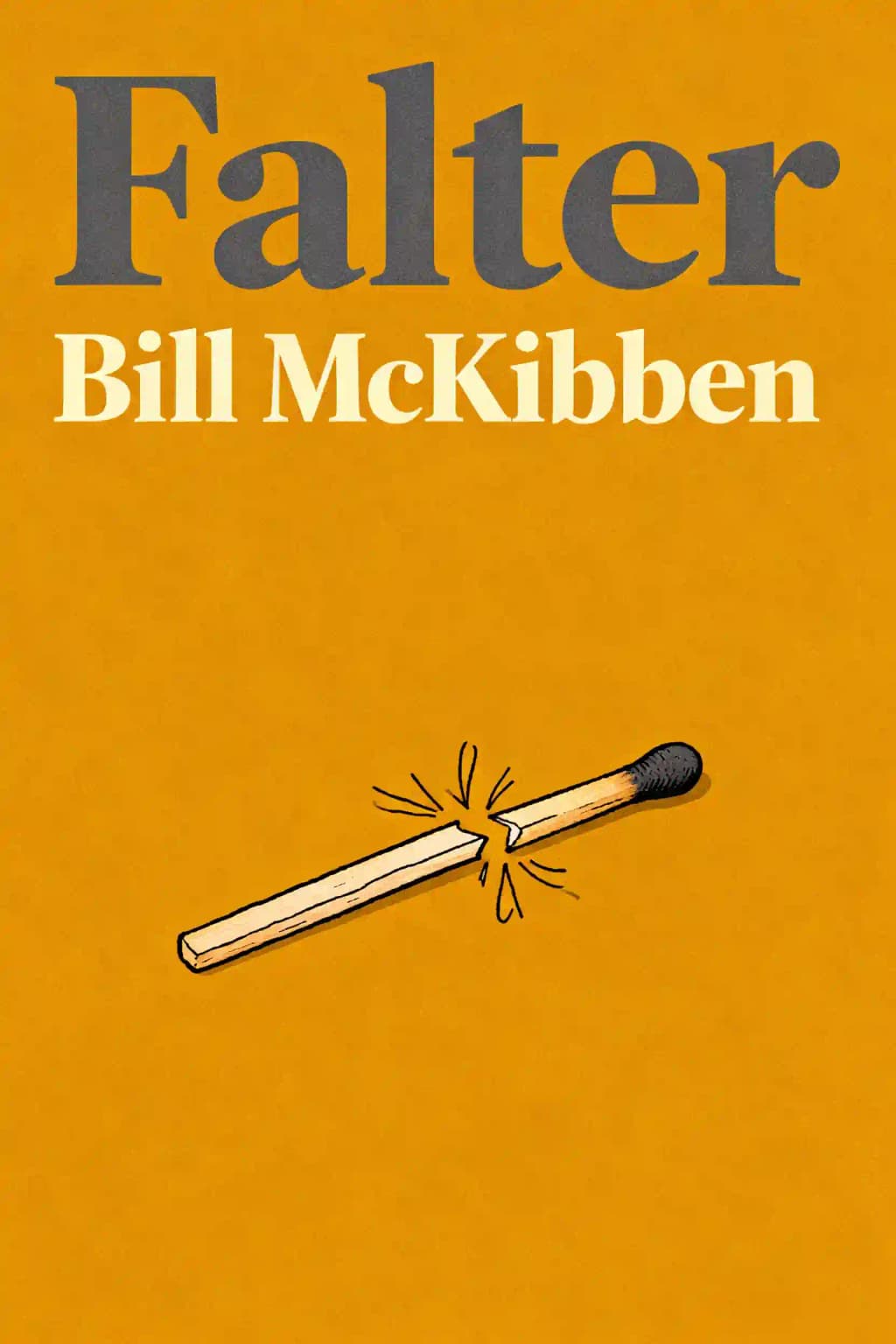
Bill McKibben's "Falter" arrived at a pivotal moment in human history. Named one of Time Magazine's most influential books of 2019 and endorsed by luminaries from Jane Fonda to Leonardo DiCaprio, this urgent work forces us to confront uncomfortable truths about our collective future. McKibben, founder of the global climate movement 350.org and recipient of the Right Livelihood Prize (often called the "alternative Nobel"), brings decades of environmental expertise to this exploration of humanity's precarious position. What distinguishes "Falter" from countless other climate books is its unflinching examination of the converging threats of unchecked capitalism, technological hubris, and environmental collapse. As climate anxiety has entered mainstream consciousness, McKibben's work stands as both warning and roadmap, asking not just if civilization will survive, but whether what remains will still be recognizably human.
Kapitel 2
The Human Game: Our Greatest Achievement Now at Risk
For all our technological marvels and cultural achievements, the most remarkable thing humans have created might be what McKibben calls "the human game" itself-the sum total of our civilization, commerce, art, religion, and relationships. To illustrate this extraordinary complexity, McKibben begins with something seemingly mundane: roofing materials. From palm leaves to thatch to terra-cotta tiles to modern asphalt shingles, he traces how even this simple element of shelter represents an intricate web of knowledge, materials, and coordination spanning generations.
The manufacturing process of a single CertainTeed asphalt shingle reveals the astonishing depth of our industrial systems-from oil drilling to refineries to transportation networks to regulatory standards. This mundane example demonstrates the remarkable depth of human organization that extends to everything from music to food to clothing. Our civilization represents something "unimaginably deep, complex, and beautiful."
Yet this magnificent achievement now faces unprecedented threats. While humanity has made remarkable progress in reducing poverty, disease, and violence, McKibben argues we've reached a critical inflection point. The human game is "beginning to falter" due to what he calls "leverage"-our newfound ability to cause both accidental and intentional harm on a planetary scale through climate change and dangerous technologies like artificial intelligence.
Unlike past civilizational collapses that were localized, today's interconnected world faces truly global threats that could end "the human game" entirely. Most troublingly, the decisions affecting billions are increasingly concentrated in the hands of a wealthy few who prioritize profit over sustainability. What makes our current predicament uniquely dangerous is that we've created systems with enough power to permanently alter Earth's life-support systems-and placed control of these systems in the hands of those least likely to use restraint.
Kapitel 3
Climate Crisis: No Longer a Future Threat
McKibben's description of our climate emergency is both scientifically precise and emotionally devastating. He begins with Delhi, where smog grows so thick visibility drops to mere feet, causing flight cancellations and cricket players vomiting mid-match. This pollution crisis, which kills 9 million people annually (far more than AIDS, malaria, TB, and warfare combined), represents just one facet of our environmental breakdown.
Climate change itself McKibben calls "perhaps the greatest of all these challenges." By increasing atmospheric carbon dioxide from 275 to 400 parts per million, humanity has fundamentally altered Earth's energy balance. The heat trapped equals "400,000 Hiroshima-sized bombs every day." This unprecedented change manifests in record temperatures, devastating droughts in major cities like Cape Town and Bangalore, and increasingly catastrophic wildfires.
Fire seasons have extended by 78 days since 1970, with "megafires" creating their own weather systems that defy conventional firefighting methods. These fires launch firebrands miles ahead, create their own pyrocumulus clouds that generate lightning to start new blazes, and cannot be controlled by any available resources. The devastation extends beyond burned homes to devastated ranches where cattle die horrifically, forcing ranchers to mercy-kill their own herds.
The climate crisis also intensifies the water cycle-dry places get drier, wet places wetter. With ocean temperatures rising about one degree Fahrenheit off the Texas coast, atmospheric moisture increased 3-5%, fueling Hurricane Harvey's unprecedented rainfall that dumped 34 trillion gallons on Houston-enough to physically sink the city by centimeters. Scientists concluded this "biblical" rainfall was 40% higher than would have occurred before carbon levels spiked.
Perhaps most visibly, Earth's ice is vanishing at astonishing speed. Arctic sea ice visible in early satellite images has largely disappeared, making our planet look strikingly different from space. Himalayan glaciers have shrunk hundreds of vertical feet in recent decades. The melting has such momentum that even if we stopped all greenhouse emissions today, over a third of the planet's glacial ice would still disappear.
Kapitel 4
The Human Toll: Beyond Economic Calculations
Climate change already costs the U.S. economy $240 billion annually and the world $1.2 trillion, wiping 1.6% from global GDP. But these abstract figures mask the human suffering behind them. Hurricane Maria inflicted $90 billion in damage to Puerto Rico's $100 billion economy, with recovery projected to take 26 years. Climate disruption has reversed positive global trends-after years of decline, chronic malnutrition increased by 38 million people to 815 million total, while child labor has risen to 152 million children, both driven by "conflicts and climate-induced disasters."
These conflicts themselves increasingly stem from climate disruption, as demonstrated by Syria's drought-influenced civil war and resource conflicts between herders and farmers around Mount Kenya, where disappearing glaciers have intensified competition for water and grazing land.
Far from self-limiting, climate change triggers feedback loops that accelerate warming. Hoped-for cooling effects from increased cloud cover haven't materialized-instead, new cloud patterns appear to trap more heat. When Arctic ice melts, reflective white surfaces are replaced by dark blue seawater that absorbs rather than reflects solar radiation, raising Arctic sea temperatures by seven degrees Fahrenheit in some areas. Thawing permafrost releases methane and carbon dioxide that could add another 1.5 degrees Fahrenheit of warming.
McKibben illustrates this accelerating crisis through California's recent climate whiplash-from a five-year drought so severe it tapped 20,000-year-old groundwater and killed 102 million trees, to devastating floods, to unprecedented wildfires that jumped ten-lane highways, to deadly mudslides on burned hillsides that carried victims and wildlife alike to the ocean. As writer Nora Gallagher warns, climate disaster "won't happen next year, or somewhere else. It will happen right where you live and it could happen today."
Kapitel 5
The Future: How Bad Could It Get?
McKibben shifts from documenting current climate disasters to exploring how much worse things could become. He focuses on the most likely scenarios rather than extreme possibilities, noting that the most basic concerns are food security and coastal flooding.
Despite the Green Revolution's success at increasing crop yields since World War II, climate change is now reversing these gains. Australian wheat productivity has "flatlined" due to warming temperatures and declining rainfall. A two-degree Celsius temperature rise could cut U.S. corn yields by 18 percent, while four degrees would slash them nearly in half. Even drought-resistant sorghum faces yield reductions of 17 percent with two degrees warming and 60 percent with five degrees.
Food system disruptions can trigger political instability, as when Russia's 2010 heat wave led to export bans, price spikes, and contributed to the Arab Spring. Climate change threatens both crop yields and nutritional content, with studies showing CO2-enriched atmospheres reduce protein, calcium, iron and zinc in staple crops-potentially putting millions at risk of nutritional deficiencies.
Many of humanity's greatest cities developed along coastlines for their rich ecosystems and trade advantages, but this now creates profound vulnerability. Recent research indicates the West Antarctic Ice Sheet could collapse within a hundred years, and Antarctica has already lost three trillion tons of ice in three decades, with the melt rate tripling since 2012. Scientists are now dramatically revising sea level rise estimates upward to one or two meters, with some warning of "several meters in the next fifty to 150 years," making coastal cities "practically ungovernable."
The refugee crisis this would create would dwarf today's Syrian war refugee crisis. The International Organization for Migration estimates 200 million climate refugees by 2050, with some projections reaching one billion. Military leaders like Admiral Samuel Locklear consider climate change their greatest security concern as mass displacement will destabilize entire regions.
Kapitel 6
Shrinking Habitable Space: The World Closes In
Our modern privilege lies in our ability to ignore the natural world, treating it as mere backdrop. This comfortable obliviousness is now breaking down as climate change disrupts our carefully engineered systems. When Hurricane Sandy hit New York City, it channeled energy from the record-hot Atlantic and rode rising sea levels to flood FDR Drive with whitecaps and cascade saltwater into subway stations.
The game board on which we're playing is shrinking, a remarkable reversal after centuries of human expansion. Europeans who colonized North America vastly expanded their playing field, discovering not just a new trade route but an entire continent of abundant resources. Later, fossil fuels created another expansion, freeing us from geographic limitations. But these were one-time gains, and now climate change is forcing contraction.
Sheer heat is narrowing our habitable world. Nine of the ten deadliest heat waves in human history have occurred since 2000. In hotter regions, the consequences are dire-a single degree Fahrenheit increase since 1960 has raised the chance of mass heat-related deaths in India by 150%. Scientists have determined that when temperatures exceed 95F with humidity above 90%, human survival becomes impossible beyond a few hours as the body can't cool itself. By the 2070s, tropical regions will face hundreds of deadly heat days annually.
Rising oceans are similarly shrinking our habitable space. Tens of thousands evacuate Vietnam's fertile Mekong Delta annually as saltwater ruins farmland. Coastal communities worldwide face imminent threats-Louisiana officials are relocating thousands, Hawaii predicts thirty-eight miles of roads will become chronically flooded, Jakarta's nearly 30 million residents face increasing inundation. Though areas vulnerable to sea level rise represent only 2% of Earth's land surface, they contain 10% of the global population and generate 10% of world economic output.
As coastal populations flee rising waters, others will migrate because of water scarcity. By 2050, even if we meet the Paris climate targets, about 25% of Earth will experience serious drought and desertification. The consequences for agriculture are devastating-studies predict corn and soybean yields across America's Grain Belt could plummet 22-49% as hotter days increase evaporation.
Kapitel 7
The Thirty-Year Lie: How We Lost Precious Time
Climate change has been a public issue for thirty years, emerging dramatically when NASA scientist James Hansen testified before Congress in 1988 that "the greenhouse effect has been detected and it is changing our climate now." The immediate response seemed promising-Congress introduced climate legislation, scientists formed the IPCC, and George H.W. Bush pledged to "fight the greenhouse effect with the White House effect." Yet in the three decades since, global carbon emissions have nearly doubled, with over half of all industrial-era greenhouse gases released after 1988.
The most damning revelation in McKibben's account is that major oil companies knew the truth about climate change decades before the public. In July 1977, Exxon senior scientist James F. Black warned company leaders that mankind was influencing climate through carbon dioxide from fossil fuels. By 1978, he predicted a doubling of CO2 would raise global temperatures 2-3C, potentially causing dramatic rainfall changes and desertification. This was a full decade before climate change became a public issue.
Through extensive research including equipping the tanker Esso Atlantic with CO2 detectors, Exxon concluded by 1982 that earlier estimates were likely too conservative, warning in internal documents that "potentially catastrophic events" required "major reductions in fossil fuel combustion." Exxon took these warnings seriously enough to build oil platforms with higher decks to accommodate rising seas, and Arctic teams calculated that warming would extend drilling seasons from two to five months.
Had these companies simply confirmed Hansen's 1988 Senate testimony, history would have unfolded differently. Instead, Exxon's public affairs manager recommended they "emphasize the uncertainty" in climate science, launching what became history's most consequential lie. By 1989, major oil companies formed the Global Climate Coalition, hiring veterans from tobacco industry fights to produce videos claiming CO2 would "end world hunger" and oppose the Kyoto Protocol.
This three-decade campaign of deception cost us the generation that might have made the crucial difference in the climate fight. Alex Steffen coined the term "predatory delay"-blocking needed change to profit from unsustainable systems. Had we begun cutting emissions in 1990, we could have tackled climate change with confidence through incremental reforms, reducing emissions by roughly 25% per decade. Now, after thirty years of soaring emissions, meeting even modest Paris targets requires "disruptive cuts" of 50% per decade. What would have been "a bunny slope is now a double black diamond."
Kapitel 8
Ideological Blindness: Ayn Rand's Dangerous Legacy
McKibben identifies an unlikely philosophical villain in our climate tragedy: Ayn Rand, whose simplistic, one-dimensional philosophy captured the hearts of America's most powerful figures during the crucial decades when America's decisions shaped the planet's future. Alan Greenspan, architect of the post-Soviet global economy, was an early devotee. The Thatcher-Reagan years marked "the second age of Rand," transforming her laissez-faire philosophy from fringe obsession to governing credo.
Her influence extends through generations of political and business leaders: Paul Ryan required interns to read her books; Supreme Court Justice Clarence Thomas screened The Fountainhead as staff training; Trump cabinet members Rex Tillerson and Mike Pompeo count Atlas Shrugged as their favorite book; and Trump himself claims The Fountainhead as his favorite.
Rand's philosophy emerged from genuine trauma. Born Alisa Zinovyevna Rosenbaum in 1905 Russia, she witnessed Bolsheviks seize her father's pharmacy at gunpoint when she was twelve. This formative experience taught her that "those who invoked lofty ideals were not to be trusted" and that talk of helping others masked raw power.
Instead of writing manifestos that would have relegated her to the status of a forgotten crank, Rand wrote stories-melodramas that appealed to teenagers and casual readers. The Fountainhead featured Howard Roark, an architect portrayed as the greatest on Earth but unrecognized because everyone else was merely "second-handers." Atlas Shrugged depicted industrialists on strike against government regulation, retreating to a Colorado valley to create a world based on individual talent. Both novels railed against altruism as "a weapon of exploitation" while celebrating unfettered individualism.
This systematic worldview-that government is bad and productive individuals and corporations need freedom from its clutches-emerged in the latter half of the twentieth century with power comparable to Leninism in the first half, changing American politics so fundamentally that even liberals embraced free trade agreements and ended "welfare as we know it."
Kapitel 9
Silicon Valley's Dangerous Dreams: From AI to Immortality
Silicon Valley represents another nexus of game-changing leverage, culturally distant yet geographically close to the fossil fuel industry's power centers. Unlike aging fossil fuel moguls, tech billionaires are youthful social progressives who embrace renewable energy-Google powers its global business with green energy, and Tesla's Gigafactory features the world's largest rooftop solar array.
Yet surprisingly, Ayn Rand bridges these disparate plutocratic worlds. Vanity Fair declared her "perhaps the most influential figure in the tech industry," with devotees including Steve Jobs, Elon Musk, Uber founder Travis Kalanick, and PayPal co-founder Peter Thiel. This libertarian streak predates smartphones and social media. As early as 2001, writer Paulina Borsook identified the "terribly libertarian culture of high-tech" as the industry's defining worldview.
This anti-government sentiment stems partly from early clumsy regulation attempts and partly from coders' frustration with messy human systems compared to logical programming environments. Despite government investment creating the internet, tech leaders remain deeply attached to Howard Roark's defiant question from The Fountainhead: "Who will stop me?"
Ray Kurzweil, Google's "director of engineering," exemplifies Silicon Valley's techno-optimism. He lives with extraordinary caution-avoiding mountain roads, downhill skiing, and cliffs-because he believes he only needs to survive until around 2030 to live forever. He takes approximately 100 pills daily, including extended-release metformin every four hours, believing it kills cancer cells.
Kurzweil's fundamental insight is acceleration-our machines are getting smarter at an exponentially increasing rate. He traces this trajectory back to the 1890 census, arguing critics mistakenly apply linear thinking to exponential processes. He points to genome sequencing as an example: what seemed like it would take 700 years was nearly complete after just seven years because of exponential doubling.
This exponential growth in computing power has enabled revolutionary technologies like CRISPR, which allows precise genetic editing. While early medical applications show promise for treating conditions like leukemia, the technology also enables germline genetic engineering-changing humans before birth by altering embryonic DNA. These changes would be heritable, passed to all future offspring, giving us unprecedented power to "direct the evolution of our own species."
Kapitel 10
The Price of Enhancement: What Makes Us Human?
Beyond practical concerns about AI and genetic engineering lies a deeper question: even if these technologies work perfectly, what do they do to the meaning of human existence? The "human game" differs from conventional games in having no obvious end-its only real goal may be to continue itself.
When athletes use performance enhancers like EPO, they strip sports of meaning. Lance Armstrong's seven Tour de France victories, once celebrated as triumphs of human will, became hollow once revealed as drug-assisted achievements. We test athletes for these substances not out of philosophical purity, but because the human story is the point, not simply going faster.
Some ethicists like Julian Savulescu see no meaningful distinction between "artificial" and "natural" human enhancement, comparing genetic engineering to traditional dog breeding-just accelerated. While humans have always tried to influence offspring through mate selection and parenting, these methods have inherent limitations. CRISPR fundamentally replaces chance with design, creating humans built to specification.
As our capabilities advance, parents might design children with traits aligned to their own values-optimism, musical talent, religiosity, or enhanced intelligence. But what does it feel like to be that designed child? They become disconnected from both past and future, marooned in time as technological obsolescence inevitably renders them outdated compared to newer models. More profoundly, they lose the ability to truly discover themselves, as every achievement or personality trait leads back to their design specifications rather than authentic self-discovery.
Even parents are cheated in this scheme, losing the genuine pride that comes from nurturing a child whose development wasn't predetermined. The randomness of natural genetic inheritance provides mental freedom from determinism-a freedom that disappears when we understand ourselves as engineered products.
Kapitel 11
Paths of Resistance: Solar Power and Nonviolence
Despite these daunting challenges, McKibben offers pathways for hope. Solar power represents a true miracle of human innovation, dropping from $100 per watt in the 1960s to under 30 cents by 2018, making it the cheapest electricity source across much of the world. Unlike fossil fuels with their complex extraction and distribution chains, solar panels directly convert sunlight to electricity-"Hogwarts-level magic."
In rural Africa, where approximately half a billion people may still lack electricity by 2040, solar offers a transformative leapfrog technology. Just as cell phones allowed Africa to bypass landlines, solar enables communities to skip traditional grid infrastructure. The overnight arrival of electricity profoundly changes communities-from children studying by LED light to farmers receiving weather forecasts on charged phones.
Solar power represents an interesting technological shift-it's less concentrated than fossil fuels, requiring collection from countless locations rather than a few extraction points. While some will profit from renewable infrastructure, nobody can monopolize sunlight the way fossil fuel companies control oil and gas. The energy economy becomes more democratic, keeping money closer to home instead of enriching distant corporate interests.
Nonviolence works hand-in-hand with technological innovations like solar power, serving as a "bulldozer for reshaping the zeitgeist" through movement-building. Though less immediately powerful than violence, its effectiveness has grown since Henry Thoreau first refused to pay his poll tax in 1846 to protest slavery. Nonviolence encompasses more than just civil disobedience-it includes the full spectrum of organizing aimed at building mass movements that change the zeitgeist.
The environmental movement demonstrated nonviolence's power when twenty million Americans joined the first Earth Day in 1970. This unprecedented mobilization shifted the political balance, forcing even Nixon to sign landmark environmental legislation. The movement has increasingly been led by youth, indigenous nations, and communities of color. Fifteen-year-old Greta Thunberg's school strike inspired students across Europe and Australia, while Britain's Extinction Rebellion shut down London traffic through civil disobedience.
Kapitel 12
Finding Balance: The Mature Human Game
Imagine our technological progress as a gambler on a hot streak who, after some losses and increasingly risky bets, wisely decides to cash out his winnings rather than risk everything on one more hand. Solar energy and nonviolence represent technologies of repair rather than expansion, of consolidation rather than disruption-technologies of maturity. They recognize that humanity has grown powerful enough, and now must focus on sharing and controlling that power.
Our culture finds maturity less exciting than growth because maturation means making choices and accepting limits. Just as individuals mature by committing to relationships and communities, societies demonstrate maturity by setting boundaries on exploitation. The wilderness areas that protect forests from immediate economic exploitation represent such mature choices.
We're surrounded by signals to slow down. Athletic records have plateaued-the 2000s were the first decade in a century when no man ran a faster mile. Human physical development is stalling too: after dramatic 20th century improvements in height and lifespan, these metrics are leveling off. Even IQs, which Steven Pinker celebrated as rising (the "Flynn effect"), are now dropping by seven points per generation across multiple countries.
These indicators suggest our task isn't reaching utopia but preventing dystopia. Scientists who studied human performance concluded we should focus on maintaining past gains rather than expecting continued improvement-"one of the most intense challenges of this century." We're at peak human, and should work to spread these benefits across geography and class while mitigating the side effects of progress.
The human game is fundamentally a team sport, not an individual pursuit. If the antigovernment conservatives are right that individuals are all that matter, that "there is no such thing as society," we cannot mount an effective response to climate change or manage technological development. Everything we learn about humans confirms our social nature-our big brains develop in community, we evolved to hunt in groups, and our complex language enables social bonding.
As an eight-year-old in July 1969, McKibben was captivated by the Apollo 11 mission. This childhood fascination came full circle in spring 2018, when he stood on the roof of the Vehicle Assembly Building at Cape Canaveral watching one of Elon Musk's Falcon 9 rockets launch toward the International Space Station. Today's space program is increasingly privatized, with billionaires like Musk, Bezos, Allen, and Branson leading the charge. Their motivations range from entrepreneurial expansion to escaping Earth's problems.
But these space dreams face harsh physical realities. Space travel devastates human bodies-cosmic rays cause cancer and brain damage, radiation damages hearts, and psychological health deteriorates. The vastness of space presents another insurmountable barrier: even our fastest spacecraft would take 19,000 years to reach Alpha Centauri, our nearest stellar neighbor.
Science fiction author Kim Stanley Robinson, who wrote the definitive Mars colonization trilogy, now believes the whole enterprise creates a "moral hazard"-the dangerous idea that we can always escape to space if we ruin Earth. In his more recent novel Aurora, a character who returns to Earth after a failed space colonization mission finds meaning in rebuilding beaches destroyed by climate change. She experiences the profound joy of Earth's beauty-feeling the sand beneath her, seeing the sparkling ocean, kissing the ground itself.
The message is clear: there is no Planet B. Our only hope lies in preserving the remarkable planet we already inhabit-and the uniquely human game we've spent millennia creating.