Kapitel 1
The Magic of Persuasive Language: Words That Unlock Human Decisions
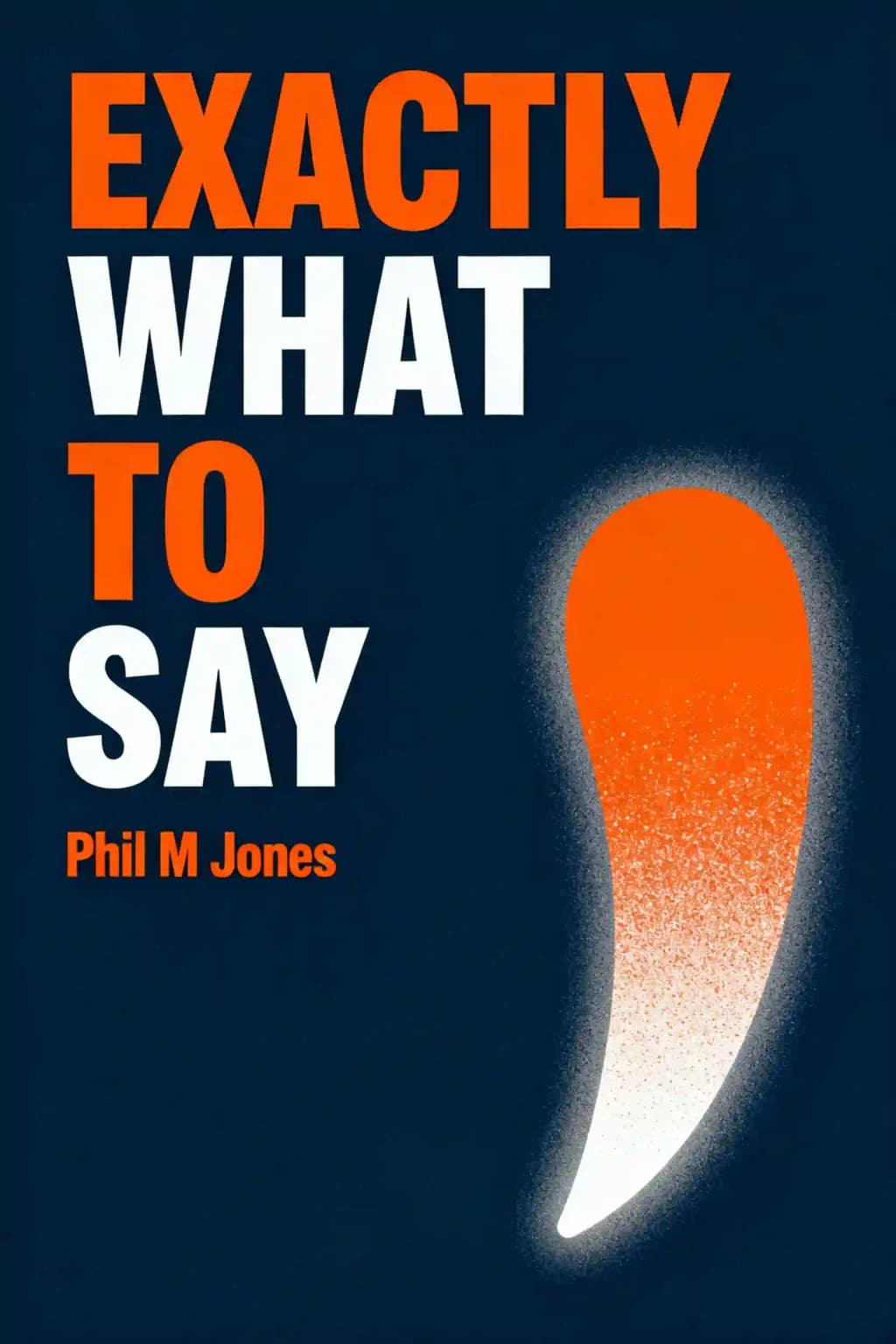
Have you ever wondered why some people seem to effortlessly get their way while others struggle to make an impact? The difference often comes down to a handful of carefully chosen words. Phil M. Jones's "Exactly What to Say" has become a cult favorite among entrepreneurs, sales professionals, and negotiation experts, with over 500,000 copies sold worldwide. Celebrities like Gary Vaynerchuk and Marie Forleo have praised its practical approach, and it's become required reading at companies including HubSpot, Salesforce, and LinkedIn. What makes this book so powerful isn't complex psychology or manipulative tactics-it's the simple recognition that tiny language shifts can dramatically change conversation outcomes. In a world where the average person makes 35,000 decisions daily, knowing exactly what to say at crucial moments gives you an almost unfair advantage in any interaction.
Kapitel 2
The Psychology Behind Persuasive Language
The human brain is wired to make quick, binary decisions without overanalyzing. This reflex-driven decision-making happens in the subconscious mind, which processes information 500 times faster than our conscious mind. When we understand this, we can craft language that speaks directly to this powerful decision-making system.
Think about how you make important choices. Do you carefully analyze every option with perfect logic? Or do you often "go with your gut" and then rationalize that choice afterward? Research shows that emotions drive decisions first, with logic following to justify what we've already decided. This explains why traditional persuasion techniques focusing solely on facts and features often fail.
The magic phrases in this book work because they bypass resistance and speak directly to the decision-making part of the brain. They create psychological triggers that make agreement the path of least resistance. When someone says "I'm not sure if it's for you, but..." your brain automatically becomes curious rather than defensive. When you hear "Most people in your situation choose..." your brain instinctively wants to align with the majority.
These language patterns aren't about manipulation-they're about understanding how human psychology naturally works and aligning your communication accordingly. By removing friction points in conversation, you create space for genuine connection and mutual benefit. The most successful communicators understand that persuasion isn't about forcing others to do something against their will; it's about making it easier for them to say yes to things they already want.
Kapitel 3
Creating a Pressure-Free Environment for Ideas
One of the biggest barriers to effective persuasion is the fear of rejection. This fear often prevents us from even introducing our ideas in the first place. The magic phrase "I'm not sure if it's for you, but..." works brilliantly because it creates a pressure-free environment that naturally increases curiosity.
Consider what happens in your brain when someone says, "You need to try this new restaurant." Immediately, you feel pressured and might resist. But when someone says, "I'm not sure if it's your kind of place, but I discovered this amazing restaurant," you lean in, curious to hear more. The psychological difference is profound.
The word "but" in this phrase is particularly powerful because it negates everything that comes before it. What your listener actually processes is closer to "You might want to look at this." This rejection-free approach creates two possible outcomes: either they become genuinely interested because you've removed the pressure, or at worst, they say they'll give it some thought.
This approach works in countless scenarios. A financial advisor might say, "I'm not sure if this investment strategy is for you, but it's helped several of my clients in similar situations." A friend suggesting a book could say, "I'm not sure if this is your type of read, but I couldn't put it down." By removing the pressure to agree, you paradoxically make agreement more likely.
The beauty of this technique is that it works equally well in personal and professional settings. Whether you're suggesting a restaurant to friends, proposing a new project at work, or selling a product to customers, creating this pressure-free environment dramatically increases your chances of a positive response.
Kapitel 4
Leveraging the Power of Self-Perception
Nearly everyone considers themselves open-minded-after all, who wants to be seen as closed-minded or stubborn? This universal self-perception creates a powerful opportunity in persuasive conversations.
By asking "How open-minded are you about..." before introducing a new idea, you shift the odds dramatically in your favor-from a 50/50 chance of acceptance to something closer to 90/10. This simple phrase makes it difficult for others to reject your proposal outright because doing so would contradict their self-image as an open-minded person.
Imagine you're proposing a new approach to a team project. Instead of saying "I think we should try this new method," which invites immediate judgment, you ask "How open-minded would you be about trying a different approach that could cut our timeline in half?" This subtle shift makes people feel obligated to at least explore the possibility.
This technique works because it taps into cognitive dissonance-the mental discomfort people feel when their actions contradict their beliefs about themselves. If someone sees themselves as open-minded but immediately rejects your idea without consideration, they experience this discomfort. To avoid it, they're more likely to at least hear you out.
The approach is particularly effective when introducing ideas that might initially seem unconventional or when speaking with people who tend to be skeptical. It creates a psychological commitment to consideration before you've even presented your idea.
What makes this technique so powerful is that you're seemingly giving people a choice while actually heavily weighting the only option you're really offering. You're not forcing anyone to agree with you-you're simply making it easier for them to listen with an open mind, which is often all you need to make your case effectively.
Kapitel 5
Moving from Certainty to Doubt
We've all encountered people who think they know everything-the colleague who lectures you with absolute certainty or the friend who has strong opinions based on limited information. When someone is entrenched in their position, direct contradiction rarely works. Instead, you need to gently move them from certainty to doubt.
The magic phrase "What do you know about..." accomplishes this by questioning the knowledge foundation on which their opinion is built. Rather than challenging their conclusion directly, you're exploring the evidence they used to reach it.
For example, if someone confidently declares that a particular business strategy won't work, responding with "What do you know about companies that have implemented this strategy?" shifts the conversation. This approach often reveals that their strong opinion was based on limited information or assumptions rather than facts.
The beauty of this technique is that it allows the other person to save face while becoming more receptive to new information. Instead of feeling attacked, they're simply being asked to share their knowledge-something most people are happy to do. If their opinion was indeed based on solid information, you learn something valuable. If not, you've created space for introducing new perspectives without creating defensiveness.
This approach works particularly well with technical objections or when dealing with self-proclaimed experts. A customer might say, "I've heard that product doesn't perform well." Rather than defending your product, you can ask, "What do you know about how this product performs in different environments?" This gives you insight into their specific concerns while gently testing whether those concerns are well-founded.
The goal isn't to prove someone wrong but to create an environment where both parties can reach better conclusions based on fuller information. Remember: in persuasive conversations, either everybody wins, or everybody loses. Moving someone from certainty to doubt is often the first step toward a productive dialogue where new possibilities can emerge.
Kapitel 6
Emotional Time Travel: The Decision-Making Catalyst
Understanding motivation is key to persuasion. At its core, motivation simply means "a reason to move"-and people are motivated by two primary forces: avoiding loss or acquiring gain. Research consistently shows that avoiding loss is the stronger driver, with most people working harder to keep what they have than to get something new.
People make decisions based on emotion first, then logic-something must feel right before it makes sense. The magic phrase "How would you feel if..." leverages this reality by allowing others to mentally time-travel and experience the emotions of a future scenario.
When you ask "How would you feel if you missed this opportunity?" or "How would you feel if this problem was completely solved?", you're not just presenting information-you're creating an emotional experience. This emotional projection becomes a powerful decision-making catalyst.
The technique works by creating conditional future scenarios with both positive and negative outcomes. For example, a financial advisor might ask, "How would you feel if you reached retirement age and discovered you didn't have enough saved?" followed by "How would you feel if you could retire early with financial security?" The greater the contrast between these scenarios, the more compelling the motivation becomes.
This approach is particularly effective because it allows people to experience future consequences in the present moment. Most poor decisions happen because people disconnect current choices from future outcomes. By bringing those future feelings into the present, you help people make better decisions.
The technique works across contexts-from sales conversations to personal relationships. Parents might ask children, "How would you feel if you failed the test because you didn't study?" Managers might ask team members, "How would you feel if we completed this project ahead of schedule and received recognition from leadership?"
By helping people emotionally experience both the pain of inaction and the pleasure of making the right choice, you create compelling reasons to move either toward good news or away from bad news-the two fundamental motivational drivers that influence all human behavior.
Kapitel 7
The Power of Mental Visualization
Every significant decision is made twice-first hypothetically in your mind, then in reality. If you can't visualize yourself doing something, you likely won't do it. The magic words "Just imagine" activate the brain's image viewer, allowing you to place pictures in people's minds that influence their decisions.
This technique works because visualization is a fundamental aspect of human cognition. Studies show that when people vividly imagine an outcome, the same neural pathways activate as when they actually experience it. This is why elite athletes use visualization techniques to improve performance-the brain doesn't always distinguish between vivid imagination and reality.
When you say "Just imagine having this problem completely solved" or "Just imagine how this would transform your daily routine," you're not just describing possibilities-you're creating mental experiences that feel real. Like children responding to "Once upon a time," adults respond to "Just imagine" by mentally picturing the scenario you describe.
The key is to make these visualizations as detailed and sensory-rich as possible. Don't just say "Imagine having more time"; say "Just imagine waking up on Tuesday morning, knowing your presentation is already prepared, giving you an extra hour to enjoy your coffee and start the day without rushing." The more specific and sensory-detailed your language, the more powerful the visualization becomes.
This technique is particularly effective when helping people overcome fear or inertia. When someone can't see themselves succeeding, they typically won't try. By helping them create a detailed mental image of success, you increase their belief that it's possible. A fitness trainer might say, "Just imagine walking into your reunion feeling confident about how you look." A business coach might say, "Just imagine ending each day with your inbox empty and your major projects moving forward."
By letting others' creative minds build your case, you create more vivid realities than anything you could describe directly. Once they've visualized success, their belief in achieving it increases dramatically-and belief is often the missing ingredient that turns possibility into reality.
Kapitel 8
Guiding Conversations to Positive Outcomes
Even with perfect persuasive language, conversations can stall without clear direction. Three powerful techniques-"When would be a good time?", "I'm guessing you haven't got around to...", and strategic word swaps-help guide interactions toward positive outcomes.
The phrase "When would be a good time to...?" works because it assumes there will be a good time, making "no" seem like a non-option. Rather than asking "Can we meet next week?" (which invites a yes/no response), asking "When would be a good time to meet next week?" focuses the conversation on finding a specific time and date. This direct question prevents the common objection of not having enough time by shifting the focus to when, not if.
When following up with someone who hasn't completed a promised action, saying "I'm guessing you haven't got around to..." disarms their prepared excuses. This technique prevents people from using the very excuse you anticipate by acknowledging it first. Most people want to honor their word when called out, so they'll either prove you wrong (by showing they've completed the task) or make a new commitment.
Strategic word swaps can dramatically improve conversation outcomes. Instead of asking "Do you have any questions?" (which suggests they should have questions), ask "What questions do you have for me?" Similarly, rather than permission-based questions like "Can I have your phone number?" ask "What's the best number to reach you at?" These simple swaps turn open questions into closed ones that generate better responses.
When following up after sharing information, don't ask what they thought-instead ask "So, what do you like about it?" This encourages positive responses rather than concerns. If they mention concerns anyway, you've created an opportunity to address them directly.
These techniques work because they create conversational paths of least resistance that lead to your desired outcome. By assuming positive engagement and making it easier to move forward than to object, you naturally guide conversations toward productive conclusions without appearing pushy or manipulative.
Kapitel 9
Decision Frameworks That Drive Action
People often struggle with decisions not because they lack information, but because they lack frameworks for processing that information. Three powerful techniques-"You have three options," "Two types of people," and "If...Then"-provide these frameworks and drive action.
When you say "As I see it, you have three options," you appear impartial while actually guiding their choice. The rhythm of three makes for easy listening, and by strategically placing your preferred option last, you can build its value while making alternatives seem less attractive. End with "What's going to be easier for you?" to further steer them toward your preferred choice by framing it as the path of least resistance.
The "Two types of people" approach works by creating polarizing choices that make one option clearly more appealing. Saying "There are two types of people in this world" immediately makes listeners wonder which category they belong to. By carefully crafting these options-making one clearly more appealing than the other-you guide people toward your preferred choice. For example: "Those who leave financial success in employers' hands versus those who build their own futures."
The "If...Then" structure creates powerful associations that people naturally believe. Our speech patterns and belief systems are hardwired from childhood through conditional statements like "If you don't tidy your room, then you're going to be grounded." By creating "if...then sandwiches" in your persuasive communication ("If you decide to give this a try, then I promise you won't be disappointed"), you tap into deeply ingrained belief systems that make your conclusions seem logical and inevitable.
These frameworks work because they simplify complex decisions into manageable choices. Rather than facing overwhelming options or analysis paralysis, people can follow clear pathways to decisions. The frameworks also leverage our natural desire for categorization and pattern recognition-we instinctively want to sort information into meaningful structures.
By providing these decision frameworks, you help people move from uncertainty to clarity, from hesitation to action. You're not manipulating them-you're organizing information in ways that make decision-making easier and more comfortable.
Kapitel 10
Breaking Through Resistance and Objections
Even with perfect persuasive language, you'll encounter resistance. Five powerful techniques-"Don't worry," "Most people," "What happens next," "What makes you say that?", and "Before you make your mind up"-help overcome objections and move conversations forward.
The simple words "Don't worry" have remarkable power when dealing with anxious or uncertain people. When said confidently and calmly to someone showing signs of nervousness, you can visibly see tension release from their body. This phrase is particularly effective in high-stress scenarios or when someone is panicking about a decision.
"Most people" works by leveraging our desire for social proof and guidance. When you tell someone what "most people" do in their situation, their subconscious thinks "I'm most people, so perhaps that's what I should do too." Examples include "Most people complete the forms with me here today" or "Most people in your circumstances would grab this opportunity with both hands."
"What happens next" bridges the gap between information-sharing and decision-making. By confidently stating "What happens next is..." you take responsibility for guiding the process forward. Rather than asking what they want to do, you create a scene that assumes forward movement: "What happens next is that we're going to take a few moments, complete some personal details..." Then finish with an easy-to-answer question that naturally advances the process.
When facing objections, "What makes you say that?" shifts control back to you and obliges the other person to explain their position more thoroughly. This prevents prejudgment and argument while giving you better understanding of their true concerns.
"Before you make your mind up" keeps conversations alive when someone is leaning toward rejection. This phrase creates an opportunity to present additional information that might change their perspective: "Before you make your mind up, let's make sure we've looked at all the facts."
These techniques work because they address the psychological roots of resistance-fear, uncertainty, social concerns, and information gaps. By acknowledging these underlying issues and providing pathways forward, you transform resistance from a conversation-ender into a stepping stone toward agreement.
Kapitel 11
Closing Techniques That Seal the Deal
The final moments of any persuasive conversation are critical. Five powerful closing techniques-"If I can, will you?", "Enough," "Just one more thing," "A favor," and "Just out of curiosity"-help seal the deal when it matters most.
The question structure "If I can..., will you...?" isolates objection conditions and removes barriers. When someone pushes back with reasons they can't do what you want, this approach helps isolate these conditions. For example, when a customer wants a price reduction, ask "If I can match that price, would you place the order today?" This puts you in control without obligating you to meet the condition.
When customers are deliberating over quantity decisions, the word "Enough" can influence them to choose the higher option. Rather than offering a choice between two quantities, ask directly about the larger option: "Would eight be enough for you?" This direct question drives people toward answering "yes" as the path of least resistance.
"Just one more thing" creates a perfect moment for a "downsell" when your primary objective wasn't achieved. As you're concluding a meeting where the prospect hasn't committed, pack up your things, head for the door, then turn back with this phrase. When their guard is down, introduce a smaller, easier commitment that keeps the conversation alive.
The phrase "Could you do me a small favor?" is remarkably powerful-people almost always agree before knowing what the request is. This approach is particularly effective for generating referrals. The perfect moment is when a customer says "thank you," as this indicates they feel indebted to you.
When facing the objection "I just need some time to think about it," the phrase "Just out of curiosity" provides a gentle way to probe this resistance. By prefacing direct questions with these magic words, you transform potentially rude inquiries into soft, acceptable ones that help uncover real objections.
These closing techniques work because they address the psychological barriers that prevent decisions-uncertainty, fear of commitment, concern about making mistakes, and the desire to avoid confrontation. By creating comfortable pathways to "yes" that address these concerns, you make it easier for people to make positive decisions they won't regret.
Kapitel 12
The Compound Effect of Magical Language
Having the right words at the right time makes all the difference in persuasion. These magic words won't work with everyone every time-but they will work with most people most of the time. The real power comes not from using them occasionally but from incorporating them consistently into your communication patterns.
Consider the story of Roger, a successful telecommunications salesperson who learned that when customers asked how complex technology worked, answering simply "It works great" satisfied them more than technical explanations. This illustrates an important principle: sometimes simpler answers work better than comprehensive ones.
The compound effect of these subtle language changes can transform your results dramatically. If each technique improves your success rate by just 5-10%, the combined impact across all your interactions can be extraordinary. Imagine if every conversation included just one more positive outcome, every sale included just one more unit, every client referred just one more person.
These techniques aren't about manipulating others-they're about making it easier for people to make decisions they won't regret. They remove the friction points that often prevent people from taking positive actions. When used ethically and with genuine intent to create win-win outcomes, these magic words help everyone involved.
Don't try these phrases once and give up; practice until they become natural parts of your communication style. Like any skill, persuasive language improves with deliberate practice. Start by focusing on one or two phrases that seem most relevant to your situation. Use them consistently until they feel natural, then add more to your repertoire.
The ultimate goal isn't just to count more conversations but to make your conversations count. When you master the art of saying exactly the right thing at exactly the right moment, you transform not just your results but the quality of your interactions with others. That's the true magic of persuasive language-creating connections that benefit everyone involved.