Kapitel 1
The Code That Threatened America's Darkest Secrets
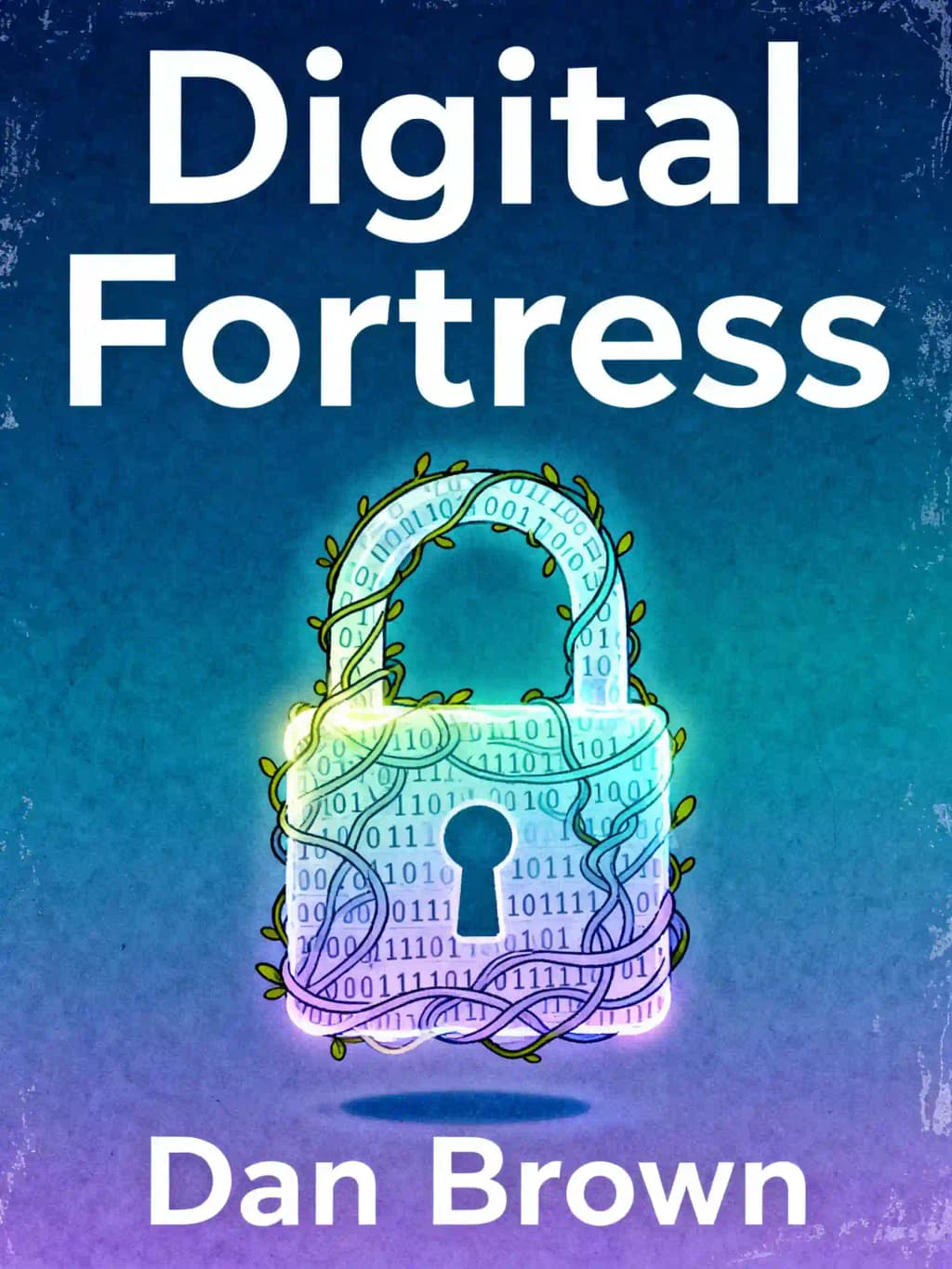
Dan Brown's techno-thriller has captivated over 10 million readers worldwide since its 1998 release, earning praise from both the cybersecurity community and literary critics. A favorite of Bill Gates, who called it "frighteningly plausible," Digital Fortress anticipated our modern privacy debates decades before Edward Snowden. The novel's exploration of the tension between national security and personal privacy remains startlingly relevant in today's surveillance-heavy world. When the NSA's most brilliant cryptographer discovers a code that cannot be broken, she's thrust into a deadly game of international intrigue where nothing is as it seems-and the fate of America's most classified secrets hangs in the balance.
Kapitel 2
Inside the Fortress: The NSA's Secret Weapon
Deep within the National Security Agency's headquarters lies a technological marvel known only to those with the highest security clearances: TRANSLTR. This massive supercomputer, rising twenty-three feet above the floor of a circular chamber called Crypto, represents America's most powerful weapon in the digital age-not a missile or bomb, but a code-breaking machine. Like an iceberg, 90% of its mass extends six stories underground, surrounded by cooling systems that keep its three million processors from melting down. The facility consumes enough electricity to power a small city, with backup generators ensuring continuous operation even during widespread power failures.
TRANSLTR was born of necessity when the Internet revolution changed intelligence gathering forever. As public awareness of government surveillance grew, programmers developed encryption software allowing users to scramble their messages into unbreakable code. These encryption methods used pass-keys functioning like PIN numbers, making messages readable only to those with the key. Commercial encryption programs like PGP (Pretty Good Privacy) became widely available, allowing anyone from business executives to potential terrorists to communicate in complete secrecy.
As encryption grew more sophisticated, the NSA faced increasingly complex codes with keys over fifty characters long, creating 10^120 possible combinations - a number greater than all the atoms in the universe. Breaking such codes through traditional means could take decades, rendering intercepted intelligence useless. The NSA's response was TRANSLTR-a $1.9 billion quantum computing machine designed to try every possible key combination simultaneously until finding the right one. The project was so classified that even most NSA employees believed it was merely a theoretical concept.
Despite engineers' doubts, TRANSLTR succeeded brilliantly, breaking a sixty-four-character key in just twelve minutes instead of the expected two decades. Commander Trevor Strathmore, the NSA's Deputy Director of Operations, immediately leaked false information that the project had failed, while TRANSLTR secretly began cracking hundreds of codes daily, becoming America's silent guardian against terrorist plots and foreign threats. The machine's existence was protected by multiple layers of security, including armed guards, retinal scanners, and a sophisticated climate control system that would detect any unauthorized presence.
For cryptographer Susan Fletcher, TRANSLTR represents both technological triumph and ethical quandary. The machine's existence enables the NSA to read anyone's encrypted communications-a power that could be used for good or ill. This tension between security and privacy forms the central conflict that will soon explode into a crisis threatening the entire intelligence community. Fletcher's expertise in cryptography makes her uniquely aware of both TRANSLTR's capabilities and its potential for abuse, especially in an era where digital privacy is increasingly viewed as a fundamental right. The machine's ability to break any code raises serious questions about the balance between national security and individual liberty, questions that become more pressing as digital communication becomes increasingly central to modern life.
Kapitel 3
The Unbreakable Algorithm: Digital Fortress Emerges
Susan Fletcher's peaceful Saturday morning is violently disrupted when Commander Trevor Strathmore's urgent call pulls her into what will become the NSA's most critical crisis. Racing through the agency's labyrinthine corridors, she arrives at Crypto, where Strathmore's glass-walled office-nicknamed "the fishbowl" for its transparent walls and fishbowl-like acoustics-houses a revelation that will shake the foundations of global intelligence.
Inside, Strathmore reveals the impossible: TRANSLTR, the NSA's three-million-dollar decryption supercomputer, has been grinding away at a single file for over fifteen hours without success. For a machine designed to crack the most sophisticated codes in minutes-processing an astounding thirty million keys per second through its rotating matrix of processors-this unprecedented failure signals something revolutionary and terrifying.
"This code is unbreakable," Strathmore announces, his words violating the sacred Bergofsky Principle, the mathematical certainty that has guided cryptography for decades: given enough time and processing power, any code can be broken. This new algorithm, dubbed Digital Fortress, employs an ingenious rotating cleartext function that continuously shifts its encryption pattern, effectively blinding TRANSLTR to successful decryption attempts. The machine can't recognize when it's found the right key because the target keeps moving.
The creator's identity makes the threat even more ominous: Ensei Tankado, once the NSA's most brilliant cryptographer, whose departure from the agency three years ago ended in bitter accusations and thinly veiled threats. His life story reads like a modern Greek tragedy, filled with suffering and redemption. Born in Nagasaki in 1965, his body was devastated by radiation from Hiroshima's aftermath, leaving him with severe physical deformities. Abandoned by his father and shuttled through foster homes, young Tankado initially channeled his pain into hatred of America. However, his discovery of Buddhism gradually transformed that hatred into understanding and forgiveness.
Tankado's extraordinary gift for mathematics and computer programming made him legendary in coding circles, earning him the nickname "Nuke" for his ability to devastate any encryption system. The NSA recruited him to help design TRANSLTR, assuring him the system would only be used with proper judicial oversight. When Tankado discovered these promised safeguards had been eliminated, allowing unlimited surveillance of private communications, his sense of betrayal was absolute.
His final day at the NSA became infamous within the agency. As security officers escorted him out, Tankado made a chilling vow that now seems prophetic: "We all have a right to keep secrets. Someday I'll see to it we can." That day has arrived with devastating precision.
Tankado's masterpiece is both elegant and devastating in its simplicity. He's already uploaded an encrypted copy of Digital Fortress to the internet, protected by its own unbreakable algorithm-a perfect, impenetrable loop. The pass-key to unlock it is being auctioned to the highest bidder, with a public announcement scheduled for noon tomorrow. If released, Digital Fortress would become the new global standard for encryption, rendering TRANSLTR obsolete and effectively blinding U.S. intelligence operations worldwide. Every computer user, from teenage hackers to sophisticated crime syndicates, would have access to unbreakable encryption.
The crisis takes an unexpected turn with news from Spain: Ensei Tankado has been found dead in Seville's Plaza de America, his body discovered by tourists in the early morning hours. His death, while solving one problem, may have created an even greater one-the location of the critical pass-key now lies buried with its creator.
Kapitel 4
A Professor's Dangerous Mission in Spain
While Susan grapples with the Digital Fortress crisis at NSA headquarters, her fiance David Becker finds himself unexpectedly boarding a Learjet bound for Spain. A university professor with no intelligence training, David has been recruited by Strathmore for what should be a simple task: collect the belongings of a Japanese tourist who died of a heart attack in Seville.
What David doesn't know is that the tourist was Ensei Tankado, and Strathmore is desperately searching for the Digital Fortress pass-key. When David arrives at the Seville morgue, he carefully examines Tankado's corpse and notices something crucial-a pale band of skin on the dead man's deformed hand indicates a missing ring. The Spanish lieutenant reveals that the Canadian tourist who reported the death had mentioned a ring, but this vital detail wasn't communicated to David.
Thus begins David's increasingly dangerous mission through Seville. He tracks the ring's path from a Canadian tourist named Cloucharde to a German tourist and his red-headed escort named "Dewdrop" (or Rocio in Spanish). Each encounter pulls David deeper into danger as he races against time to recover the ring that might contain the pass-key engraved in its surface.
At the Alfonso XIII hotel, David discovers Rocio no longer has the ring-she gave it away to a young punk girl in the park due to Gypsy superstitions about keeping items from the dead. The girl, who wasn't Spanish but likely British, had "red, white, and blue" hair and wore a British flag T-shirt. David's pursuit takes him to Club Embrujo, a chaotic punk rock venue filled with potential matches.
What David doesn't realize is that he's being hunted. A deaf assassin with wire-rim glasses named Hulohot is following his every move, leaving a trail of bodies in his wake. This professional killer has already murdered the German tourist and his escort, and now has David in his sights. As David closes in on the ring, he finds himself in an increasingly deadly game of cat and mouse through Seville's ancient streets.
The simple favor for Strathmore has evolved into a desperate fight for survival, with David using his wits to stay one step ahead of a killer who will stop at nothing to obtain Tankado's ring. His only thought as he flees through the labyrinthine alleys of Seville's old quarter: will he ever see Susan again?
Kapitel 5
The Enemy Within: Deception in the NSA's Inner Sanctum
Back at the NSA, Susan's investigation takes a shocking turn when cryptographer Greg Hale enters Node 3, the private chamber where she's working. Nicknamed "Halite" by colleagues, Hale is a former Marine programmer with a checkered past. Susan recalls how he was hired during the Skipjack fiasco-when he publicly exposed a back door Commander Strathmore had secretly inserted into a government encryption standard, creating a national scandal.
When Susan's tracer program searching for Tankado's partner "North Dakota" mysteriously aborts, she discovers someone manually terminated it while she was speaking with Strathmore. Suspecting Hale, she searches his terminal and makes a stunning discovery-emails between Tankado and NDAKOTA@ARA.ANON.ORG. The messages reveal they were collaborating on Digital Fortress, using mutation strings and rotating cleartext to create an algorithm that would "set the NSA back decades."
Susan realizes the unthinkable: Greg Hale is North Dakota, Tankado's partner. Before she can process this revelation, Hale returns to Node 3, nearly catching her at his terminal.
The situation grows more complicated when Phil Chartrukian, a systems security technician, discovers TRANSLTR has been running for over fifteen hours-something he's never witnessed before. Suspecting a virus infection, he confronts Strathmore, who claims he's running a diagnostic. Unconvinced and unable to reach senior Sys-Sec officer Jabba, Chartrukian decides to manually shut down TRANSLTR from the sublevels before any potential virus can spread to the NSA's main databank.
As tensions escalate, Chartrukian mysteriously falls to his death in TRANSLTR's cooling system, shorting the main power. The Crypto floor plunges into darkness except for faint twilight through the dome and red glow from the open trapdoor. Susan discovers Greg Hale crouched in the shadows near the body, seemingly confirming her suspicions about his treachery.
Strathmore seals Hale in the sublevels by closing the trapdoor, but when Susan returns to Node 3, she discovers Hale has somehow escaped. He captures her, claiming Strathmore killed Chartrukian and begging for her help. Susan manages to escape by shattering Node 3's glass wall, leaving Hale injured behind her.
The web of deception grows more tangled as Susan begins to question who she can trust. Is Hale truly North Dakota? Is Strathmore hiding something? And what is the true nature of Digital Fortress? In the darkened halls of Crypto, with power failing and TRANSLTR running hot, Susan must unravel these mysteries before it's too late.
Kapitel 6
The Cathedral Confrontation: A Deadly Chase Through Seville
David Becker's desperate pursuit of the ring culminates at the Seville airport where he tracks down Megan, a purple-haired punk teenager wearing multiple piercings. Their initial encounter turns violent when she, mistaking him for a stalker, unleashes a stream of pepper spray directly into his eyes. Through watering eyes and burning pain, David manages to convince her of his legitimate mission, explaining his connection to the NSA and the ring's importance. Megan reluctantly surrenders the ring, a simple gold band bearing an inscription that appears to be Latin, though David can't decipher it in the dim airport lighting. His relief is short-lived-moments later, he discovers Megan's body slumped in the women's restroom, a precise bullet wound centered in her forehead, blood staining the white tile floor.
The assassin Hulohot, a gray-haired killer wearing wire-rim glasses and a leather jacket, emerges from the shadows wielding a silenced Beretta. His cold efficiency marks him as a professional. David, running purely on instinct, hurls himself through the revolving door as bullets spider-web the glass behind him. He reaches his rented Vespa, the engine sputtering to life as more shots ping off nearby vehicles. Hulohot commandeers a yellow taxi, forcing the driver out at gunpoint, initiating a frantic chase through Seville's winding streets.
The pursuit weaves through the city's historic quarter, past outdoor cafes and startled tourists, until David abandons his failing scooter and plunges into Barrio Santa Cruz. This medieval maze of cobblestone alleys, some barely shoulder-width, proves too narrow for vehicles. The ancient neighborhood, with its whitewashed walls and wrought-iron balconies, becomes both haven and trap.
The massive Seville Cathedral looms ahead, its Gothic spires piercing the morning sky. David slips inside during early mass, joining hundreds of worshippers in the world's largest Gothic cathedral. The interior's vast columns and soaring vaults offer countless hiding places. When Hulohot enters moments before the huge bronze doors seal shut, David finds himself in a deadly game of cat and mouse among the chapel's ninety-foot pillars and ornate side altars.
As communion begins unexpectedly early, David realizes he'll be exposed in the procession. In a desperate improvisation, he approaches a well-dressed Spanish banker, offering five thousand pesetas for his black blazer. The deception works-Hulohot mistakes the banker for his target, firing a fatal shot that echoes through the sacred space. During the ensuing chaos, a red-faced cardinal, secretly drinking sacramental wine in a side chapel, shows David a concealed door leading to the Giralda tower.
The final confrontation unfolds in the ancient minaret-turned-bell tower, where David ascends the same ramp once used by mounted guards. Trapped at the top, hearing Hulohot's measured footsteps approaching, David grabs a ceremonial candle pole. In a perfectly timed move, he extends it across the spiral ramp, catching Hulohot's legs mid-stride. The assassin tumbles backward, his body making sickening impacts against the stone walls before coming to rest at the bottom, neck bent at an impossible angle.
Exhausted and nursing various wounds, David retrieves Hulohot's weapon and finally examines the ring closely. The Latin inscription reads: "Quis custodiet ipsos custodes" - Who will guard the guards? The ancient question takes on new urgency as two military operatives suddenly appear, calling him by name. When David attempts to flee, one raises his weapon. The last thing David sees is the muzzle flash before darkness claims him.
Kapitel 7
The Truth Revealed: Strathmore's Fatal Gambit
As TRANSLTR continues its marathon processing run, Susan makes a shocking discovery-there is no North Dakota. The entire persona was an elaborate hoax created by Tankado himself, who had been sending emails to himself through anonymous remailers to create the illusion of a partner. There was never a second pass-key.
The realization hits her with devastating force: Digital Fortress isn't an unbreakable algorithm at all, but a virus Strathmore unknowingly introduced by bypassing Gauntlet's security filters. Even "NDAKOTA" itself was a mocking anagram for "TANKADO."
When Susan confronts Strathmore, he reveals his true plan-a global intelligence coup attempted single-handedly. After acquiring Digital Fortress, he intended to secretly insert a back door into the algorithm before releasing it as the new worldwide encryption standard. This would give the NSA continued access to all encrypted communications while appearing to concede defeat.
But Strathmore's ambition led him into a trap. The virus is now infiltrating the NSA's main databank, with a message demanding they "TELL THE WORLD ABOUT TRANSLTR" to save themselves. Susan realizes Tankado's ring contains the pass-key to deactivate the virus-his plan wasn't to destroy the databank but to force the NSA to reveal TRANSLTR's existence.
As the situation deteriorates, Strathmore becomes increasingly unstable. He confesses his love for Susan and reveals he sent Hulohot to kill Tankado and retrieve the pass-key. When that failed, he recruited David instead, never telling Susan the true danger of the mission. Most horrifying of all, Strathmore admits to pushing Chartrukian to his death and framing Hale with a fabricated suicide note.
The commander's obsession has cost multiple lives, and now threatens the entire NSA. When Susan discovers a message on Strathmore's pager indicating David has been "terminated," she breaks free from the commander's grasp and races to escape. Behind her, TRANSLTR's processors ignite at the base of the silo, creating a fireball that races upward.
In the final moments before the explosion, Strathmore stands before the inferno, seeing in Susan's eyes not heaven but the death of trust. As TRANSLTR's casing shatters and oxygen rushes in, Strathmore is consumed in a brilliant flash while Susan is blown backward into his office.
Commander Trevor Strathmore-brilliant strategist, patriot, and ultimately villain-dies in the flames of his own ambition, a victim of Tankado's revenge and his own fatal pride.
Kapitel 8
The Final Countdown: Race Against Digital Destruction
In the NSA's main databank command center, a crisis unfolds on massive screens. Director Leland Fontaine, Susan Fletcher, and the agency's top technical experts watch as Tankado's worm systematically destroys their security shields. Unlike a virus that replicates, this worm is targeting the five-tier security system protecting the NSA's most classified information.
The visual representation shows the outermost shield already failing, with four more to follow. Once all shields fall, every byte of classified NSA information-covert operations, witness protection details, launch codes-will become public domain. They have less than an hour before complete vulnerability.
Jabba, the NSA's massive computer security expert, urges Fontaine to shut down the databank immediately, though the complex process would take thirty minutes. Susan reveals that Tankado gave away the pass-key when he died, and Strathmore had sent David to find it.
In a stunning twist, Director Fontaine reveals David Becker is alive. The "termination" message referred to Hulohot, not David. The agents Fontaine secretly sent to monitor the situation in Spain show David on screen, wounded but conscious in their surveillance van.
With the security shields failing rapidly, the team discovers strange "orphans" in the worm's code-four-letter groups that serve no programming purpose. When arranged in an 8x8 grid and read vertically rather than horizontally, they reveal a message: "PRIME DIFFERENCE BETWEEN ELEMENTS RESPONSIBLE FOR HIROSHIMA AND NAGASAKI."
As hackers worldwide begin swarming toward the exposed databank, the team races to solve this final puzzle. They realize "elements" refers to chemical elements-the uranium isotopes used in the atomic bombs. David calculates that the difference between uranium isotopes U238 and U235 is three, while Susan simultaneously realizes Tankado wasn't showing his ring in his final moments but holding up three fingers.
Three-a prime number-is the kill-code they've been seeking. Susan enters it just as the databank is being breached. After tense seconds, the system confirms the code and reinstates all firewalls. The attack is thwarted with minimal data loss, and America's secrets remain secure.
In the aftermath, Susan learns the full truth about Tankado's motivations. His plan was never to destroy the NSA but to force transparency about government surveillance-to make those who guard our secrets accountable to the public they serve. His dying message, both literal and figurative, was a question that haunts intelligence agencies worldwide: "Who will guard the guards?"
Kapitel 9
Love Without Wax: Redemption and Revelation
The epilogue brings both closure and new beginnings. Susan awakens at Stone Manor to find David watching her from across the room. Having survived his ordeal in Spain, he's resigned as department chair to return to teaching, while Susan plans to publish her ideas on variant filter protocols-lessons learned from the Digital Fortress crisis.
David proposes marriage with a diamond ring, and Susan accepts with one condition-that he finally explain his signature phrase "without wax." Though he playfully refuses to reveal its meaning, we learn it comes from sculptors who created flawless works "sincera" (without wax patches), the origin of the word "sincerely." It's a fitting metaphor for their relationship, built on truth rather than deception.
Meanwhile in Osaka, Tokugen Numataka-the powerful Japanese executive who had agreed to pay twenty million dollars for Digital Fortress-stands over a casket. He's learned he is the deceased's only living relative. Thirty-two years ago, he abandoned his deformed child and dying wife in the name of honor and face. Among the adoption papers and birth records is a golden ring engraved with words he doesn't understand.
With bitter clarity, Numataka realizes fate has cruelly reunited him with the son he forsook-Ensei Tankado. The man who nearly brought down the NSA was seeking not just revenge against American surveillance, but perhaps unconsciously, against the father who rejected him for his imperfections.
Digital Fortress ultimately explores the consequences of our choices-personal and political. Strathmore's well-intentioned patriotism twisted into deadly obsession. Tankado's righteous crusade for privacy led to his death. Numataka's abandonment of his son came full circle in tragic irony.
In a world increasingly defined by digital surveillance and the tension between security and privacy, Brown's thriller poses questions that have only grown more relevant with time: How much of our privacy are we willing to sacrifice for security? Who watches those who watch us? And perhaps most importantly, what happens when the guardians of our secrets become corrupted by power or noble intentions?
As Susan and David begin their life together, these questions remain unanswered-just as they do in our own world, where the balance between privacy and security continues to evolve with each technological advance and each new threat to national safety.