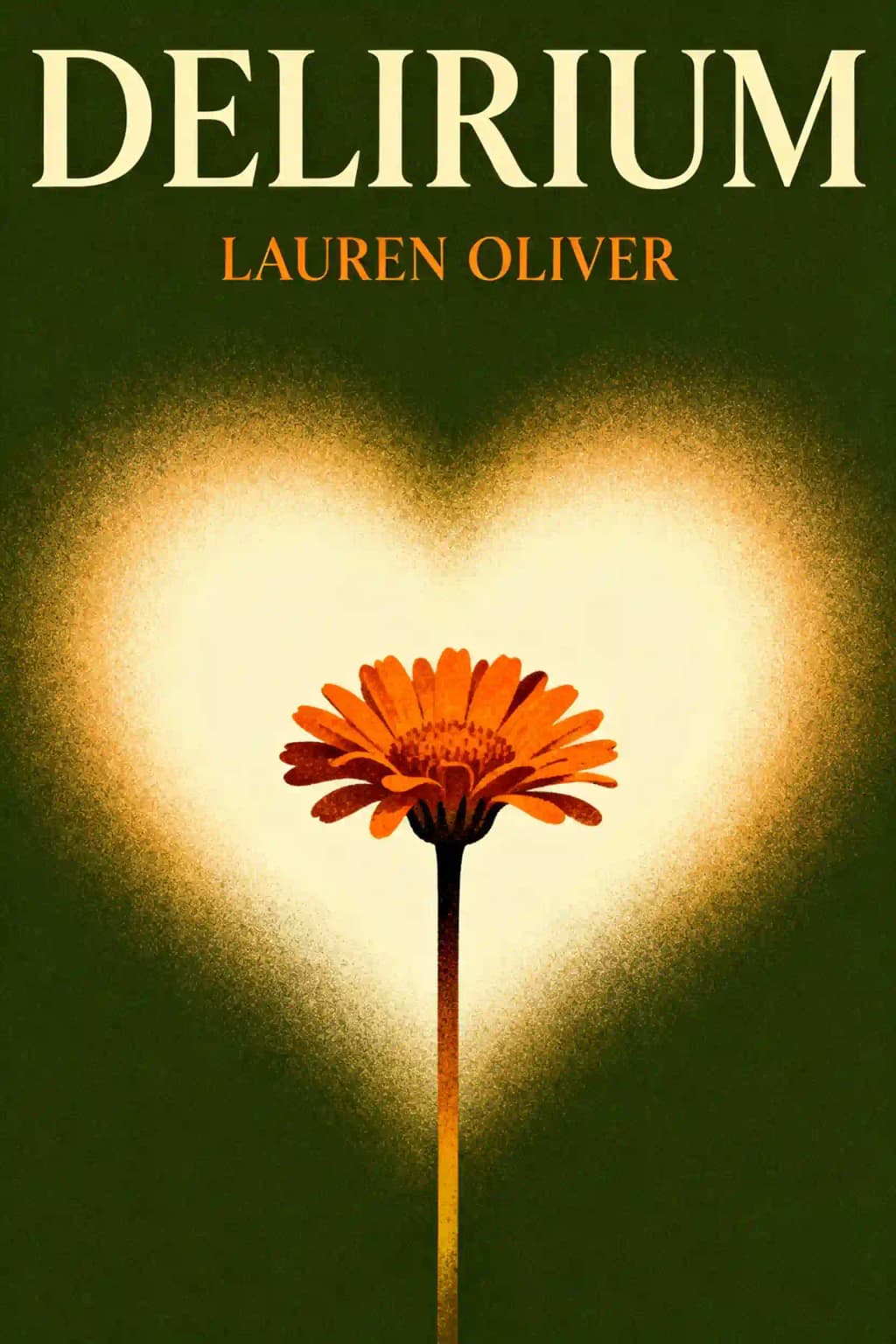
In "Delirium," love is a disease to be cured. Lauren Oliver's poetic dystopian masterpiece - translated into 30+ languages and named Best Book by USA Today - imagines a world where feeling nothing means surviving everything. What would you sacrifice for forbidden emotion?
Lauren Oliver is the New York Times bestselling author of Delirium, a dystopian young adult novel that reimagines love as a deadly disease cured by government mandate. The first book in the Delirium trilogy, it explores themes of freedom, emotion, and control in a society where feelings are eradicated. Inspired by Gabriel García Márquez's assertion that "all good books are about love or death," Oliver created a world where love itself is pathologized.
A University of Chicago graduate who studied philosophy and literature, Oliver earned her MFA from NYU. She is also a screenwriter and co-founder of Glasstown Entertainment. Her debut novel, Before I Fall, was adapted into a motion picture that premiered at Sundance, and she created and wrote every episode of Amazon Prime's Panic.
The Delirium trilogy has sold over two million copies and been translated into more than thirty-five languages, establishing Oliver as a leading voice in young adult dystopian fiction.
Delirium by Lauren Oliver is a dystopian young adult novel set in Portland, Maine, where love has been classified as a deadly disease called amor deliria nervosa. The story follows 17-year-old Lena Haloway, who eagerly awaits her 18th birthday when she'll receive a mandatory procedure that removes all emotions and prevents falling in love. However, when Lena meets Alex Warren, an uncured boy from the Wilds, she begins questioning everything she's been taught about love, safety, and freedom.
Delirium by Lauren Oliver is ideal for young adult readers aged 13-19 who enjoy dystopian romance and thought-provoking fiction. The book appeals to fans of The Hunger Games and Divergent who appreciate stories exploring themes of rebellion, forbidden love, and individual freedom versus societal control. Readers who enjoy emotionally engaging narratives with strong character development and vivid world-building will find Lauren Oliver's writing particularly compelling.
Delirium by Lauren Oliver is worth reading for its creative dystopian premise and masterful emotional storytelling. Lauren Oliver's flawless writing vividly describes each scene and evokes powerful emotions that transcend boundaries, making readers feel every moment alongside Lena. The novel challenges readers to consider what makes life meaningful and whether a safe, emotionless existence is preferable to one filled with both love and pain.
Amor deliria nervosa, also called "delirium," is the fictional disease that love has been classified as in Lauren Oliver's dystopian world. In this society, love is considered life-threatening and dangerous, prompting the government to mandate a lobotomy-like procedure that removes all heightened emotions and prevents people from falling in love. The cure is performed on all citizens shortly after their 18th birthday to create what authorities believe is a more stable and safe society.
Lena Haloway undergoes a dramatic transformation in Delirium by Lauren Oliver, evolving from an obedient girl who believes in the cure to a rebel willing to risk everything for love. After meeting Alex Warren at an illegal party, Lena experiences forbidden emotions and discovers shocking truths about her mother, who supposedly died from delirium but may actually be alive. When authorities discover their relationship, Alex rescues Lena and they attempt to escape to the Wilds, where Lena crosses the fence to freedom while Alex sacrifices himself to ensure her survival.
The central message of Delirium by Lauren Oliver is that a life without love is not worth living. Lauren Oliver explores how eliminating emotions to achieve safety creates an emotionless shell of a community where parents show no compassion for children and married couples exchange no affection. The novel teaches readers to embrace both the joys and pains of human emotion, fight for the right to choose one's own fate, and recognize that genuine happiness requires the freedom to feel deeply.
Delirium by Lauren Oliver ends with a devastating cliffhanger as Lena and Alex race toward the Wilds while being chased by government agents. Lena successfully makes it over the fence into freedom and safety in the Wilds, but Alex stays behind, sacrificing himself so that Lena can escape. The ambiguous ending leaves readers uncertain about Alex's fate and sets up the continuation in the sequel, Pandemonium, creating emotional tension that resonates powerfully with the book's themes of love and sacrifice.
Delirium by Lauren Oliver explores several interconnected themes including love as essential to humanity, individual freedom, and rebellion against oppressive social control. The novel examines the cost of sacrificing human emotions for perceived safety and stability, questioning whether conformity truly leads to happiness. Additional themes include:
The Wilds in Delirium by Lauren Oliver represent freedom, authenticity, and life beyond government control. This untamed territory outside Portland is home to Invalids—uncured people who live with their emotions intact and reject the mandatory procedure. While the government portrays the Wilds as dangerous, they symbolize the possibility of choosing one's own path and living an emotion-filled life despite risks. The ambiguity surrounding what life is truly like in the Wilds allows readers to imagine the full spectrum of human experience beyond the regulated society.
Yes, Delirium by Lauren Oliver is the first book in the Delirium trilogy. The series continues with Pandemonium (Book 2) and Requiem (Book 3), following Lena's journey after her escape to the Wilds. The cliffhanger ending of Delirium, where Alex's fate remains uncertain and Lena begins her new life in freedom, sets up the continuing narrative in subsequent books. Lauren Oliver also wrote companion novellas that expand the series universe and provide additional character perspectives.
Delirium by Lauren Oliver is appropriate for readers aged 13-19 years and is classified as young adult fiction. The American Library Association recommends it for ages 12-18 as quality literature that appeals to teen readers. While the book contains mature themes including forbidden romance, government oppression, and references to death, Lauren Oliver handles these topics in an age-appropriate manner that resonates with teenage audiences navigating questions about identity, autonomy, and emotional authenticity.
Delirium by Lauren Oliver stands out among dystopian novels through its unique premise of love being classified as a disease rather than focusing on traditional dystopian elements like resource scarcity or class warfare. While comparable to The Hunger Games and Divergent in its young adult dystopian setting, Delirium places greater emphasis on emotional authenticity and romance as acts of rebellion. Lauren Oliver's masterful writing style and emotionally evocative prose create deeper character connections than many comparable dystopian novels, making readers feel Lena's emotions intensely throughout her transformation.
Erlebe das Buch durch die Stimme des Autors
Verwandle Wissen in fesselnde, beispielreiche Erkenntnisse
Erfasse Schlüsselideen blitzschnell für effektives Lernen
Genieße das Buch auf unterhaltsame und ansprechende Weise
I love you. Remember. They cannot take it.
Safety, Sanctity, Community.
It will kill me, it will kill me, it will kill me. And I don't care.
Zerlegen Sie die Kernideen von Delirium Trilogy Delirium Pandemonium Requiem in leicht verständliche Punkte, um zu verstehen, wie innovative Teams kreieren, zusammenarbeiten und wachsen.
Destillieren Sie Delirium Trilogy Delirium Pandemonium Requiem in schnelle Gedächtnisstützen, die die Schlüsselprinzipien von Offenheit, Teamarbeit und kreativer Resilienz hervorheben.

Erleben Sie Delirium Trilogy Delirium Pandemonium Requiem durch lebhafte Erzählungen, die Innovationslektionen in unvergessliche und anwendbare Momente verwandeln.
Fragen Sie alles, wählen Sie die Stimme und erschaffen Sie gemeinsam Erkenntnisse, die wirklich bei Ihnen ankommen.

Von Columbia University Alumni in San Francisco entwickelt
"Instead of endless scrolling, I just hit play on BeFreed. It saves me so much time."
"I never knew where to start with nonfiction—BeFreed’s book lists turned into podcasts gave me a clear path."
"Perfect balance between learning and entertainment. Finished ‘Thinking, Fast and Slow’ on my commute this week."
"Crazy how much I learned while walking the dog. BeFreed = small habits → big gains."
"Reading used to feel like a chore. Now it’s just part of my lifestyle."
"Feels effortless compared to reading. I’ve finished 6 books this month already."
"BeFreed turned my guilty doomscrolling into something that feels productive and inspiring."
"BeFreed turned my commute into learning time. 20-min podcasts are perfect for finishing books I never had time for."
"BeFreed replaced my podcast queue. Imagine Spotify for books — that’s it. 🙌"
"It is great for me to learn something from the book without reading it."
"The themed book list podcasts help me connect ideas across authors—like a guided audio journey."
"Makes me feel smarter every time before going to work"
Von Columbia University Alumni in San Francisco entwickelt

Erhalten Sie die Delirium Trilogy Delirium Pandemonium Requiem-Zusammenfassung als kostenloses PDF oder EPUB. Drucken Sie es aus oder lesen Sie es jederzeit offline.
Imagine a society where the most fundamental human emotion is classified as a disease. Where teenagers count down to their eighteenth birthday not for freedom, but for a mandatory brain procedure that will permanently remove their capacity to love. This is the chilling reality of Portland, Maine, sixty-four years after love-officially termed "amor deliria nervosa"-was declared the deadliest of all diseases. For seventeen-year-old Lena Haloway, the procedure represents salvation. Unlike many peers who fear the operation, Lena can't wait to be "cured." Her mother committed suicide when Lena was six, unable to overcome her love for Lena's father-a family tragedy that has marked Lena as potentially "sympathetic" to the disease and desperate to prove her commitment to the cure. The government's safety manual, The Book of Shhh, has shaped her entire worldview, convincing her that emotional detachment equals security and that the procedure will protect her from suffering her mother's fate. The society's dehumanizing mechanics are on full display during Lena's evaluation-the process determining her future husband and social standing. Standing nearly naked before four evaluators, Lena endures scrutiny of everything from her physical appearance to her personal preferences. She's been carefully coached by her aunt Carol to give generic, inoffensive answers: blue or green as her favorite color, appropriately feminine hobbies, and absolutely no hint of independent thinking. This system reveals the underlying social engineering at work-by matching people based on superficial compatibility rather than emotional connection, the government creates stable but passionless partnerships. What makes this dystopian world particularly disturbing is how thoroughly its citizens have internalized its logic. The system has effectively weaponized Lena's trauma, turning her fear of emotional pain into willing compliance with a regime that denies humanity's most fundamental connection.