Kapitel 1
Unlocking the Enigma of Mind
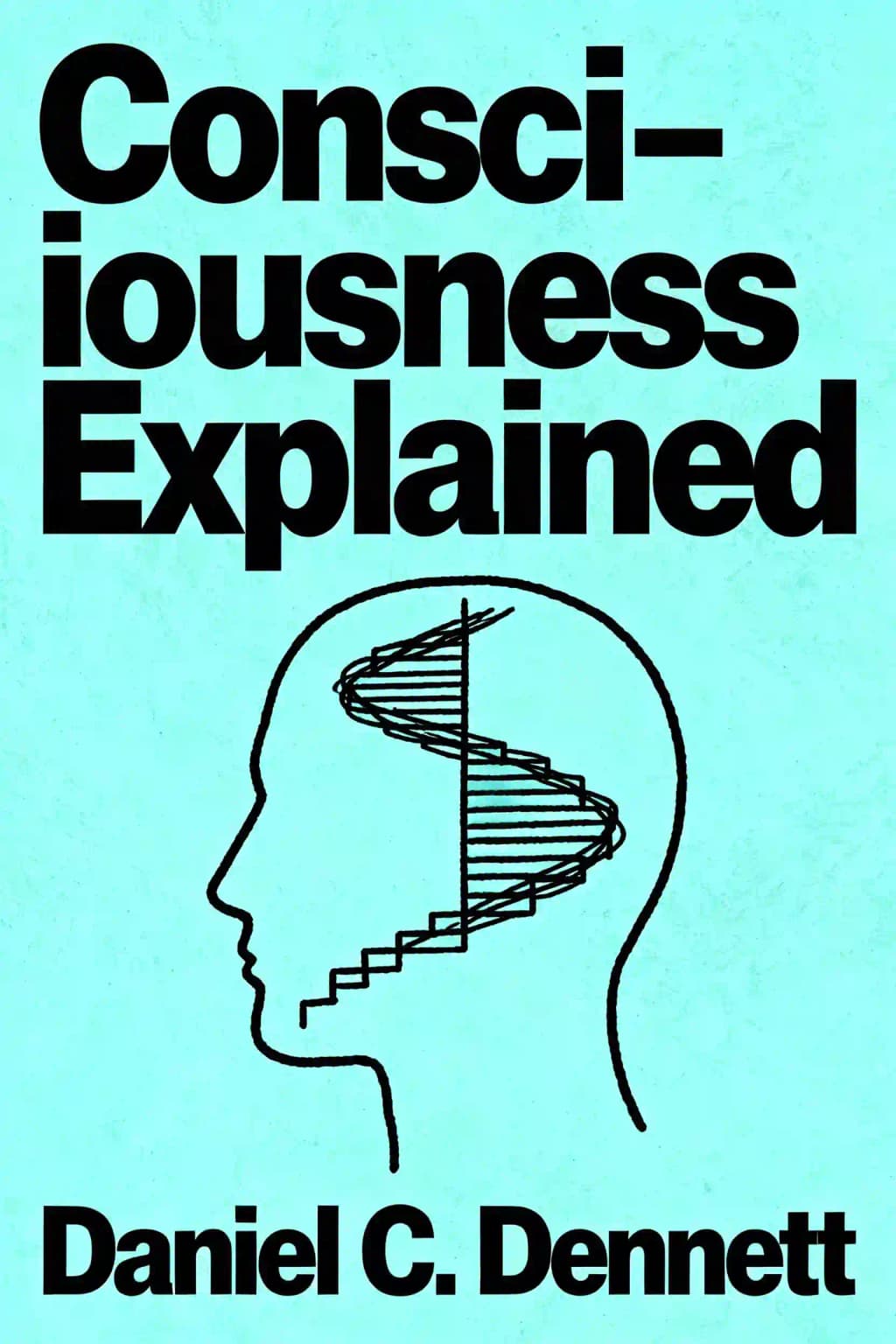
Consciousness Explained has become one of the most influential-and controversial-books in modern philosophy of mind since its publication in 1991. Daniel Dennett's ambitious work has been hailed by Richard Dawkins as "a landmark in our understanding of the human mind" and by Douglas Hofstadter as "a counterintuitive but compelling alternative to the common-sense view of consciousness." The book represents Dennett's attempt, after thirty years of exploration, to sketch an outline of the solution to the mind-body problem that has fascinated philosophers since Descartes: how could thoughts and feelings exist in the same world as brain cells and molecules?
Kapitel 2
Dismantling the Cartesian Theater
At the heart of Dennett's theory lies a fundamental rejection of what he calls the "Cartesian Theater"-the intuitive but misleading idea that consciousness happens at a specific place and time in the brain, where all sensory information comes together to be observed by an internal "audience." This notion creates an infinite regress problem: who's watching the show in the theater? Another little person inside that person's head? And who's watching that show?
Instead, Dennett proposes the "Multiple Drafts" model of consciousness. In this view, all perception and thought occur through parallel, multitrack processes of interpretation and elaboration. Information entering the nervous system undergoes continuous "editorial revision" through distributed processes throughout the brain. There is no single canonical version or "final draft" that constitutes consciousness-rather, multiple "drafts" of narrative fragments exist at various stages of editing throughout the brain.
This model resolves puzzling phenomena like the phi effect (where two different colored dots flashed in sequence appear to change color mid-movement) without resorting to "backwards time referral." When we experience such illusions, it's not that our brain somehow sends information backward in time; rather, the brain simply makes its best interpretation of the sequence after receiving all relevant information.
The Multiple Drafts model also explains why there can be no definitive answer to questions like "exactly when did you become conscious of stimulus X?" Such questions falsely assume consciousness happens at a precise moment, when in reality, it emerges from distributed processes occurring over hundreds of milliseconds. Probing consciousness at different intervals produces different narratives, with no single "correct" version representing the definitive moment of consciousness.
Kapitel 3
The Evolution of Consciousness
Consciousness didn't appear suddenly but evolved gradually from simpler precursors. Dennett traces this evolution through three successive processes: genetic evolution, phenotypic plasticity, and memetic evolution.
The evolutionary story begins with simple replicators that created the first "point of view" from which events could be classified as favorable or unfavorable. These entities brought reasons into existence before these reasons could be recognized. Self-preservation necessitated boundaries-the primordial selfishness that marks life-distinguishing "me" from "the world."
As organisms became more complex, they developed increasingly sophisticated ways of "producing future"-anticipating events rather than merely reacting to them. Early organisms could only manage proximal anticipation, but evolution favored those that could extract information faster and avoid threats before contact. Nature selected for "lucky anticipators"-makeshift systems that track regularities in the environment, trading off accuracy for speed and economy.
The Baldwin Effect accelerated this process. When a population has variation in brain wiring, with only one specific configuration offering a survival advantage, plasticity allows individuals to explore and potentially find this configuration during their lifetime. Those born closer to the optimal wiring have an advantage since they can find the beneficial behavior more easily. Over generations, the population genetically shifts toward being born with this wiring already in place.
The third and most transformative evolutionary process involved memes-cultural replicators that spread through imitation. Words, ideas, and technologies began evolving according to their own replicative success, not necessarily for our benefit. Our minds themselves are artifacts created when memes restructure our brains to better accommodate them, explaining why literate minds differ from illiterate ones, and why Chinese minds differ from French minds.
Kapitel 4
The Joycean Machine: How Language Transforms Consciousness
Human consciousness operates as a virtual machine implemented on neural hardware never designed for such activities. This "Joycean machine" (named after author James Joyce's stream-of-consciousness writing style) helps solve critical problems like self-exhortation, self-monitoring, and social simulation through introspection. Much like how computer software can run sophisticated programs on basic hardware, our consciousness emerges from neural structures originally evolved for simpler tasks.
Our capacity for self-stimulation evolved as an accidental byproduct of social communication. When early hominids who already used vocalizations to communicate accidentally "asked" questions when no one was around, they discovered they could provoke themselves into answering their own questions. This self-questioning might have started with simple survival-related queries like "Where did I see those berries?" or "Which way leads home?" This autostimulation created "virtual wires" between brain subsystems that weren't directly connected, essentially bootstrapping new cognitive capabilities from existing neural architecture.
These habits of vocal self-stimulation were refined over time-first becoming sotto voce self-talk, then entirely silent internal dialogue. Children demonstrate this progression clearly - from loud self-talk during play to whispered private speech, and finally to silent internal monologue. Though not the most efficient possible neural architecture, this jury-rigged solution was readily available and effective. Other forms of autostimulation emerged too, like drawing pictures that triggered useful associations, creating maps in sand, or using fingers for counting - all external aids that became internalized as mental tools.
Language fundamentally transformed human consciousness by providing a scaffold for complex thought. When we ponder difficult problems, we engage in internal dialogue that helps shape exploration down well-trod paths. Through rehearsal, rhymes, rhythms, and multi-sensory associations, we discipline our brains into mature minds. Consider how we might solve a complex problem: we "talk it through" internally, test different verbal formulations, and often reach insights through this self-directed dialogue. Unlike a computer's precise fetch-execute cycle, our virtual machine relies on imperfect, wandering association chains-not guaranteed algorithms but better-than-chance forays into memory.
What makes this virtual machine conscious, unlike an unconscious computer? The key difference: the workings of our Joycean machine are "visible" and "audible" to our own perceptual systems-we use the same machinery to perceive our own thoughts as we use to perceive the external world. This self-perception creates a feedback loop where thoughts become objects of consciousness themselves, enabling metacognition - thinking about thinking. This recursive capability allows us to examine, refine, and direct our own thought processes in ways that distinguish human consciousness from simpler forms of awareness.
Kapitel 5
Pandemonium vs. Bureaucracy: How Words Get Themselves Said
Contemporary linguistics has largely ignored language production while focusing extensively on comprehension, creating a significant gap in our understanding of how we actually generate speech. Traditional models posit a problematic "Conceptualizer"-essentially a Central Meaner who generates "preverbal messages" for the "Formulator" to execute. This bureaucratic hierarchy model assumes an already determinate content as input and requires a carefully pre-designed flow of control, much like a corporate organizational chart where decisions flow from top to bottom.
Dennett proposes an alternative "pandemonium" model where speech begins as noise that gets progressively shaped by competing "word-demons"-a bottom-up rather than top-down process. In this model, multiple potential expressions vie for attention simultaneously, similar to how evolution works through natural selection rather than intelligent design. Language generation might be better understood as an evolutionary process where words compete for expression, with the strongest or most relevant emerging victorious. This explains why we often start sentences without knowing exactly how they will end, or why we sometimes surprise ourselves with our own word choices.
Authors often discover their intentions only after writing, a phenomenon that challenges the traditional model. E.M. Forster famously noted, "How do I know what I think until I see what I say?" This experience is common among writers who find their ideas crystallizing through the act of writing itself. Even in emotional situations like expressing love, we may discover our true feelings only upon hearing ourselves speak them. The traditional view assumes we have privileged access to our meanings, but this requires supporting evidence beyond tradition and seems to contradict lived experience.
Evidence against the Central Meaner includes numerous cases where our meaning becomes shattered or fragmented: Dennett once signaled "OUT" while yelling "SAFE!" as a baseball umpire, genuinely unsure which he meant. This type of conflict suggests multiple competing processes rather than a single controlling entity. Pathological conditions further demonstrate how verbalization can occur without central direction. Jargon aphasics produce fluent but meaningless speech without anxiety about their deficit, suggesting speech production can operate independently of meaning. Similarly, confabulators create entirely fictional accounts without awareness they're fabricating, demonstrating how narrative construction can occur automatically without conscious oversight.
These observations suggest that language production is more emergent and self-organizing than traditionally assumed, arising from the interaction of multiple competing processes rather than flowing from a central executive. This better explains phenomena like slips of the tongue, mixed metaphors, and the common experience of words "coming to us" rather than being consciously selected.
Kapitel 6
The Illusion of Detailed Perception
Our conviction that we directly experience rich, detailed visual scenes is an illusion of "virtual presence." Just as a library needn't store every book on its premises when it can retrieve them quickly through interlibrary loans, our brains don't need to represent every detail of our visual field internally. Instead, the world itself serves as external storage, with our visual system's "sentries" monitoring for changes and triggering saccades to bring the fovea to bear on anything interesting. This efficient system allows us to navigate complex environments while minimizing cognitive load.
Eye-tracking experiments demonstrate this dramatically: when words on a screen are changed during a saccade, readers remain completely unaware of the substitution. Even substantial alterations - changing entire words or phrases - go unnoticed if timed precisely with eye movements. This happens not because visual input is suppressed during saccades, but because there's no prior detailed representation to compare against. What seems like a rich, stable visual field is actually constructed through rapid sampling of the environment, with most details only "virtually present"-accessible when needed rather than continuously represented.
Consider seeing wallpaper with hundreds of Marilyn Monroe portraits. You foveate only one or two images, yet "instantly" perceive walls covered with identical detailed portraits. Your brain doesn't photocopy that high-resolution image across your visual field-it simply labels the region "more Marilyns" without rendering each one. This same principle applies to many everyday experiences: looking at a crowd of people, viewing a field of flowers, or scanning a bookshelf. We perceive the general pattern and extrapolate details only when we focus on specific areas.
The blind spot in our vision provides another compelling example of this phenomenon. It requires no "filling in" because the region is already labeled (e.g., "plaid" or "more of the same"). Since the brain never receives information from that retinal region, no "epistemically hungry agencies" demand to be fed from it-the area is simply neglected. We all "suffer" from a tiny bit of "anosognosia" regarding our blind spots-we're unaware of this visual deficit. This remarkable adaptation extends beyond the blind spot to our entire visual experience: we're largely unaware of the limitations in our peripheral vision, the constant movement of our eyes, or the fact that we only see color in a relatively small portion of our visual field.
This perceptual strategy represents a brilliant evolutionary solution to the problem of processing vast amounts of visual information with limited neural resources. Rather than maintaining a detailed internal model of everything in view, our brain creates a dynamic, just-in-time representation that feels complete but actually contains only the details we need at any given moment. This system is so efficient that we rarely notice its limitations until they're explicitly demonstrated through careful experiments or visual illusions.
Kapitel 7
Qualia Disqualified
Philosophers have long debated "qualia"-the supposedly intrinsic, ineffable qualities of experience like the redness of red or the painfulness of pain. Dennett argues that this concept is hopelessly tangled in Cartesian Theater intuitions and should be abandoned rather than untangled. The notion of qualia as private, ineffable experiences accessible only to the experiencer creates more problems than it solves.
The inverted qualia thought experiment fails because there's no coherent way to separate the experience from the reactions. Consider someone whose color experiences are suddenly inverted - red appears green, blue appears yellow, etc. The qualophile needs to imagine a scenario where your reactive dispositions return to normal while inverted qualia remain. But this is impossible without assuming a Cartesian Theater-a central place where consciousness happens. Since consciousness is distributed across multiple drafts being edited simultaneously throughout the brain, we cannot place switcheroos "before" and "after" consciousness. The very idea of "pure experience" separate from behavior and disposition is incoherent.
Adaptation scenarios fare no better. If you adapt to inverted colors, would qualia remain inverted while behavior normalizes? Dennett argues this question has no answer because it falsely assumes adaptations can be neatly categorized as pre-experiential or post-experiential. Like beer drinkers who can't determine whether they've come to enjoy "the original taste" or now experience a different taste they enjoy, there's no fact of the matter about "the way things look" independent of reactive dispositions. The same applies to wine tasting, where experts gradually develop more refined palates - there's no way to separate the "raw sensation" from learned discrimination abilities.
Dennett also tackles Jackson's famous thought experiment about Mary the color scientist who knows everything physical about color but has never seen colors. He argues that the experiment's premise that Mary has "all the physical information" is actually impossible to imagine properly-most people just imagine she knows a lot, not literally everything. With complete knowledge, Mary would know exactly how each color would affect her nervous system, allowing her to identify colors "from the inside" before experiencing them. She would understand precisely how red wavelengths interact with retinal cells, how visual processing occurs in the brain, and how this creates behavioral dispositions.
The quest to isolate pure qualia leads to contradictions. Consider pain - is it purely the sensation, or does it include the negative affect? Morphine can separate these aspects, showing that even seemingly basic experiences are complex composites. Similarly, blind sight patients can respond to visual stimuli without conscious awareness, challenging the notion of unified conscious experience. These examples demonstrate that consciousness is not a simple matter of "raw feels" but rather a sophisticated interplay of multiple neural systems and behavioral dispositions.
Kapitel 8
The Reality of Selves
The self isn't a physical thing in the brain but an abstraction-a "center of narrative gravity" that serves as the "owner of record" for our experiences and possessions. Just as spiders spin webs and beavers build dams without understanding why, humans spin "webs of words and deeds" that form the self. Our self-construction is as much a biological product as any animal's protective structure-what Dawkins calls the "extended phenotype." This biological imperative to create a self manifests through our constant storytelling, much like how birds instinctively build nests or bees construct honeycombs.
Unlike other creatures, humans constantly represent themselves through language and narrative, creating elaborate autobiographical stories that define who we are. These narratives aren't consciously crafted; rather, "our tales are spun, but for the most part we don't spin them; they spin us." We are simultaneously the authors and products of our own stories, continuously weaving experiences, memories, and interpretations into a coherent narrative that becomes our identity. This process happens largely beneath our conscious awareness, much like how we breathe without thinking about it.
Dennett challenges the notion that there must be exactly one self per body, presenting a more nuanced view of consciousness and identity. Multiple Personality Disorder provides compelling evidence against this assumption, as trauma victims psychologically "leave" by creating boundaries so trauma happens to "someone else." These distinct personalities emerge as separate narrative centers, each with their own memories, preferences, and behavioral patterns. The distinctness of different narratives is what creates different selves, not physical boundaries. This phenomenon suggests that consciousness and selfhood are more fluid and malleable than traditionally assumed.
Self-knowledge extends beyond physical identification to tracking our internal states through "incessant bouts of storytelling." We build a defining story organized around what Dennett calls a "center of narrative gravity." This center isn't a real thing but a magnificent theoretical fiction-like centers of gravity in physics or characters in literature. Just as the center of gravity helps us understand and predict the behavior of physical objects without actually existing as a tangible point, our narrative center helps us make sense of our experiences and actions without being a concrete entity in the brain. This theoretical construct allows us to maintain a sense of continuity and coherence in our identity despite constant change and evolution in our thoughts, beliefs, and behaviors.
The self emerges as a practical fiction that serves crucial biological and social functions. It provides a framework for decision-making, moral responsibility, and social interaction, while remaining fundamentally different from physical objects or traditional scientific constructs. This understanding challenges both materialist reductions of consciousness and dualist notions of a spiritual essence, suggesting instead that the self is a sophisticated biological adaptation that enables human social life and personal development.
Kapitel 9
Consciousness and Morality
Dennett explores the moral implications of consciousness, drawing extensively on Marian Stamp Dawkins' groundbreaking work on animal suffering and welfare. He argues that suffering isn't simply about experiencing an intrinsically awful state, but rather encompasses the complex interaction between an organism's desires, intentions, and their frustration. The capacity to suffer, he maintains, correlates strongly with cognitive complexity-the more sophisticated a creature's mental states and self-awareness, the greater its potential range and depth of suffering.
Through detailed analysis of Dawkins' experiments with hens and their litter preferences, Dennett demonstrates how we can objectively investigate suffering without relying on ineffable qualia or subjective experiences. In these studies, hens showed clear preferences between different floor surfaces and would work to access preferred materials, providing measurable indicators of their wants and needs. This empirical approach allows us to assess welfare through behavioral and physiological measures rather than speculation about internal states.
Language plays a transformative role in human consciousness, creating layers of abstraction and self-reference that dramatically expand our cognitive capabilities. In contrast, languageless animals have what Dennett terms "truncated" consciousness - while they experience the world richly, they lack many sophisticated mental capabilities that language enables. Bats, for instance, while possessing extraordinary sensory abilities, lack the capacity for self-reflection, cannot experience regret about past actions, and don't engage in complex future planning or abstract reasoning.
Dennett argues that recognizing these cognitive limitations isn't mere anthropocentric prejudice but follows from careful empirical investigation of animal behavior and capabilities. He points to studies in comparative cognition showing that even highly intelligent animals like chimpanzees and dolphins, while displaying remarkable abilities, operate within specific cognitive constraints. This understanding has important implications for animal welfare and rights - while we should absolutely prevent animal suffering, we should base our moral considerations on real cognitive capabilities rather than romantic projections of human-like consciousness onto all creatures.
The ethical framework Dennett proposes suggests a graduated approach to moral consideration based on cognitive sophistication, while maintaining that even simpler organisms deserve protection from unnecessary harm. This nuanced perspective helps resolve practical questions about animal welfare while avoiding both excessive anthropomorphization and callous dismissal of animal suffering.
Kapitel 10
Beyond the Cartesian Theater
Dennett acknowledges that his theoretical framework doesn't simply replace the Cartesian Theater metaphor with a purely literal explanation, but rather introduces a new constellation of metaphors - Software, Virtual Machines, Multiple Drafts, and a Pandemonium of Homunculi. He argues forcefully that metaphors aren't mere rhetorical flourishes but are fundamental tools for understanding complex phenomena. The brain's operations are so intricate and multifaceted that metaphorical thinking becomes not just useful but essential for comprehension. Just as physicists use wave-particle duality to understand light, consciousness researchers need multiple complementary metaphors to capture different aspects of mental experience.
These new metaphors serve distinct explanatory purposes. The Software metaphor helps us understand how abstract patterns of information processing can emerge from physical substrates. Virtual Machines illuminate how different levels of mental organization can coexist and interact. The Multiple Drafts model captures the dynamic, revisionary nature of conscious experience, while the Pandemonium of Homunculi represents the parallel, competitive processes underlying cognition. Each metaphor highlights different aspects of consciousness while avoiding the pitfalls of the Cartesian Theater's unified observer.
The theory presented in Consciousness Explained aims not to diminish human experience but to transform our understanding of it, much as our scientific understanding of love hasn't reduced its emotional power but enriched it with insights about biochemistry, evolution, and psychology. Understanding the neural basis of consciousness doesn't make it any less remarkable, just as knowing how rainbows form doesn't make them less beautiful. In fact, the scientific perspective reveals layers of complexity and elegance that mysterian approaches, which insist consciousness must remain forever inexplicable, could never uncover.
By rejecting the Cartesian Theater and embracing the Multiple Drafts model, we gain a more sophisticated understanding of consciousness as a distributed process emerging from countless parallel operations across the brain. This view resolves numerous philosophical puzzles, such as the timing of conscious experience and the nature of sensory integration, while opening new avenues for empirical research. Though this perspective may initially seem counterintuitive - as it conflicts with our subjective sense of consciousness as a unified, continuous stream - it ultimately provides a more coherent and empirically grounded account of what it means to be a conscious being. The distributed model better explains phenomena like change blindness, decision-making, and the construction of narrative self-identity, showing how consciousness emerges from the brain's parallel processing architecture rather than requiring a central observer or internal theater.