Kapitel 1
The Golden Oligarchy: Brazil's Billionaires and the Shaping of a Nation
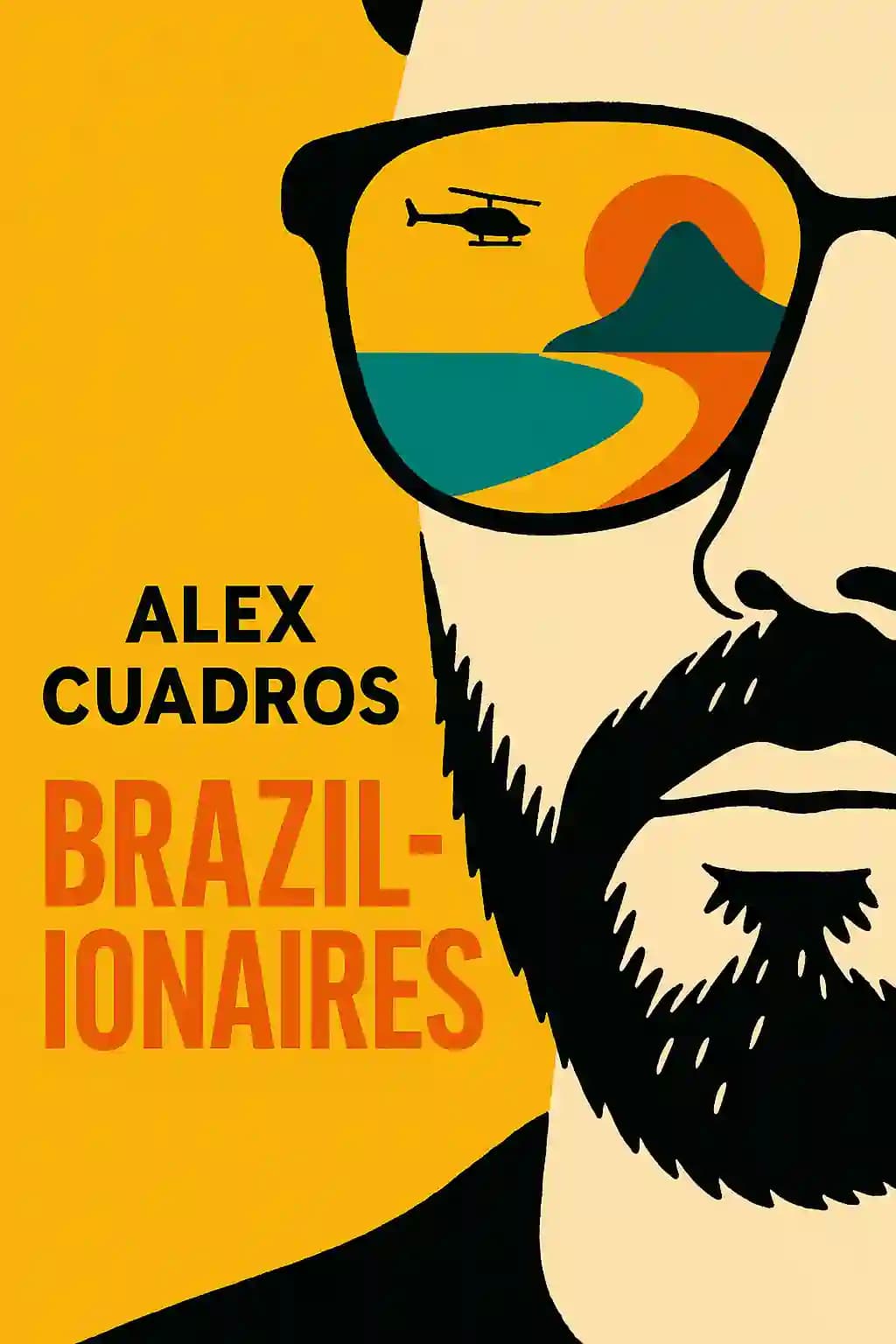
When Thor Batista's silver McLaren supercar struck and killed cyclist Wanderson Pereira dos Santos on a highway near Rio de Janeiro, it wasn't just a tragic accident-it was a stark symbol of Brazil's extreme inequality. The impact tore off Wanderson's limbs and split his chest open, yet Thor-the twenty-year-old son of Brazil's richest man Eike Batista-faced minimal consequences. While Wanderson was buried in a simple ceremony, Thor was back racing Ferraris within months. This incident captured the essence of modern Brazil: a country where justice, opportunity, and even life itself seem to operate on different terms depending on one's social position. Alex Cuadros' "Brazillionaires" takes us deep into this world where extreme wealth and poverty coexist, where corruption is endemic, and where the stories a nation tells itself about prosperity and progress often mask uncomfortable truths about power and privilege.
Kapitel 2
The Hidden Hands Behind Brazil's Economy
Walking through any Brazilian city reveals an invisible web of billionaire ownership. That luxury hotel? Owned by the Siaulys family of pharmaceutical fortune. Those ubiquitous pharmacies? Francisco Deusmar de Queiros' empire. Even the subway lines and corporate headquarters trace back to enormous family-owned construction giants like Camargo Correa and Odebrecht, whose wealth exceeds that of flashier billionaires but who prefer operating in the shadows.
Brazil's entrepreneurial culture differs fundamentally from American ideals of innovation independent from government. Sociologist Sergio Buarque de Holanda explained this through his concept of "the cordial man"-Brazilians prize personal relationships over impersonal institutions. This manifests in friendly informality but also in the attitude that "for my friends, anything; for my enemies, the law."
This system traces back to colonial times when power flowed through patronage. Brazil's first business elite were slave traffickers who bribed officials, establishing a tradition where rules existed "para ingles ver" (for the English to see) but were routinely broken. After independence, the imperial government continued assigning contracts and capital based on connections rather than merit.
The blurred line between public and private has entrenched corruption in Brazilian culture and language, with specialized vocabulary for front men (testa de ferro, laranja), political mutual protection (rabo preso), and scandals that die in bureaucracy (ending in pizza). Researchers estimate 50-90% of political campaign spending comes from undeclared caixa dois (second cash register) that companies maintain for bribes and under-the-table donations.
Take Sebastiao Camargo, whose success wasn't merely due to military connections. Born poor in 1909, he quit school at six to support his family, working his way up from laborer to business owner. His partnership with lawyer Sylvio Correa, brother-in-law to politician Adhemar de Barros, launched Camargo Correa in 1939. Through political patronage, Sebastiao secured contracts across Brazil, showing remarkable ambition and risk-taking.
His political adaptability was legendary-"I'm always here. It's you gentlemen who change," he once told officials. This chameleon-like quality served him well during Brazil's democratic transition, allowing him to capitalize on privatizations in the 1990s.
Kapitel 3
The Price of Progress: Belo Monte Dam
The Belo Monte dam in Altamira exemplifies Brazil's complex "patrimonialist" business model: a sophisticated hybrid between public and private sectors that characterizes many of the country's major infrastructure projects. While Norte Energia maintained majority government ownership, the actual construction was strategically outsourced to construction giants Camargo Correa, Odebrecht, and their peers. This arrangement created a peculiar dynamic where these private companies secured guaranteed revenues while being insulated from significant financial risks - a perfect illustration of Brazil's corporate-government entanglement.
The sheer magnitude of the project defies ordinary comprehension. The construction required enough concrete to build forty-eight Maracana stadiums - Brazil's largest football arena. The steel used could construct sixteen replicas of the Eiffel Tower, while the excavated earth, if loaded into dump trucks, would circle the planet twice. The main dam structure features eighteen colossal turrets that dominate the landscape like an ancient Aztec temple, where workers appear as tiny specks among the massive framework of iron rods and towering cranes.
The environmental and social costs have been devastating and far-reaching. The Juruna tribe, who had sustainably harvested rare ornamental fish for generations, faced the imminent collapse of their economic foundation. Local fishermen reported dramatic decreases in fish populations as soon as the initial river blockages began. A comprehensive 2009 environmental impact study, conducted by independent experts, predicted severe ecological damage that would outweigh the dam's benefits. However, the government deliberately sidelined these findings, preferring to rely on studies produced by entities with direct financial interests in the project's approval.
The political maneuvering behind Belo Monte revealed the project's controversial nature. Two consecutive directors of Ibama, Brazil's environmental protection agency, resigned rather than approve the construction - a unprecedented protest against political pressure. Indigenous tribes organized numerous protests and demonstrations, but their voices were systematically ignored. Norte Energia's promised billion-dollar environmental and social protection plan proved inadequate as construction rapidly proceeded. Their solution - distributing fifteen thousand dollars monthly per village - created new problems. This influx of cash disrupted traditional social structures and economic patterns. Villages artificially divided to receive multiple payments, while traditional agricultural practices were abandoned in favor of processed foods, leading to a health crisis marked by increasing rates of diabetes and hypertension.
Alternative energy solutions existed but were overlooked. Professor Celio Bermann's research demonstrated that the ethanol industry's unused sugarcane biomass could generate energy equivalent to two or three Belo Monte dams. Additionally, modernizing Brazil's aging power grid could recover the fifteen percent of electricity lost through transmission - roughly equivalent to Belo Monte's entire output. However, these distributed solutions lacked the political appeal of mega-projects. Large dams offered concentrated opportunities for patronage, dramatic ribbon-cutting ceremonies, and campaign photographs - political advantages that alternative energy solutions couldn't match.
Kapitel 4
The Media Empire That Shaped Brazil
Roberto Marinho, founder of the Globo media empire, represents a case of wealth accumulation reaching its logical conclusion: monopoly. Taking over his father's newspaper at just 21 after his sudden death, Marinho gradually built a media conglomerate that shaped Brazil's national discourse on wealth, sex, and race for half a century.
Though often vilified by the left for supporting the 1964 military coup and running anti-Goulart propaganda, Marinho was more complex than his critics suggest. He championed American-style journalistic objectivity while maintaining his own convictions: anticommunist, pro-business, pro-democracy, yet sympathetic to the military.
Marinho's relationship with the military regime was complex. While supporting it, he protected his "communist" employees, joking "Nobody messes with my communists." Despite his anticommunist views, he employed leftist artists for business reasons. Unlike newspapers that published Portuguese poems in place of censored stories, Marinho rarely challenged censorship limits. He only publicly denounced censorship in 1975 when censors forced cancellation of his novela "Roque Santeiro" after filming 36 episodes-protesting not human rights abuses but censorship that hurt his profits.
By the 1980s, Globo averaged 80% ratings, making Marinho immensely powerful during Brazil's transition to democracy. He helped moderate this transition, backing opposition candidate Tancredo Neves against the military's choice. In exchange, Tancredo let Marinho approve cabinet picks, including his friend ACM as communications minister. This political influence continued as Marinho distributed lucrative Globo affiliate contracts to politicians, creating regional power bases and preventing anti-monopoly legislation.
In 1989, Marinho backed Fernando Collor de Mello against Lula in Brazil's first free presidential election in three decades. Despite Collor's history of nepotism, Marinho helped frame him as an anti-corruption outsider. When the final debate left the race neck-and-neck, Globo's news program edited footage to heavily favor Collor, showing only his best moments and Lula's worst. Collor won but proved disastrous-freezing citizens' savings accounts, triggering recession, and eventually facing impeachment over a bribery scheme.
Roberto Marinho's three sons inherited his empire while maintaining his core convictions: better education and small government. In their newspaper editorials, they oppose wealth taxes and expanded government while benefiting from massive government advertising. Though claiming television neutrality, Globo's coverage reveals bias-highlighting welfare fraud while minimizing tax evasion, and presenting orthodox economic views without labor perspectives.
Kapitel 5
Faith, Prosperity, and the Rise of Edir Macedo
Edir Macedo, founder of the Universal Church of the Kingdom of God and owner of Brazil's second-largest TV network, represents a different kind of billionaire-one who emerged outside traditional elite circles as a rival to Globo. With two million followers and a net worth of $1.2 billion, Macedo preaches the prosperity gospel, promising financial success through faith in God.
Despite his small stature and congenitally deformed hands, he transforms into a commanding presence before his followers. In Belo Horizonte, addressing five thousand people, he explained America's economic success through Protestant tithing, contrasting it with Brazil's "retrograde" Catholic culture. "When you start tithing faithfully, you're changing your situation," he proclaimed to choruses of "Amen!"
Macedo's background mirrors many of his followers' experiences. Born prematurely in 1945 after an explosion at a nearby dairy, he was one of seventeen children, ten of whom died in infancy. His family moved to Rio when he was young, where they lived without luxuries like television or refrigeration. He began working at eleven in his father's bar and later pushed a coffee cart for the Rio de Janeiro State Lottery.
After his daughter was born with a cleft lip and palate, Macedo dedicated himself fully to Jesus at age thirty-two, quitting his government job to start a ministry. Beginning in a public park gazebo with just sound equipment, he was willing to preach for even a single person when his partners hesitated. Known as the "bossa nova pastor" for his passionate style and voluminous hair, Macedo's congregation grew until he founded the Universal Church in 1977.
His services brilliantly synthesized Brazil's religious traditions-Catholic ritualism energized with American Pentecostal ecstasy, while reframing Afro-Brazilian Candomble spirits as biblical demons he could exorcise. He performed miracle cures, conducted baptisms in plastic pools, and when donations increased, purchased radio airtime.
The Universal Church operates like a franchise, with themed services each day of the week. Thursday's "Love Therapy" targets the lovelorn who might otherwise seek Candomble love spells. Friday services focus on "cures and liberation," featuring testimonials of miraculous healings and exorcisms of Candomble spirits. The most popular service, "Congress of Winners," celebrates financial success, with congregants testifying how donating to the church transformed them from poverty to prosperity.
Macedo's fundraising tactics are controversial. During "Holy Bonfires" campaigns, pastors urge followers to make bold donations-cars, houses, even children. One woman surrendered her two-week-old baby, whom Macedo adopted and named Moyses. Pastors receive substantial bonuses for meeting revenue targets, creating a culture where money measures success. In a leaked beach retreat video, Macedo instructs pastors: "You have to impose yourself... Demand, demand, demand."
The Universal Church's appeal extends beyond spiritual salvation to practical life improvement. Its "bootstrap preaching" provides the guidance many poor Brazilians never received-encouraging concrete goals, financial discipline, and networking opportunities among fellow believers. For many, the church fills gaps left by the Brazilian state, particularly in prisons where conditions are horrific and overcrowding rampant.
Kapitel 6
The Rise and Fall of Eike Batista
Eike Batista cultivated a devoted following through social media, where he personally engaged with followers who often adopted Xs in their Twitter handles to emulate him. His appeal resonated with Brazil's emerging middle class who believed that they too could get rich. His bestselling book "O X da Questao" (The Crux of the Matter) blended memoir with business advice, promoting the American notion that wealth springs from personal will and imagination.
Eike attributed his success to what he called "360-Degree Vision"-a comprehensive business approach he illustrated with an atom-like diagram connecting concepts like "financial engineering," "meritocracy," and "perseverance," centered around an Incan sun symbolizing supernatural power. He embraced both skill and superstition, inserting his lucky number sixty-three into his business dealings, including ending all OGX oil block bids with sixty-three centavos.
Unlike traditional Brazilian business magnates who relied on government contracts, Eike positioned himself as a risk-taking entrepreneur in the American mold, willing to "spend eighty million dollars and might not find anything." When OGX finally began pumping oil in January 2012-the first private Brazilian company to do so-it seemed to vindicate his vision.
By March 2012, Eike's fortune approached $30 billion, ranking him tenth on Bloomberg's Billionaires Index. He owned a 115-foot yacht worth $42 million, three jets totaling $84 million, and over $100 million in Rio real estate. Yet he remained fixated on overtaking Carlos Slim as the world's richest man, reportedly even challenging Slim directly at a Latin billionaire gathering with "Te voy a pasar" (I'm going to pass you).
Despite positioning himself as an American-style meritocratic entrepreneur, Eike pulled every lever to ensure favorable outcomes. He donated $400,000 to Rio Governor Sergio Cabral's reelection campaign and offered unlimited access to his private jet. In return, Cabral granted Eike's companies millions in tax credits and expedited permits.
Though initially skeptical of Lula, calling his election a "step backward," Eike later donated $500,000 to his reelection campaign. Their relationship warmed in 2009 when Eike attempted to take over Vale, promising Lula he would maximize employment and add value to raw materials rather than just exporting ore. Calling himself a "soldier of Brazil," Eike won Lula's ear despite the takeover bid failing.
Unknown to Dilma Rousseff when she endorsed him, Eike's empire began crumbling just as she praised him. His oil wells were producing only 5,000 barrels per day-far below the 20,000 he had promised investors. OGX's engineers discovered they had misinterpreted the geology; instead of continuous oil reservoirs, they found disconnected pockets requiring more wells and higher costs. The company was spending more to extract oil than it earned selling it.
On June 26, 2012, OGX finally disclosed these problems publicly. The next day, its shares plunged 25%, triggering a domino effect across Eike's empire. The interconnectedness that once seemed brilliant now became a liability-each company was losing money on operations and carrying enormous debt. In total, his companies owed about $15 billion, more than the entire nation of Panama.
Kapitel 7
Meritocracy Myths and Brazil's New Elite
Jorge Paulo Lemann, a buyout tycoon who'd acquired Budweiser and Burger King, took Eike's place as Brazil's richest person. Unlike the flashy Eike, Lemann was private, disciplined, and largely unknown to the public despite orchestrating the largest food industry acquisition in history-the twenty-eight-billion-dollar takeover of H.J. Heinz with Warren Buffett's backing.
Though self-made, Lemann wasn't a rags-to-riches story. His Swiss father founded a dairy company in Brazil, and his mother came from a family of cocoa exporters. Educated at the American School of Rio de Janeiro and later Harvard, Lemann combined academic strategy with risk-taking.
In 1971, Lemann took over a Rio brokerage called Garantia, implementing Goldman Sachs's partnership model with extreme modifications. His system allowed top performers to use bonuses to buy shares while offering lower base salaries, creating a high-risk, high-reward environment. Seniority meant little; performance was everything.
Lemann's appeal in Brazil connects to the country's cultural mythology described in Sergio Buarque de Holanda's "Roots of Brazil," which contrasted the methodical "worker" who colonized New England with the precocious "adventurer" who colonized Brazil. Historically, work was considered so abhorrent in colonial Brazil that wealthy landowners were carried about by slaves in palanquins. Lemann, with his Swiss heritage and "Protestant work ethic," embodied the idealized "worker" archetype, while Eike represented the "adventurer" seeking quick profits.
Despite his reputation as a free-market purist, Lemann benefited from government connections. The BNDES lent over four billion dollars at subsidized rates to his companies, despite his access to cheap foreign credit. He manipulated regulatory processes, once having his team tie up fax lines with darkened pages to prevent a court order from reaching the antitrust agency before AmBev's approval.
The concept of meritocracy becomes diluted as it travels through Brazilian society. Well-to-do Brazilians invoke "meritocracia" to criticize government welfare programs while ignoring their own benefits from public subsidies. Lemann himself stated, "I think equality is great too, just that it doesn't work. Equality of opportunity, yes. But equality for equality's sake... People are not equal."
Kapitel 8
The Backlash: Protests and Collapse
Public opinion turned sharply against Brazil's elites as fundamental inequalities persisted despite economic growth. While over half the population had internet access, fewer than half had sewage lines. Unemployment remained low at around 5.5%, but inflation spiraled out of control, reaching nearly 6.5% by 2013. The stark contrast between gleaming shopping malls in Sao Paulo and Rio's favelas without basic infrastructure became increasingly difficult to ignore. Basic services like education and healthcare remained woefully inadequate for much of the population, even as luxury car sales hit record highs.
What began as protests over a R$0.20 (approximately $0.10) increase in bus fares in Sao Paulo quickly evolved into nationwide demonstrations against Brazil's political establishment. The movement, known as "Manifestacoes dos 20 centavos" (Twenty Cents Demonstrations), brought millions to the streets across 100 cities. As journalist Ricardo Boechat described it, it was "like an atomic bomb after it explodes... flowing without owner, logic or direction." Protesters demanded everything from better public services to an end to corruption, carrying signs reading "We Want FIFA-standard Hospitals" and "Stop the PEC 37," referring to controversial legislation.
The protests sealed Eike Batista's fate at a critical moment. Just when he desperately needed government support for his struggling ventures, particularly OGX's oil exploration projects, politicians couldn't risk appearing beholden to special interests. His empire unraveled despite his continued bluster on Twitter, where he dismissed critics and promised a business plan with "good older projects" and "new Partnerships!" He maintained an active social media presence, often engaging in heated exchanges with critics and repeatedly insisting his companies were fundamentally sound.
But his credibility collapsed completely when regulatory filings revealed he had secretly sold $60 million in OGX shares while publicly declaring confidence in the company-directly contradicting his earlier promise to invest a billion dollars. By July 25, 2013, the former national icon of wealth had lost approximately $34 billion in just sixteen months, becoming a cultural reference point for spectacular failure. His fall from grace became fodder for social media: "Eike's so poor that he was seen waiting in line to recharge his public transit card" and "Eike now has to shop at the same supermarkets as mere mortals" were popular memes.
In October 2013, OGX filed for bankruptcy protection with $5.1 billion in debt-the largest corporate bankruptcy in Latin American history-followed shortly by his shipbuilding company OSX Brasil. Brazil's securities commission (CVM) and federal prosecutors brought multiple charges against him, including market manipulation, false representation, and insider trading. He faced potential prison time of up to thirteen years. The investigation revealed a pattern of misleading statements about oil discoveries and production capabilities, highlighting how Batista had built his empire on promises rather than proven results.
Kapitel 9
After the Crash: Brazil's Reckoning
Despite his catastrophic financial collapse, Eike Batista demonstrated the peculiar resilience of the ultra-wealthy, remaining what could only be described as billionaire-poor. While creditors aggressively seized control of his once-mighty OGX oil company and he reported staggering losses of $10 billion for 2013 alone, his lifestyle maintained a startling semblance of luxury. Though observers noted him flying commercial instead of private, he still maintained his fleet of exotic cars, including several Ferraris, and lived in his Rio mansion. His Emirates backers, hedging their bets on his potential comeback, continued paying him $5 million annually to keep his office operational, proving J. Paul Getty's famous observation that owing millions makes you the bank's problem, while owing billions makes you untouchable.
As Brazil plunged into its most severe recession in decades, Eike's collapse took on deeper political significance. Despite having raised billions from private investors worldwide, his downfall became increasingly linked in public consciousness to the Workers Party's economic policies and alleged favoritism. This narrative gained strength as the massive Lava-Jato (Car Wash) corruption investigation unfolded, revealing an intricate scheme where major construction companies had formed a sophisticated cartel to divide Petrobras contracts, resulting in billions in kickbacks and bribes that reached the highest levels of government.
Even at his lowest point, Eike's legendary self-belief remained remarkably intact. He pursued an array of increasingly outlandish ventures - from an ambitious project to clone rare animals with a controversial Korean scientist, to developing fast-dissolving Viagra alternatives and marketing an energy drink that claimed to enhance sexual pleasure. His relentless drive for expansion and reinvention perfectly illustrated the billionaire mindset: occasionally productive in pursuing ambitious infrastructure projects, but frequently justified by grandiose self-narratives that diverged dramatically from reality.
Billionaires typically construct narratives of their wealth as purely self-made, though Eike's story demonstrates that even a $30 billion fortune isn't solely the product of individual genius. Born into Brazil's privileged class with powerful connections at a time when quality education was a rare commodity, Eike combined natural business acumen with perfect timing during Brazil's commodity boom years. His empire required a complex ecosystem of collective belief - from government backing and regulatory support to enthusiastic press coverage and unwavering investor confidence - revealing how entire societies can become entranced by messianic visions of wealth creation.
Eike's spectacular bubble, like the tragic death of worker Wanderson, was the product of a complex system of entrenched values, inherited privileges, and manipulated rules. While his eventual conviction would demonstrate that Brazil's justice system could occasionally hold the wealthy accountable, it did little to prevent the formation of the next financial bubble. As his trial proceedings remained suspended in legal limbo, Eike was already methodically laying the groundwork for his next business empire - maintaining his characteristic confident smile in the courtroom despite facing mounting debt, intense public animosity, and serious legal consequences.