Kapitel 1
Beyond Self-Interest: The Revolutionary Power of Caring for Others
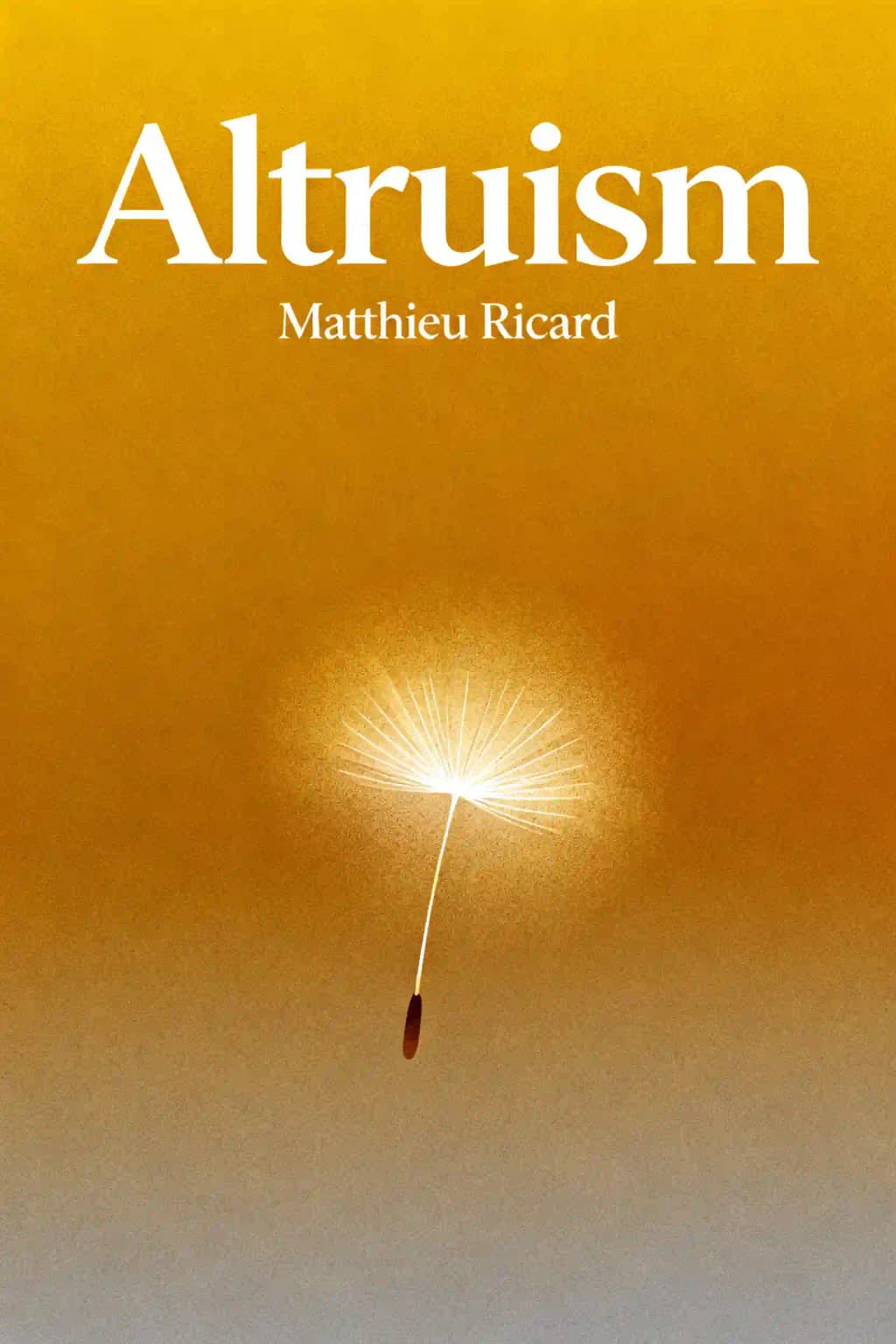
In a world that often celebrates self-interest as the path to success, Matthieu Ricard's "Altruism" arrives as a revolutionary manifesto challenging our fundamental assumptions about human nature. A former molecular geneticist turned Buddhist monk, Ricard has created what the Dalai Lama calls "a truly indispensable book" that has captivated readers across disciplines-from psychology and neuroscience to economics and environmental studies. Named one of the "Books for a Better Life" by the New York Times, this work has influenced everyone from tech CEOs seeking more meaningful business models to everyday people questioning whether self-focus truly leads to happiness. Drawing on his unique position straddling Western science and Eastern contemplative traditions, Ricard weaves compelling evidence showing that altruism isn't just a naive ideal but a practical solution to our most pressing personal and global challenges.
Kapitel 2
The Science Behind Our Natural Capacity for Kindness
Are humans fundamentally selfish or altruistic? This question has divided philosophers, economists, and biologists for centuries. Thomas Hobbes famously claimed humans are naturally selfish, requiring civilization to restrain our base impulses. Sigmund Freud viewed altruism as merely a defense mechanism against our innate aggression. Even today, many economists build models assuming humans act solely from self-interest.
But what if these assumptions are wrong?
Decades of research now reveal that genuine altruism-caring about others' welfare without expectation of reward-is deeply embedded in human nature. Psychologist Daniel Batson conducted thirty-one experiments over eighteen years, systematically testing whether helping behavior could be explained by selfish motives. He created scenarios where participants could easily avoid helping others in distress without consequences, yet many still chose to help. When subjects felt empathy for someone suffering, they consistently acted to relieve that suffering even when they could have easily walked away.
This pattern appears early in human development. By eighteen months, toddlers spontaneously help strangers complete tasks or retrieve dropped objects without prompting or rewards. When experimenters deliberately drop items, children as young as fourteen months immediately try to help retrieve them. Remarkably, external rewards actually decrease this natural helping behavior rather than reinforcing it.
Even our biology reflects this capacity for connection. Barbara Fredrickson's research shows that positive social connections create measurable changes in our cardiovascular, hormonal, and immune systems. When we experience "positivity resonance" with others-those moments of genuine connection-our bodies synchronize physically. Our vagus nerve, which regulates heart rate and social engagement, becomes more active. This "vagal tone" improves with compassion meditation practice, creating an upward spiral of improved health and social connection.
The evidence extends to neuroscience. When we witness others suffering, brain regions associated with pain activate as if we ourselves were in pain. However, those trained in compassion meditation show a different pattern-their brains activate regions associated with maternal love and positive emotions instead. This explains why healthcare workers experiencing "compassion fatigue" are actually suffering from empathic distress, not from too much compassion. True compassion energizes rather than depletes.
Kapitel 3
Beyond Human Exceptionalism: Altruism Throughout the Animal Kingdom
For centuries, we've justified our treatment of animals by claiming they lack the higher capacities that make humans special - consciousness, empathy, and moral behavior. Yet research increasingly reveals that many animals demonstrate remarkable empathy and altruistic behavior that challenges these long-held assumptions about human uniqueness.
When a female chimpanzee named Washoe learned that her caretaker had lost a baby, she signed "cry" upon seeing the woman's sad face. Then she signed "please person hug"-offering comfort for the woman's grief. This sophisticated display of empathy showed not only emotional recognition but also the desire to console. Another chimpanzee, Kuni, found a stunned starling that had crashed into her enclosure window. She gently picked up the bird, climbed to the top of the tallest tree, carefully unfolded its wings "like a miniature airplane," and launched it toward freedom. When the bird failed to fly, she protected it from curious juveniles, demonstrating both problem-solving and compassion across species boundaries.
These aren't isolated incidents. Elephants display complex social behaviors that mirror human empathy. They help injured herd members, creating protective formations around vulnerable calves and supporting wounded adults who struggle to walk. They return to the bones of deceased relatives, touching them gently and standing in silent vigil in what resembles mourning behavior. Research has documented elephants using their trunks to comfort distressed herd members and responding to recordings of deceased family members' calls with visible distress.
Dolphins exhibit extraordinary altruism through their pod behavior. They cooperate to lift injured pod members to the surface for breathing, sometimes continuing this exhausting effort for days or weeks. They've been observed protecting swimmers from shark attacks and guiding stranded whales back to deeper waters. Even rats, often maligned as selfish creatures, demonstrate surprising levels of prosocial behavior. Studies show they will free trapped companions before accessing food rewards, share treats with hungry neighbors, and show signs of emotional contagion - becoming distressed when witnessing others in pain.
These behaviors challenge the notion that altruism is uniquely human or requires abstract moral reasoning. Instead, they suggest that caring for others evolved because it enhanced survival in social species. As Darwin himself wrote, "Those communities which included the greatest number of the most sympathetic members would flourish best and rear the greatest number of offspring." Modern research in evolutionary biology supports this view, showing how cooperative behaviors can provide selective advantages in group living situations.
This perspective fundamentally changes how we view both human nature and our relationship with other species. If empathy and cooperation are evolutionary adaptations rather than cultural inventions, then the capacity for altruism may be far more widespread throughout the animal kingdom than we've assumed. This doesn't mean that selfishness doesn't exist - clearly it does - but rather that we possess competing tendencies toward both self-interest and caring for others, a pattern we share with many other species. Understanding this shared heritage of compassion could reshape our approach to animal welfare and our understanding of what makes us human.
Kapitel 4
The Paradox of Happiness: Why Seeking Your Own Joy Fails
Perhaps the most counterintuitive finding in happiness research is that directly pursuing personal happiness often backfires. Study after study shows that materialistic people-those focused on acquiring wealth, status, and possessions-report lower life satisfaction, experience more anxiety and depression, and maintain weaker social relationships than those who prioritize other values. Research from Tim Kasser demonstrates that even achieving materialistic goals provides only temporary satisfaction, followed by a quick return to baseline happiness levels or even decreased well-being.
This creates what psychologists call the "hedonic paradox": the more directly we chase happiness for ourselves, the more it eludes us. Yet when we focus on creating happiness for others, our own well-being improves as a side effect. As John Stuart Mill observed, "Those only are happy who have their minds fixed on some object other than their own happiness... aiming thus at something else, they find happiness by the way." This principle appears across various philosophical traditions, from Buddhist teachings to Aristotelian ethics.
Elizabeth Dunn's research demonstrates this paradox experimentally. She gave participants money to spend either on themselves or on others. Those who spent on others reported significantly greater happiness afterward, regardless of the amount given. This finding has been replicated across 136 countries, from wealthy nations to poor ones, suggesting a universal human pattern. Even toddlers show more joy when giving treats to others than when receiving treats themselves. Similar studies with cancer patients found that those who volunteered to help other patients experienced greater improvements in their own well-being than those who focused solely on their own recovery.
Why does this paradox exist? One explanation is that humans evolved as ultra-social creatures whose survival depended on group cooperation. Our brains developed to reward behaviors that strengthen social bonds-like generosity and kindness-with positive emotions. When we help others, our brains release oxytocin and activate reward circuits, creating what researchers call a "helper's high." Neuroimaging studies show that acts of generosity activate the same pleasure centers in the brain as receiving rewards ourselves, suggesting that giving is inherently rewarding at a biological level.
This doesn't mean altruism requires self-sacrifice. The Dalai Lama explains: "If you want others to be happy, practice compassion. If you want to be happy, practice compassion." True altruism creates what philosopher Michel Terestchenko calls "fidelity to self"-a profound alignment with our deeper nature that brings satisfaction not as a calculated reward but as a natural consequence. Research by Sonja Lyubomirsky shows that sustainable happiness comes from engaging in meaningful activities and nurturing relationships rather than pursuing happiness directly. Even small acts of kindness, like buying coffee for a stranger or helping a neighbor with groceries, can trigger this positive feedback loop of well-being.
The paradox teaches us that happiness is often found indirectly through service to others and meaningful engagement with our communities. Organizations that encourage volunteering and corporate social responsibility programs often report higher employee satisfaction and retention, further supporting this principle at an institutional level.
Kapitel 5
The Illusion of the Separate Self: How Ego Limits Our Potential
Our tendency to see ourselves as completely separate entities represents one of the greatest obstacles to altruism. We construct an "I" that feels permanent and autonomous, building walls between "me" and "others" that seem real but exist only in our minds. This ego-centered perspective creates a fundamental distortion-we perceive our own happiness as separate from others' wellbeing rather than interconnected with it.
When we examine this sense of self closely, however, it proves surprisingly elusive. Is the "I" located in our bodies? Our thoughts? Our memories? As both Buddhist contemplatives and Western philosophers have noted, the self isn't a fixed entity but a dynamic process-a useful concept for organizing experience, but not an independent reality.
This insight doesn't mean denying individuality, but recognizing that our boundaries are more permeable than we assume. Our bodies constantly exchange molecules with the environment. Our thoughts incorporate ideas from countless others. Even our genes reflect ancient viral insertions. We exist as nodes in a vast network of interdependence rather than as isolated units.
Realizing this interconnectedness doesn't diminish us but expands us. As the boundaries between self and other become more fluid, harming others feels increasingly like harming ourselves, while helping others feels like helping ourselves. This represents not self-sacrifice but self-transcendence-moving beyond the cramped confines of ego to a more spacious sense of identity.
Neurological research supports this perspective. When experienced meditators generate compassion during brain scans, they show decreased activity in regions associated with self-referential processing and increased activity in areas linked to social cognition. Their brains literally process information differently, with less rigid self-other distinction.
This shift in perspective helps explain why those who regularly practice compassion meditation report greater happiness despite focusing less on themselves. By loosening the grip of self-preoccupation, they paradoxically experience more fulfillment. As philosopher Andre Comte-Sponville notes, "Happiness is not something we pursue; it is what happens when we stop thinking about ourselves."
Kapitel 6
Training the Mind: Cultivating Altruism Through Practice
Can altruism be deliberately cultivated? For centuries, contemplative traditions have claimed that qualities like compassion can be developed through mental training. Now, neuroscience confirms this possibility through what researchers call "neuroplasticity"-the brain's ability to reorganize itself through experience and practice.
Richard Davidson's pioneering research at the University of Wisconsin-Madison demonstrates that compassion meditation produces measurable changes in brain function and structure. When experienced practitioners generate feelings of altruistic love during brain scans, they show dramatically increased activity in regions associated with positive emotions and maternal care. These changes correlate with hours of practice-the more someone has meditated, the stronger the effect.
Most remarkably, even short-term training creates significant changes. In one study, participants who practiced compassion meditation for just seven weeks showed increased altruistic behavior in laboratory tests and daily life. Their brains processed emotional stimuli differently, with greater activation in regions associated with empathy and positive emotion. Another study found that just seven minutes of loving-kindness meditation increased feelings of social connection toward strangers.
These findings suggest that compassion isn't a fixed trait but a skill that can be strengthened like a muscle. The basic technique involves first generating feelings of warmth and kindness toward loved ones, then gradually extending those same feelings toward acquaintances, strangers, difficult people, and eventually all beings. With practice, this perspective becomes increasingly natural and spontaneous.
Importantly, compassion training differs from merely increasing empathy. When we simply share others' suffering without the balancing quality of altruistic love, we risk empathic distress-becoming overwhelmed by others' pain. True compassion combines clear awareness of suffering with the warmth and stability that allow effective action. As the Dalai Lama explains: "If you approach a suffering person with genuine concern, you won't become overwhelmed, because your motivation isn't just to share their pain but to help relieve it."
This distinction explains why healthcare professionals often experience burnout. They're trained to recognize others' suffering but not given tools to cultivate the emotional resilience that compassion provides. Programs teaching compassion meditation to doctors and nurses show promising results in reducing burnout while improving patient care.
Kapitel 7
The Economics of Altruism: Reimagining Our Systems
Our economic systems fundamentally shape how we relate to each other and our planet. Unfortunately, conventional economics has been built on a profoundly flawed model of human nature-homo economicus, the purely self-interested rational actor who maximizes personal gain. This model not only misrepresents how humans actually behave but actively promotes selfishness by treating it as normal and inevitable.
The consequences have been devastating. Financial deregulation based on the assumption that self-interest produces optimal outcomes led directly to the 2008 global crisis. The belief that corporations should maximize shareholder value above all else has contributed to environmental destruction, worker exploitation, and extreme inequality. The assumption that competition always outperforms cooperation has undermined community institutions and social trust.
But alternative approaches are emerging. Behavioral economists have demonstrated that humans routinely make decisions based on fairness, reciprocity, and concern for others-not just narrow self-interest. Elinor Ostrom won the Nobel Prize for showing how communities successfully manage shared resources through cooperation rather than competition. Economists like Joseph Stiglitz and Kate Raworth are developing frameworks that measure prosperity not just by GDP but by human wellbeing and environmental sustainability.
These insights are inspiring practical innovations. The Mondragon Corporation in Spain's Basque region employs 85,000 worker-owners in democratically managed cooperatives, with the highest-paid members earning no more than six times the lowest-paid (compared to ratios of 300:1 or higher in many corporations). Their model has proven remarkably resilient through economic crises while maintaining high wages and job security.
Muhammad Yunus's concept of "social business" represents another promising direction-companies designed to solve social problems while remaining financially self-sustaining. Unlike conventional businesses that maximize profit for shareholders, social businesses reinvest profits to expand their positive impact. Yunus's Grameen Bank has lifted millions from poverty through microloans, while his Grameen Shakti has brought solar power to over a million rural households.
Even conventional businesses are beginning to evolve. The B Corporation movement certifies companies that meet rigorous standards of social and environmental performance, accountability, and transparency. More than 3,500 companies across 70 countries have achieved certification, including well-known brands like Patagonia, Ben & Jerry's, and Danone.
Kapitel 8
Altruism for Future Generations: Our Greatest Moral Challenge
Perhaps the ultimate test of altruism is how we treat those who cannot yet speak for themselves-future generations who will inherit the world we leave behind. Climate change, biodiversity loss, soil degradation, and other environmental crises threaten not just wildlife but the very foundations of human civilization. Yet because these impacts will fall primarily on people not yet born, they create a profound moral challenge.
For the past 12,000 years, humanity has flourished during the Holocene epoch-an unusually stable climate period that enabled agriculture and complex societies to develop. We're now leaving this stability behind, entering what scientists call the Anthropocene-an era where human activity has become the dominant influence on Earth's systems. We've already crossed several "planetary boundaries" that define the safe operating space for humanity, including climate regulation, biodiversity, and nitrogen cycles.
The consequences will unfold over decades and centuries, affecting countless future humans who have no voice in today's decisions. This represents what philosopher Stephen Gardiner calls a "perfect moral storm"-a situation where those causing harm (present generations) are separated in time from those who will suffer most (future generations), creating a powerful temptation to prioritize short-term interests.
Addressing this challenge requires extending altruism across time. Just as we've learned to care about contemporaries beyond our immediate tribe, we must now develop concern for humans we will never meet. This doesn't mean sacrificing present wellbeing-indeed, many climate solutions would improve life today through cleaner air, healthier communities, and more meaningful work. But it does mean considering impacts beyond our own lifetimes when making decisions about energy, agriculture, and resource use.
Some indigenous cultures have long practiced this temporal extension of care. The Iroquois Confederacy's "seventh generation principle" requires considering how decisions will affect people seven generations in the future-roughly 150 years. This perspective fundamentally changes how we evaluate actions, shifting focus from quarterly profits to long-term flourishing.
Kapitel 9
The Courage to Care: Embracing Altruism in a Complex World
Cultivating altruism doesn't mean becoming a doormat or abandoning healthy self-care. It means recognizing that our wellbeing is inseparable from others' wellbeing-that we flourish together or not at all. This understanding requires courage-the willingness to open ourselves to others' suffering rather than turning away, the determination to act despite uncertainty, and the patience to persist when change comes slowly.
We see this courage in countless examples throughout history and today. We see it in Holocaust rescuers who risked their lives hiding Jewish families from the Nazis. We see it in civil rights activists who faced violence and imprisonment to secure justice for future generations. We see it in ordinary people who make daily choices to reduce their environmental impact despite knowing that individual actions alone cannot solve global problems.
These examples remind us that altruism isn't naive idealism but practical wisdom. In an interdependent world, caring for others isn't just morally right but pragmatically necessary. As Martin Luther King Jr. observed, "We are caught in an inescapable network of mutuality, tied in a single garment of destiny. Whatever affects one directly, affects all indirectly."
The path forward isn't about choosing between self-interest and altruism but recognizing their profound interconnection. When we understand that our happiness depends on others' wellbeing, that our fate is bound with all life on Earth, altruism becomes not self-sacrifice but self-fulfillment. This perspective doesn't eliminate life's challenges but transforms how we meet them-with open hearts rather than closed fists, with cooperation rather than competition, with hope rather than despair.
As we face unprecedented global challenges, from climate change to inequality to technological disruption, this altruistic vision offers our best hope for creating a world where all can flourish. It invites us to expand our circle of concern beyond immediate family and friends to embrace all humanity and the living systems that sustain us. It challenges us to consider not just short-term gains but long-term flourishing. And it reminds us that in giving to others, we often receive our greatest gifts.
Kapitel 10
The Personal Journey: Finding Meaning Through Service
Throughout his extraordinary life journey-from promising scientist to Buddhist monk to global humanitarian-Matthieu Ricard has consistently found that serving others brings the deepest fulfillment. His organization Karuna-Shechen now operates over 140 humanitarian projects across the Himalayan region, providing healthcare, education, and sustainable development to some of the world's most vulnerable communities.
Ricard's experience echoes what researchers consistently find: people who devote themselves to helping others report greater life satisfaction than those focused primarily on personal achievement or pleasure. Volunteers experience better health, less depression, and even increased longevity. Those recovering from trauma heal faster when they help others facing similar challenges. Even small acts of kindness create what psychologists call "moral elevation"-a distinctive emotion that inspires and energizes rather than depletes.
This connection between service and meaning appears across cultures and traditions. As Albert Schweitzer observed after decades of medical work in Africa: "I don't know what your destiny will be, but one thing I know: the only ones among you who will be really happy are those who have sought and found how to serve." The Dalai Lama expresses the same insight more simply: "If you want others to be happy, practice compassion. If you want to be happy, practice compassion."
This perspective invites each of us to consider: How might I contribute to others' wellbeing? What unique gifts can I offer the world? Where do my talents meet others' needs? The answers will differ for each person-some find purpose in raising children, others in creating art, others in political activism, others in scientific discovery. But the underlying principle remains: we find our deepest fulfillment not in accumulating experiences for ourselves but in contributing to something larger than ourselves.
As we cultivate altruism, we discover that the boundary between self and other grows increasingly permeable. What benefits others benefits us; what harms others harms us. This realization doesn't eliminate life's difficulties but transforms how we meet them-with open hearts rather than closed fists, with cooperation rather than competition, with hope rather than despair. In this expanded perspective lies our greatest potential for both personal happiness and collective flourishing.