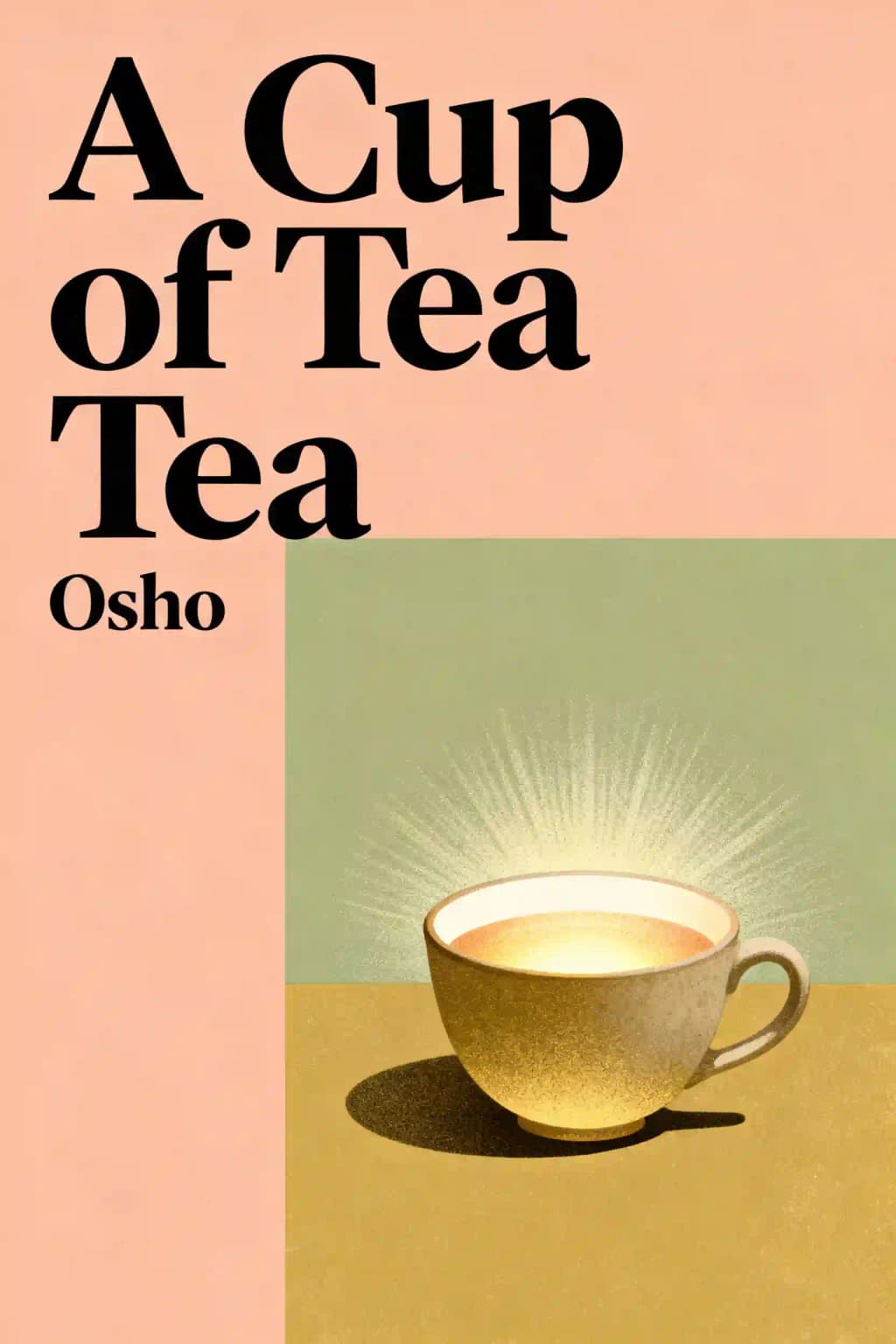
Osho's "A Cup of Tea" distills Zen wisdom into bite-sized, mind-expanding parables. When conventional thinking fails, these ancient tales offer radical clarity. What if the most profound truths aren't found in complexity, but in simple moments - like sipping tea?
Osho (born Rajneesh Chandra Mohan Jain, 1931–1990) was a provocative spiritual teacher and the bestselling author of A Cup of Tea. He revolutionized modern spirituality with his unorthodox blend of Eastern mysticism and Western psychology.
A former philosophy professor and All-India Debating Champion, Osho left academia in 1966 to teach meditation globally. He developed practices like Dynamic Meditation, which are now used by therapists and wellness practitioners worldwide. His works, including The Book of Secrets and Courage: The Joy of Living Dangerously, explore themes of mindfulness, self-discovery, and liberation from societal norms.
Osho’s 1970s Pune ashram attracted global seekers, while his controversial Oregon commune became the focus of Netflix’s documentary Wild Wild Country (2018). Over 600,000 copies of his books sold in China in 1996 alone, with translations in 42 languages. Media outlets from The New York Times to the BBC continue to analyze his legacy, and his Osho International Meditation Resort remains active today, hosting retreats rooted in his vision of "Zorba the Buddha," merging material joy with spiritual awakening.
A Cup of Tea is a collection of 200 intimate letters by Osho, offering spiritual guidance to meditation practitioners and seekers. Each letter blends personal advice with universal wisdom, urging readers to embrace inner silence, transform repressed energies like sexuality into higher consciousness, and reconnect with life’s simplicity. The book serves as a bridge between traditional mysticism and modern existential challenges.
This book is ideal for spiritual seekers, meditation enthusiasts, and those exploring Eastern philosophy. It’s also valuable for readers craving daily inspiration, as each letter functions as a standalone reflection. Osho’s insights resonate with individuals navigating modern stress or questioning societal norms, offering pathways to self-awareness and emotional resilience.
Key themes include meditation as a tool for self-transformation, the alchemy of sexual energy into spiritual vitality, and the interplay between life and death. Osho emphasizes “thirst” for truth as a catalyst for enlightenment and critiques superficial detachment, advocating mindful engagement with life’s complexities.
Osho reimagines meditation for the “hyperactive 21st-century mind,” rejecting rigid techniques. He encourages readers to integrate awareness into daily actions, like mindful breathing or conscious lovemaking, rather than isolating practice. The letters frame meditation as a dynamic process of dissolving mental clutter to access innate stillness.
Notable lines include:
These paradoxes challenge conventional thinking, merging poetic imagery with pragmatic philosophy.
Unlike his structured discourses, this book offers raw, conversational wisdom tailored to individual struggles. The letters lack formal chapters, creating an organic flow that mirrors personal journaling. It’s among Osho’s most accessible texts, avoiding complex terminology for relatable metaphors like “thirst” and “ocean.”
Yes. Osho’s letters frequently address overcoming mental turbulence by anchoring in the present moment. He advocates observing anxious thoughts without judgment during meditation, allowing natural stillness to dissolve stress. The book’s reflective pace counteracts modern frenzy, as noted in search results.
Some readers may find Osho’s views on sexuality controversial, particularly his rejection of repression in favor of conscious engagement. Others might struggle with the nonlinear structure. However, advocates praise its practicality for integrating spirituality into daily routines.
The book contains 200 standalone letters, each 1-2 pages long. Topics shift fluidly between personal anecdotes, parables, and direct advice. This modular design allows readers to consume entries in any order, making it ideal for brief daily reflection.
Its emphasis on digital-age mindfulness aligns with growing interest in mental health and purpose-driven living. Osho’s warnings about societal burnout and his solutions—simplifying life, prioritizing self-inquiry—resonate with post-pandemic seekers.
He employs symbols like “cup of tea” (mindful presence) and “ocean” (infinite consciousness) to demystify enlightenment. Sexual energy is depicted as a river needing redirection, while “thirst” represents existential longing. These metaphors make abstract concepts tangible.
While avoiding rigid formulas, Osho recommends:
These practices aim to cultivate awareness without dogma.
Erlebe das Buch durch die Stimme des Autors
Verwandle Wissen in fesselnde, beispielreiche Erkenntnisse
Erfasse Schlüsselideen blitzschnell für effektives Lernen
Genieße das Buch auf unterhaltsame und ansprechende Weise
I live two lives simultaneously-what drama!
With awareness, everything transforms-the center shifts from body to soul.
Abandon achievement in meditation.
The world itself is a dream.
Zerlegen Sie die Kernideen von A cup of tea in leicht verständliche Punkte, um zu verstehen, wie innovative Teams kreieren, zusammenarbeiten und wachsen.
Destillieren Sie A cup of tea in schnelle Gedächtnisstützen, die die Schlüsselprinzipien von Offenheit, Teamarbeit und kreativer Resilienz hervorheben.

Erleben Sie A cup of tea durch lebhafte Erzählungen, die Innovationslektionen in unvergessliche und anwendbare Momente verwandeln.
Fragen Sie alles, wählen Sie die Stimme und erschaffen Sie gemeinsam Erkenntnisse, die wirklich bei Ihnen ankommen.

Von Columbia University Alumni in San Francisco entwickelt
"Instead of endless scrolling, I just hit play on BeFreed. It saves me so much time."
"I never knew where to start with nonfiction—BeFreed’s book lists turned into podcasts gave me a clear path."
"Perfect balance between learning and entertainment. Finished ‘Thinking, Fast and Slow’ on my commute this week."
"Crazy how much I learned while walking the dog. BeFreed = small habits → big gains."
"Reading used to feel like a chore. Now it’s just part of my lifestyle."
"Feels effortless compared to reading. I’ve finished 6 books this month already."
"BeFreed turned my guilty doomscrolling into something that feels productive and inspiring."
"BeFreed turned my commute into learning time. 20-min podcasts are perfect for finishing books I never had time for."
"BeFreed replaced my podcast queue. Imagine Spotify for books — that’s it. 🙌"
"It is great for me to learn something from the book without reading it."
"The themed book list podcasts help me connect ideas across authors—like a guided audio journey."
"Makes me feel smarter every time before going to work"
Von Columbia University Alumni in San Francisco entwickelt

Erhalten Sie die A cup of tea-Zusammenfassung als kostenloses PDF oder EPUB. Drucken Sie es aus oder lesen Sie es jederzeit offline.
Imagine living two lives simultaneously-one of deep inner silence and another of active engagement with the world. This paradox sits at the heart of "A Cup of Tea," Osho's collection of intimate letters written to his disciples between 1962 and 1971. Unlike works crafted for publication, these personal correspondences reveal the unfiltered wisdom of a mystic in direct communion with his students. The letters form a spiritual touchstone that has influenced seekers worldwide, from celebrities to everyday truth-seekers. What makes this collection remarkable is how it invites us into the private conversations between a master and those seeking transformation. Through these letters, we glimpse a profound truth: awakening doesn't mean escaping the world, but experiencing it from a radically different dimension of being.