Kapitel 1
The Eternal Quest for Meaning: How Philosophy Shapes Our Lives
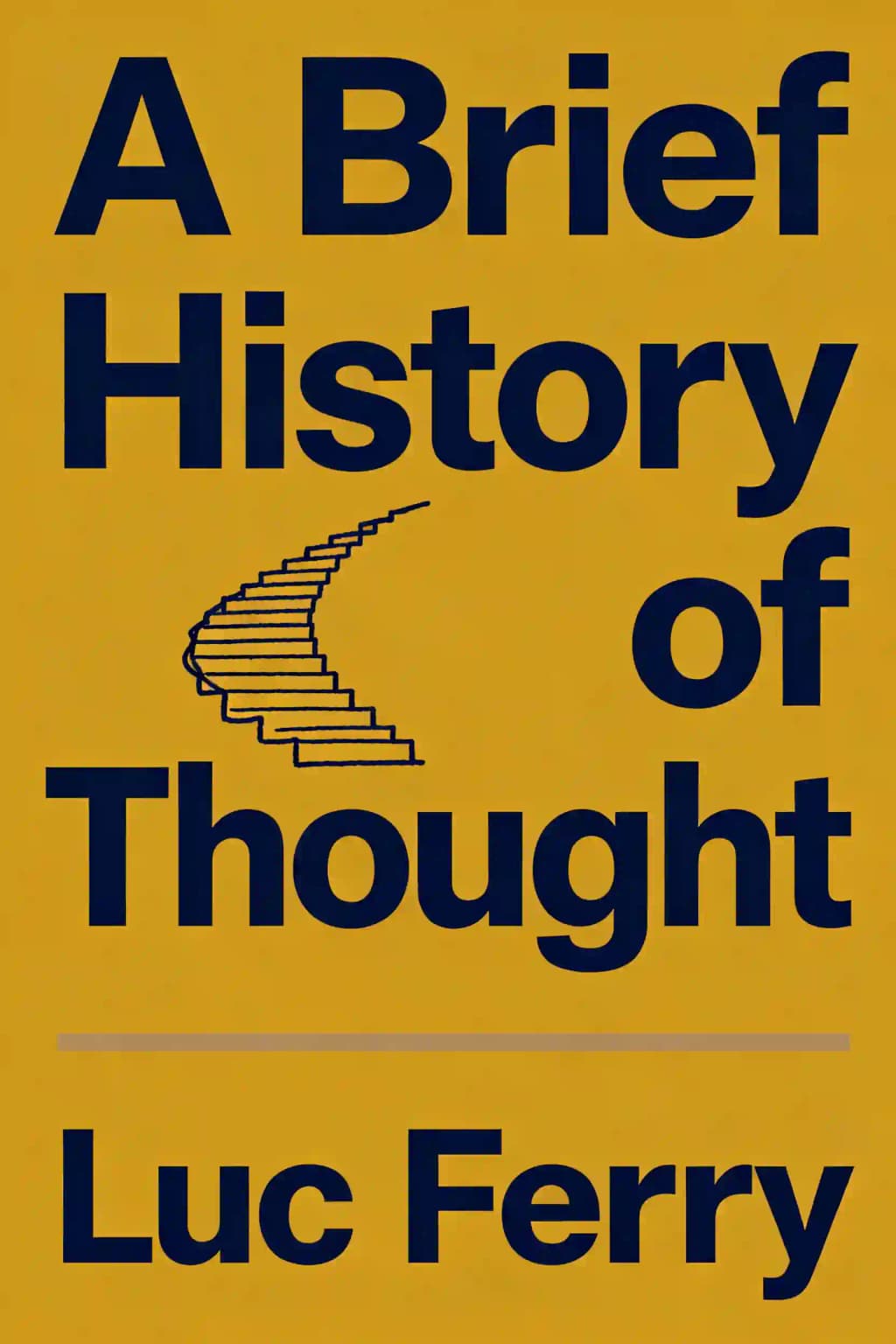
When the 1755 Lisbon earthquake killed thousands, it shattered more than buildings-it cracked the foundations of Enlightenment optimism. How could a benevolent God allow such suffering? This catastrophe forced philosophers to confront our most fundamental questions: Why are we here? How should we live? What happens when we die? Luc Ferry's "A Brief History of Thought" has become a modern philosophical classic precisely because it tackles these timeless questions with remarkable clarity. The book has sold over 300,000 copies in France alone, with celebrities like Emma Watson citing it as transformative reading. Unlike dense academic texts, Ferry's approach makes philosophy accessible without sacrificing depth, showing how philosophical ideas directly shape our understanding of everything from human rights to environmental ethics. In our age of anxiety and polarization, his exploration of how humans have sought meaning across centuries offers a compass for navigating our own existential challenges.
Kapitel 2
The Battleground of Mortality: Philosophy versus Religion
Death haunts us all. From this universal anxiety spring both philosophy and religion-two distinct approaches to conquering our fear of mortality. Religion offers salvation through faith in a transcendent being, demanding humility as the pathway to divine grace. Philosophy, by contrast, proposes to save us through our own reasoning faculties, claiming that clear understanding can free us from death's shadow without appealing to supernatural powers.
The ancient philosophers were remarkably direct about this purpose. Epicurus defined philosophy as "medicine for the soul" aimed at showing that "death is not to be feared." Epictetus reduced all philosophical questions to addressing death anxiety. This theme echoes through centuries, from Montaigne's assertion that "to philosophize is to learn how to die" to Spinoza's observation that "the wise man dies less than the fool."
Why this obsession with mortality? Because fear of death prevents us from living fully in the present moment. When we're constantly haunted by mortality, we retreat into nostalgia for the past or anxiety about the future. Greek philosophers identified these temporal distractions as primary evils, pulling us away from the only dimension worth inhabiting-the present.
This distinction between philosophical and religious approaches to mortality remains crucial today. While religions promise eternal life through divine intervention, philosophy offers something different: the possibility of conquering fear through understanding rather than faith. The philosopher believes that by comprehending ourselves and the world, we can achieve a clarity that allows us to face death without terror-not because we'll survive it, but because we understand its place in the natural order.
What makes this philosophical approach so powerful is that it doesn't require supernatural beliefs. It works through our inherent capacity for reason, suggesting that wisdom about death is available to anyone willing to think deeply about human existence. The question isn't whether we'll die-we all will-but whether we'll allow that inevitability to poison our living moments with fear.
Kapitel 3
The Three Dimensions of Philosophical Inquiry
Philosophy operates through three distinct dimensions that together form a comprehensive approach to understanding our existence. Like a three-legged stool, each dimension supports the others in creating a stable foundation for human thought.
The theoretical dimension attempts to comprehend our world-is it hostile or friendly, ordered or chaotic? This aspect builds upon natural sciences while examining the very means by which we acquire knowledge. Philosophy doesn't just question reality; it interrogates our instruments for comprehending it. When we ask "What is real?" we're simultaneously asking "How do we know what's real?" This recursive questioning distinguishes philosophical inquiry from other forms of knowledge.
The ethical dimension addresses how we should coexist with others, establishing principles for dignified and fair social interactions. This practical aspect recognizes our fundamental dependence on others from birth. No human is an island-we enter a social world that precedes us and shapes our possibilities. Ethics explores how to navigate this interdependence without sacrificing individual dignity or collective harmony.
The third dimension concerns salvation or wisdom-the ultimate purpose of our efforts to understand the world and live ethically. True wisdom transcends mere philosophical understanding, allowing one to live contentedly and freely by overcoming fears sparked by our finite nature. This dimension addresses the question: "How should I orient my life given what I know about reality and ethics?"
What distinguishes philosophy from religion is its approach to these questions. Philosophy presents itself as an art of answers that each person must judge for themselves, without appealing to external authority. There are no sacred texts or infallible prophets in philosophy-only arguments that must stand or fall on their own merits. This places enormous responsibility on individuals to think critically about philosophical claims rather than accepting them on faith.
The three dimensions work together synergistically. Our theoretical understanding of reality shapes our ethical principles, which in turn influence our conception of wisdom. Conversely, our pursuit of wisdom often leads us to revise our theories about reality and reconsider our ethical positions. This dynamic interplay makes philosophy a living, evolving enterprise rather than a static body of doctrine.
Kapitel 4
The Greek Miracle: Birth of Rational Inquiry
Around the sixth century BCE, something extraordinary happened in Greece-an intellectual revolution so sudden and profound that historians call it "the Greek miracle." What made this emergence of philosophical thinking possible, and why did it happen in Greece rather than elsewhere?
Two key factors enabled this breakthrough. First, before Greek philosophy, religion served as a substitute for philosophical inquiry across civilizations. Salvation was sought through gods rather than reason, with priests rather than philosophers guiding society. Second, the partially democratic nature of Greek city-states fostered unprecedented freedom of thought and public debate among citizens. This political environment created space for questioning traditional beliefs and developing new forms of knowledge.
The Stoics, who emerged from this Greek tradition, sought to contemplate the world's innermost essence-what they called kosmos, a harmonious and ordered universe. Unlike our modern conception of a mechanistic universe, the Stoics viewed the world as a living, animate being where each element functions perfectly within the whole. This divine cosmic order wasn't created by a personal God but was inherent in nature itself. Through sciences like physics and astronomy, they observed a rational structure (Logos) that makes the universe "well-made" from planetary movements to tiny organisms.
This theoretical understanding directly shaped Stoic ethics. If the universe is an ordered whole, then human virtue consists in aligning ourselves with this natural order-just as a cabinetmaker shapes wood to fit within a larger structure. Knowledge wasn't merely intellectual but opened directly onto action, which is why ancient philosophical schools emphasized practical exercises rather than abstract concepts.
The Cynics, who greatly influenced the Stoics, exemplified this approach through shocking public demonstrations. Their name derives from "dog" because they would nip at conventional society like annoying dogs, forcing students to perform exercises like dragging dead fish across town squares to teach them to disregard others' opinions and align themselves with cosmic reality. As Cicero explained, "The starting-point for anyone who is to live in accordance with nature is the universe as a whole"-a vision radically different from our modern democratic belief that human will, not natural order, should determine morality.
Kapitel 5
Stoic Wisdom: Mastering Time and Emotion
The ultimate purpose of Stoic philosophy was salvation-not through divine intervention but through our own reason. Facing mortality, humans have traditionally sought two strategies to outflank death: procreation, which perpetuates the species but not the individual, and performing heroic deeds worthy of historical record. Philosophy offers a third way: understanding that death isn't annihilation but transformation within the cosmic order.
"You might just as well say that the fall of leaves is ill-omened," writes Epictetus, "for all these changes are from a preceding state into a new and different one; not destruction, but an ordered management of things." The sage recognizes that as fragments of an eternal cosmos, we too participate in eternity. This realization dissolves the fear of death, allowing us, in the beautiful Stoic formula, "to live and die like a God"-mortal in one sense yet immortal in another.
Stoic exercises in wisdom primarily concern our relationship with time, as it is within time's folds that anxiety establishes itself. Marcus Aurelius articulates this insight: we must "leave all the past behind, commit the future to Providence, and direct the present alone, towards piety and justice." To achieve wisdom, we must stop living in time dimensions that don't truly exist and adhere to the present, where reality actually resides.
Contrary to popular belief that one "cannot live without hope," Stoicism views hope as misfortune-an absence creating tension in our lives. We chase objectives in a distant future, believing happiness depends on their accomplishment, while forgetting that the only reality is the present. This "headlong flight from the present" inevitably ends in disappointment, as possession rarely brings lasting happiness. As Seneca observes, "while we wait for life, life passes."
Stoicism, remarkably similar to Buddhism, advocates "non-attachment" toward worldly things. Epictetus counsels that when attached to something, we should treat it "as to something like an earthenware pot or crystal goblet, so that if it breaks, you may remember what kind of thing it was and not be distressed." Even when kissing a child or friend, we should "never give way entirely to your affections" but remember "what you love is mortal."
This isn't indifference or neglect of compassionate obligations, but recognition of what Buddhists call "impermanence"-that everything changes, and failing to understand this creates hopelessness about the past and false hope for the future. The most practical Stoic exercises connect to the most exalted spirituality. Living in the present means savoring each moment fully, aware it may be our last. The Stoic prepares for catastrophe with the future perfect tense: "When destiny strikes, I shall have been prepared."
Kapitel 6
Christianity's Revolution: Love Conquers Death
Why did Christianity triumph over Greek philosophy? The answer lies in how Christianity exploited weaknesses in Stoic wisdom and offered a more appealing solution to our deepest fears about mortality. While Stoicism offered an impersonal form of salvation where individuals merge anonymously with the cosmos, Christianity promised personal immortality and reunion with loved ones.
The fundamental shift centered on redefining the divine Logos. For Christians, the Logos was no longer an impersonal cosmic structure but became incarnate in Jesus Christ-a single extraordinary individual. This transformation changed both the divine itself and how humans approached it. Faith replaced reason as the primary means of accessing truth. Christians were called to trust in Christ's word rather than rely on their own reasoning, requiring a double humility: accepting a God who humbled himself to become human, and believers humbling themselves by setting aside rational pride in favor of faith.
Christianity introduced three revolutionary moral concepts that contradicted Greek aristocratic values. First was human equality in dignity-where Greeks saw natural hierarchies, Christians saw equal moral worth regardless of natural gifts. The Greek world was fundamentally aristocratic, accepting natural inequalities as the basis for social hierarchy and even slavery. Christianity rejected this, arguing that natural gifts (strength, intelligence, beauty) have no inherent moral value since they can be used for good or evil. What matters morally is free will-how we choose to use our gifts.
Second, Christianity elevated the "inner forum" of conscience over external law, as exemplified by Christ defending the adulteress with "let him who is without sin cast the first stone." Unlike Judaism or Islam, Christianity imposed few ritual obligations, placing moral authority within individual conscience rather than external rules.
Third, Christianity created a truly universal concept of humanity based on equal dignity rather than natural hierarchies, replacing the Greek concept of "barbarians" with the notion that all humans are brothers with equal moral worth.
Christianity's doctrine of salvation stems from transforming the Logos from an impersonal cosmic principle to a personal divinity in Christ. Providence changed from blind, anonymous fate to a personal, benevolent relationship like a father with his children, promising individual immortality rather than dissolution into cosmic consciousness.
Most significantly, Christianity proposed that love could overcome death. Christians distinguished three types of love: dangerous "love-as-attachment" (which cannot survive death), "compassion" for strangers in need, and "love-in-God"-the only form that conquers death. Through resurrection-not just of souls but of individual bodies-Christianity uniquely offers a solution that allows love to transcend mortality. This promise of personal immortality distinguishes Christianity from Buddhism (where the individual is an illusion) and Stoicism (where the self merges into the cosmos).
Kapitel 7
Humanism: When Humans Replace Gods
Modern philosophy emerged when both ancient cosmology and religious authority collapsed during an unprecedented scientific revolution in Europe. This revolution began with Copernicus (1543), continued through Galileo (1632) and Descartes (1644), and culminated with Newton (1687). These thinkers shattered the enclosed, harmonious cosmos of antiquity, replacing it with an infinite, chaotic universe devoid of inherent meaning.
The disorientation this caused was profound-far beyond today's complaints about "loss of bearings" among youth. For the first time, humanity found itself alone, without the support of either cosmos or God. This period earned the name "Humanism" precisely because humans had to confront existence without traditional foundations.
The transition from a closed world to infinite space was driven by technological advances like the telescope, which revealed observations contradicting ancient cosmology. Discoveries of new stars or disappearing ones shattered the Greek dogma of "celestial immutability"-the perfect, eternal, unchanging cosmos. With the universe now appearing chaotic rather than ordered, knowledge could no longer be passive contemplation (theoria) of divine beauty. Instead, it became active construction-humans imposing order on a chaotic universe.
Emmanuel Kant's "Critique of Pure Reason" (1781) reformulated this new approach to knowledge. Science transformed from passive spectacle to active work, constructing laws to give meaning to a disenchanted universe. The principle of causality exemplifies this shift-rather than discovering cosmic order through contemplation, modern scientists actively connect phenomena as causes and effects.
This theoretical revolution had profound moral consequences. Newton's universe of blind forces and collisions offered no moral guidance, unlike the harmonious cosmos of antiquity. Modern thought responded by placing humanity at the center where cosmos and divinity once stood. Philosophers had to build new theories, morality, and salvation doctrines on the foundation of humanity itself. The 1789 Declaration of Human Rights exemplifies this shift-placing humans at the world's center and proclaiming their equality regardless of wealth, gender, or race.
Jean-Jacques Rousseau redefined what distinguishes humans from animals. Unlike Aristotle who defined humans as "rational animals" or Descartes who saw animals as emotion-less automata, Rousseau recognized that animals possess intelligence, sensibility, and communication abilities. Instead, he located human uniqueness in "perfectibility"-our liberty to improve ourselves throughout life. Animals are guided by unerring instinct, programmed by nature with little deviation possible. Humans, however, can forge personal histories with open-ended progress, even deviating from natural rules to our detriment through excesses like drinking or smoking.
This redefinition produced three profound consequences. First, humans possess a double historicity-personal education that continues lifelong and cultural/political evolution that constantly transforms societies. Second, as Sartre would later articulate, "existence precedes essence" in humans-we have no predetermined nature that defines us completely. Third, human freedom makes us moral beings capable of choosing between good and evil, unlike animals who cannot be morally judged for their actions.
Kapitel 8
Kantian Ethics: The Foundation of Modern Morality
Kant developed two crucial moral implications from Rousseau's definition of humans as free agents: disinterestedness and universality. The truly moral action is disinterested-demonstrating our capacity to resist natural egotistical urges through "Good Will." A taxi driver taking me somewhere for payment has no special moral value, but one who helps without compensation during a transport strike earns genuine gratitude. The second principle holds that moral actions must transcend private interests to serve the common good.
The modern meritocratic model of virtue contrasts sharply with aristocratic versions. The 1755 Lisbon earthquake that killed thousands forced philosophers to question whether nature should be our moral guide. If I listen to my inner nature, I hear only egotism. The crucial modern ethical question became: how do we create coherence between humans without involving nature or divinity? The answer defines modern humanism: a world founded solely on human will, where individuals voluntarily limit their freedom to accommodate others.
Kant called this constructed moral reality "the kingdom of ends"-a world where humans are treated as ends, not means. Unlike ancient ethics where virtue meant fulfilling one's natural purpose (Aristotle's view that even a horse could have a "virtuous eye"), modern virtue means struggling against our natural inclinations. This new ethical vision produced three political features opposed to aristocracy: equality of status (since virtue resides in freedom, not natural gifts), individualism (valuing persons over the collective), and the elevation of work (from servile activity to self-realization).
Descartes' famous "Cogito ergo sum" ("I think therefore I am") marks the true beginning of modern philosophy by establishing subjectivity as its cornerstone. In an age where traditional certainties had collapsed, Descartes transformed doubt into a philosophical method. By systematically questioning every belief, he discovered one unshakable truth: if he's thinking, he must exist.
This radical doubt yielded three revolutionary ideas. First, it redefined truth as that which resists doubt, making subjective certainty the criterion of truth rather than correspondence with external reality. Second, it introduced the concept of "tabula rasa"-rejecting all preconceptions and inherited beliefs-essentially inventing the modern notion of revolution. Third, Descartes rejected all "arguments from authority," establishing that opinions should not be accepted merely because they come from external authorities.
While modern secular morality establishes values that enable peaceful coexistence, these ethical principles cannot address the existential questions that doctrines of salvation once answered. Unable to believe in God, the Moderns invented substitute religions or "religions of earthly salvation"-primarily scientism, patriotism, and communism. These godless spiritualities attempted to give meaning to human existence while professing radical atheism.
Kapitel 9
Nietzsche's Challenge: Beyond Good and Evil
Nietzsche represents postmodernity's zenith, attacking modernity's idols with unparalleled genius and violence. The critical spirit unleashed by Descartes and the Enlightenment couldn't be contained-it eventually turned against its creators. Though modern humanism weakened religious authority, it remained trapped in religious structures by believing certain values (rights, reason, democracy) were superior to life itself. Nietzsche saw this as fundamentally theological, requiring the same critique modernity had applied to religion.
Nietzsche's approach to philosophical theory represents a radical departure from tradition. Rather than constructing a conventional theoria with divine elements and contemplative vision, Nietzsche creates what might be called an "a-theoria"-a philosophy without cosmos or divinity. For him, knowledge isn't passive contemplation as the Ancients believed, nor the Modern attempt to discover order among phenomena. Instead, it's an act of "deconstruction" or "genealogy" that uncovers the hidden earthly origins of supposedly sacred, untouchable values handed down from above.
Nietzsche's most profound insight is that no perspective exists outside life itself-no privileged viewpoint can abstract itself from the forces constituting reality. For Nietzsche, there can be no "objective" or "disinterested" value judgments independent of the speaker's vital interests, which undermines classical conceptions of law and ethics. All our judgments, utterances, and ideas express our vital energies rather than autonomous, abstract entities. As he famously declared, "There are no facts, only interpretations."
Nietzsche conceives the world as fundamentally opposed to the Stoic vision. For him, reality is "a monster of energy without beginning or end," a chaotic multiplicity of forces that cannot be reduced to unity. The cosmos of the Greeks was merely a consoling fiction. While Kant and Newton attempted to inject rationality into the world, Nietzsche considered such efforts futile fantasies.
Though Nietzsche is often characterized as the "immoralist" who rejected charity and compassion, his ethical vision is more nuanced than simple rejection of morality. His actual ethical position involves harmonizing opposing forces rather than eliminating reactive ones. The good life for Nietzsche is the most intensely lived because it is the most harmonious-what he calls "the grand style." This means mastering "the chaos within" and compelling it "to become form: logical, simple, unambiguous, mathematical." Rather than rejecting rationality, Nietzsche advocates "spiritualizing" our passions and even our enmities, integrating rather than exiling our inner conflicts.
The will to power, central to Nietzsche's philosophy, is frequently misunderstood. It is not about domination or political power, but rather "the innermost essence of Being." It represents the will to intensity of experience, to avoid internal divisions that diminish us and make life stagnate. The will to power means living without the paralyzing effects of guilt, remorse, and internal conflict-those unconscious feelings that make us "pull our punches" rather than "let fly."
Kapitel 10
Finding Meaning After Deconstruction
Contemporary philosophy faces a fundamental question: why move beyond Nietzsche's corrosive insights? We cannot simply return to pre-Nietzschean thinking or pretend his questions haven't been asked. The world has changed-women's rights, worker protections, decolonization-making nostalgia for lost paradises merely wishful thinking. We face a choice: continue down the path of deconstruction or forge a new philosophical direction.
One path is to continue Nietzsche's deconstructive project, which extends beyond him to Marx and Freud-the great "philosophers of suspicion." Their approach has been amplified by the human sciences: sociologists demonstrate how supposedly autonomous choices are determined by class habitus; biologists show how our moral "idols" are merely products of brain function or evolutionary adaptation. This deconstructive tradition has dominated French and American thought through figures like Althusser, Lacan, Foucault, Deleuze, and Derrida. Yet this endless trial of humanist "idols" risks paradoxically sanctifying reality as it is-leading former revolutionaries to cynically accommodate themselves to market forces, abandoning all hope in reason, liberty, progress and humanity.
The alternative is not returning to pre-Nietzschean Enlightenment thinking, but rethinking these concepts after and in light of deconstruction. Heidegger identifies how globalization betrays democracy's fundamental promise: our collective ability to shape history and give it meaning. In today's world, technological progress continues mechanically without purpose-we must change to survive competition, but this change serves no higher ideal. This fulfills Nietzsche's program perfectly: the complete eradication of ideals and historical direction.
Contemporary materialism fails to provide coherent answers to questions of ethics and salvation. French philosopher Andre Comte-Sponville has attempted to establish a new ethics based on radical deconstruction of humanist ideals of transcendence. Like Nietzsche, he believes authority's "idols" need genealogical deconstruction, and wisdom must be found in radical immanence. His thought culminates in amor fati-reconciliation with the world as it is and critique of hope. "Hope a little less, love a little more" summarizes his path to salvation.
This materialist spirituality contains truth corresponding to our experiences of "grace" when the world seems benevolent rather than threatening. These weightless moments of happiness allow us to savor reality without needing to transform it. Yet this philosophy of happiness works only in good times. When confronted with catastrophe-a sick child, rising fascism, urgent decisions-materialist sages transform into humanists weighing alternatives, suddenly believing events depend on free choices.
Kapitel 11
Transcendence Within Immanence: A New Humanism
Contemporary post-Nietzschean humanism rehabilitates transcendence but gives it new meaning to escape materialist criticism. Three key conceptions of transcendence exist: First, the Ancient Greek cosmos-transcendence where divine order exceeds humans but remains within the universe; second, monotheistic transcendence where God exists entirely beyond creation; and third, "transcendence within immanence" developed by Kant and Husserl.
Husserl illustrated this third conception through a simple cube demonstration: we can never see more than three sides simultaneously though we know six exist. This reveals that all visibility rests on invisibility, all presence supposes absence, all immanence implies hidden transcendence. This isn't a metaphysical invention but an undeniable dimension of human existence inscribed within reality.
The horizon metaphor further clarifies this concept: objects always appear against backgrounds that continually shift without revealing any final entity or first cause. Something always escapes us at the core of what we perceive. Human consciousness, being finite and always "consciousness of something," can never attain omniscience or absolute knowledge.
This transcendence manifests in four fundamental value domains: truth, beauty, justice, and love. I cannot invent mathematical truths, the beauty of art, moral imperatives, or choose to fall in love-these values impose themselves as if from elsewhere yet are experienced within me. When confronted with mathematical necessity, artistic beauty, ethical imperatives, or love, we experience values that transcend yet are discovered within our consciousness.
Love exemplifies this perfectly: I fall in thrall to someone exterior to myself (transcendence), yet experience this most intimately within my heart (immanence). While materialism would reduce this to underlying material causes, post-Nietzschean humanism offers a phenomenological description of transcendence settled at the core of selfhood.
Knowledge has evolved through three distinct ages. First came Greek theoria-contemplation of the divinely ordered cosmos where knowledge and values were inextricably linked. The second age emerged with the modern scientific revolution, introducing knowledge radically indifferent to values. The third age-self-criticism or auto-reflection-defines contemporary post-Nietzschean humanism. This emerged after World War II when questions arose about science's role in atrocities like Hiroshima. Science began applying its critical spirit to itself, particularly in fields with moral implications like ecology and bioethics.
Kapitel 12
The Wisdom of Love: Finding Meaning in a Finite World
A humanism without metaphysics can revitalize the ancient problem of wisdom through three reflections: "enlarged thought," the wisdom of love, and the experience of mourning.
The Kantian notion of "enlarged thought" takes on new significance after Nietzsche. Beyond merely understanding others' perspectives, it becomes a way of responding to life's meaning. Unlike a "restricted" vision trapped in its origins, the enlarged thought displaces itself to understand others, then returns to view its own judgments as if from outside. This self-distancing enables consciousness through auto-reflection.
This concept connects to Rousseau's idea of human "perfectibility"-our capacity to withdraw from particular conditions to access greater universality through education, culture, and politics. This humanizing process gives life meaning and "justifies" it in quasi-theological terms.
V.S. Naipaul's Nobel Prize acceptance speech perfectly illustrates this experience. He describes growing up in Trinidad's self-centered Indian immigrant community, living in "our own fading India" while the outside world existed "in a kind of darkness." His journey as writer and human being involved enlarging his horizon through "decentering" himself to penetrate these "zones of shadow." His travels through the Caribbean and to ancestral India "broke his life in two," giving him "a world-view I had never had" and taking him "to new realms of emotion."
Between the particular (rooted in specific origins) and the universal (potentially encompassing all humanity) lies the singular-the true object of our loves and bearer of meaning. Great art exemplifies this singularity by transcending its cultural origins while remaining rooted in them. This singularity applies not only to art but to human individuals. When we enlarge our horizons-learning new languages, experiencing different cultures-we become singular beings, transcending our particular origins without reaching abstract universality.
When confronting the death of loved ones, three approaches present themselves. Buddhism counsels non-attachment: avoid entangling yourself in bonds that inevitably bring suffering when death severs them. Christianity offers the opposite solution: promising reunion with loved ones through the resurrection. A third path develops a "wisdom of love" without illusions. This means recognizing that dialogue with loved ones must eventually end, and drawing the necessary conclusions in this life. We must reconcile with our parents before they die, for afterward is truly too late, whatever Christianity promises.
This wisdom of love is elaborated largely in silence. But we can learn to live and love as adults, even if this means thinking of death daily. Not from morbidity, but to discover what needs doing here and now with those we love and will lose. This wisdom exists, and represents the crowning achievement of a humanism finally freed from the illusions of metaphysics and religion.
Kapitel 13
Enlarging Our Horizons: Philosophy as Dialogue
I love philosophy, especially Kant's notion of an enlarged horizon of thought-perhaps the central truth of modern philosophy and contemporary humanism. This concept creates space for self-reflection, offers ethics open to our globalized world, and provides a post-Nietzschean doctrine of salvation.
When confronted with multiple philosophical systems, people typically respond with either skepticism (claiming no philosophy can be true since they disagree) or dogmatism (insisting one's chosen philosophy is superior while others are mere errors). Tired of these debates and undermined by relativism, democratic impulses today often retreat to vague notions of "tolerance" and "respect for differences."
The notion of an enlarged horizon suggests a different path: extracting truth from worldviews not our own, understanding them, and incorporating what serves our purposes. This approach avoids both empty pluralism and the abandonment of conviction.
I once wrote a book with Andre Comte-Sponville, a materialist philosopher I deeply respect. Everything divided us-we were the same age (potential rivals), he came from communism while I came from the republican right, and philosophically he drew from Spinoza and Eastern wisdom while I followed Kant and Christianity. Yet rather than becoming enemies, we nearly traded places by genuinely trying to understand what might be persuasive about each other's worldviews.
Through this exchange, I came to appreciate the grandeur of Stoicism, Buddhism, and Spinozism-philosophies that invite us "to hope a little less and love a little more." I understood how past and future can diminish our enjoyment of the present, and developed greater appreciation for Nietzsche's doctrine of the innocence of becoming. Though I didn't become a materialist, I can no longer ignore materialism when comprehending human experience. My horizon expanded.
Every great philosophical system embodies a fundamental human experience in thought, just as great art translates human possibility into sensuous form. Respect for the Other doesn't exclude personal choice-it's actually the primary condition for it. Philosophy at its best isn't about winning arguments but about enlarging our understanding of what it means to be human, allowing us to navigate our finite existence with greater wisdom and compassion.