Chapter 1
When Fast Thinking Meets Slow: The Mind's Hidden Drivers
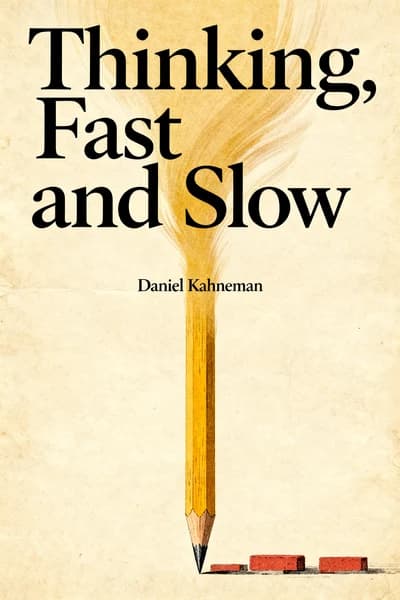
What if I told you that your brain operates like two distinct characters in a play - one impulsive and intuitive, the other deliberate and analytical? This revolutionary insight forms the core of Daniel Kahneman's "Thinking, Fast and Slow," a book that has transformed our understanding of human decision-making. As Bill Gates' favorite book and a work that earned Kahneman the Nobel Prize in Economics despite being a psychologist, this masterpiece has sold over three million copies worldwide and continues to influence fields from economics to public policy.
The book's cultural impact extends far beyond academia - it has fundamentally changed how organizations approach decision-making and has given us a vocabulary to identify the biases that plague our everyday judgments. Celebrities like Richard Thaler and Cass Sunstein have built upon Kahneman's work to create "nudge theory," which has influenced government policies around the world. But what makes this book truly remarkable is how it reveals the invisible forces that drive our choices, often without our awareness. Let's explore the fascinating dual system of thinking that shapes our lives in ways we rarely recognize.
Chapter 2
The Two Characters in Your Mind: System 1 and System 2
Imagine walking down a street and suddenly seeing an angry face in the crowd. Without conscious effort, you immediately recognize the emotion and perhaps feel a twinge of alarm. Now contrast this with solving a complex math problem that requires focused concentration. These two experiences represent the fundamental distinction at the heart of Kahneman's work - the difference between System 1 and System 2 thinking.
System 1 operates automatically and quickly, with little or no effort and no sense of voluntary control. It's what allows you to drive a familiar route while your mind wanders, recognize a friend's voice on the phone, or complete the phrase "bread and..." without hesitation. This system builds a rich tapestry of impressions and feelings that often serve as the foundation for our explicit beliefs and deliberate choices.
System 2, meanwhile, allocates attention to the effortful mental activities that demand it, including complex computations and deliberate choices. It's engaged when you're calculating 17 x 24, filling out a tax form, or checking the validity of a complex logical argument. System 2 is what we typically identify as our conscious, reasoning self - the one that makes decisions, has beliefs, and decides what to think about and what to do.
The relationship between these two systems isn't simply a matter of fast versus slow thinking. Rather, they represent different ways our minds process information. System 1 provides continuous assessments of the world around us, generating intuitions that System 2 may endorse, question, or override. As Kahneman notes, "System 1 is the hero of the book. It's System 1 that does most of the work, and it usually does it very well."
But here's the catch: System 2 is lazy. It requires effort and energy, resources that our brains are programmed to conserve. This means we often default to System 1's quick judgments, even when more deliberate thinking would serve us better. This cognitive miser approach explains why we're prone to a wide range of biases and errors in judgment.
Chapter 3
The Cognitive Miser: Why Thinking Is Hard Work
Have you ever noticed how difficult it is to solve a complex problem while walking quickly? Or how your conversation naturally pauses when driving conditions become challenging? These everyday experiences reveal a fundamental truth about our mental operations: thinking hard requires effort, and our mental resources are limited.
When System 2 engages in demanding mental activities, it draws on a shared pool of mental energy. This explains why we struggle to perform multiple challenging tasks simultaneously. In one fascinating experiment, participants were asked to memorize a seven-digit number while walking to another room. This seemingly simple task proved surprisingly difficult because both activities competed for the same limited cognitive resources.
The physical manifestations of mental effort are revealing. When people tackle difficult cognitive tasks, their pupils dilate, their heart rate increases, and their blood pressure rises. These physiological responses reflect the mental strain of System 2 thinking. As one participant in Kahneman's Add-3 experiment (where people add 3 to each digit in a sequence) remarked, "It felt like my brain was on fire!"
This mental effort comes at a cost, leading to what psychologists call "ego depletion" - the diminished capacity for self-control following periods of exertion. In a revealing study, participants who had to resist the temptation of freshly baked cookies subsequently gave up more quickly on difficult puzzles compared to those who hadn't faced such temptation. The implication is clear: willpower is a limited resource that can be depleted.
The consequences of this cognitive limitation extend to decision-making. Judges, for instance, are more likely to grant parole early in the day or immediately after their lunch break, when their mental resources are refreshed. As the day wears on and mental fatigue sets in, they increasingly default to the safer, status quo decision - denying parole.
This tendency to conserve mental effort explains why we often rely on System 1's intuitive judgments rather than engaging System 2's more demanding analytical processes. It's not just laziness; it's our brain's way of managing its limited resources. Unfortunately, this cognitive miserliness can lead to systematic errors in judgment.
Chapter 4
The Associative Machine: How Your Mind Creates Meaning
Our brains are remarkably efficient at creating connections between ideas, events, and memories. This associative machinery is the foundation of System 1's operations, allowing us to make sense of the world with minimal effort. Consider what happens when you read the word "banana." Without any conscious intention, related concepts like "yellow" and "fruit" become more accessible in your mind. This process, known as associative activation, spreads like ripples in a pond, activating connected ideas.
The associative system doesn't just link concepts - it creates coherence by automatically constructing the most plausible interpretation of partial information. When you see a sequence like "w_sh," your mind might automatically complete it as "wash" or "wish" depending on the context. This remarkable ability to find patterns and make connections happens effortlessly and continuously.
These associations extend beyond mere concepts to include emotions and physical responses. Reading about disgusting food might make you physically recoil, while thinking about embarrassing moments might cause you to blush. This embodied cognition demonstrates how thoroughly our physical experiences are integrated with our mental processes.
The power of association also explains the phenomenon of priming, where exposure to one stimulus influences the response to a subsequent stimulus without conscious awareness. In a famous experiment by John Bargh, participants who were subtly exposed to words related to old age (like "Florida," "bald," and "wrinkle") subsequently walked more slowly down the hallway - without realizing they had been influenced.
These associative processes help us navigate the world efficiently, but they can also lead us astray. Because System 1 automatically seeks to create a coherent story from whatever information is available, it often jumps to conclusions based on limited evidence. This tendency, which Kahneman calls "What You See Is All There Is" (WYSIATI), explains why we're prone to overconfidence in our judgments and blind to our own ignorance.
Chapter 5
The Illusion of Understanding: Why We Think We Know More Than We Do
Have you ever felt that you fully understood why a particular company succeeded or why a political event unfolded as it did? This sense of understanding is often an illusion created by our mind's powerful storytelling ability. System 1 excels at constructing coherent narratives from fragments of information, giving us the comforting feeling that we comprehend complex events.
Consider how we interpret the rise and fall of companies. When Apple was struggling in the late 1990s, business analysts had compelling explanations for its failures. When it later became the world's most valuable company, equally compelling explanations emerged for its success. These retrospective narratives create what Kahneman calls the "illusion of understanding" - the belief that we can make sense of the past and therefore predict the future.
This illusion is particularly evident in how we view exceptional success stories. Books about successful CEOs and companies often attribute their achievements to leadership qualities, strategic vision, or corporate culture. Yet research by Phil Rosenzweig shows that much of what we perceive as skill may actually be luck. Companies singled out for excellence in books like "In Search of Excellence" often regressed to average performance in subsequent years - a phenomenon explained by the statistical principle of regression to the mean rather than a sudden loss of the qualities that made them great.
Our susceptibility to narrative fallacies stems from System 1's constant effort to make sense of the world. We prefer simple, causal stories to complex, probabilistic explanations. This preference leads us to underestimate the role of chance and overestimate our ability to predict outcomes. As Kahneman notes, "The world makes much less sense than you think. The coherence comes mostly from the way your mind works."
This illusion of understanding fuels overconfidence in various domains. Financial experts confidently predict market movements despite overwhelming evidence that such predictions are no better than chance. Political pundits make bold forecasts about election outcomes or international events, rarely acknowledging the uncertainty inherent in complex systems.
The hindsight bias compounds this problem by making outcomes seem more predictable after they occur than they were before. Once we know what happened, we revise our understanding of what could have happened, creating the false impression that we "knew it all along." This bias not only distorts our memories but also prevents us from learning from experience.
Chapter 6
The Heuristic Mind: Mental Shortcuts and Their Pitfalls
When faced with difficult questions, our minds often substitute easier ones - a process Kahneman calls "substitution." Rather than tackling the complex question "How satisfied am I with my life?" we might unconsciously answer the simpler question "What is my mood right now?" This substitution happens automatically, without our awareness, leading to judgments that may miss the mark.
These mental shortcuts, or heuristics, help us navigate a complex world with limited cognitive resources. While often useful, they can lead to systematic biases in our judgments and decisions. Three key heuristics identified by Kahneman and his longtime collaborator Amos Tversky are particularly influential:
The availability heuristic leads us to judge the frequency or probability of events based on how easily examples come to mind. After a plane crash makes headlines, many people temporarily fear flying, even though the statistical risk hasn't changed. The vividness and emotional impact of recent or memorable events distort our perception of risk.
The representativeness heuristic causes us to judge probabilities by similarity rather than statistical likelihood. When presented with a description of Tom W. as a meticulous, introverted, and orderly person, many people judge him more likely to be a librarian than a farmer, despite the fact that farmers vastly outnumber librarians in the population. We focus on how well Tom matches our stereotype of a librarian, neglecting the base rates that should inform our judgment.
The anchoring effect demonstrates how our estimates are biased toward initial values, even when those values are arbitrary or irrelevant. In one experiment, participants were asked whether the percentage of African countries in the United Nations was higher or lower than a number determined by spinning a wheel of fortune. Those who saw the number 10 estimated around 25%, while those who saw 65 estimated around 45% - a dramatic difference caused by a clearly random anchor.
These heuristics reveal a fundamental aspect of human cognition: we often answer easier questions than the ones we face, and we do so without realizing the substitution has occurred. As Kahneman puts it, "We are not accustomed to thinking hard, and are often content to trust a plausible judgment that quickly comes to mind."
Chapter 7
The Law of Small Numbers: Why We See Patterns in Randomness
Our minds are pattern-seeking machines, eager to find meaning and causality even in random events. This tendency leads to what Kahneman calls "the law of small numbers" - our inclination to draw strong conclusions from limited data.
Consider the case of kidney cancer rates in the United States. The counties with the lowest rates tend to be rural, sparsely populated counties in the Midwest, South, and West. But here's the surprise: the counties with the highest rates are also rural, sparsely populated counties in the same regions. This apparent contradiction has a simple statistical explanation: small samples show greater extremes of variation than large ones. With fewer people, rural counties are more likely to show unusually high or low rates by chance alone.
Yet our intuition rebels against this explanation. We prefer causal stories - perhaps something about the "clean living" in rural areas protects against cancer, or conversely, something about rural poverty increases risk. Our discomfort with randomness leads us to construct explanations where none may be warranted.
This bias affects countless domains. Basketball fans and commentators talk about players having "hot hands" or being "in the zone," despite statistical analyses showing that streaks of successful shots are no more common than would be expected by chance. Investment managers are praised for beating the market, even though their success is often indistinguishable from luck.
The law of small numbers explains why we're prone to overinterpreting limited evidence. A small hospital might have more days with an unusually high proportion of boy births compared to a large hospital, simply because smaller samples show greater variation. Yet we're inclined to seek special explanations for these statistical flukes.
This tendency to see patterns in randomness is exacerbated by hindsight bias - our inclination to believe, after an event has occurred, that we would have predicted it. Together, these biases create a powerful illusion of understanding and control in a world that is often more random than we care to admit.
Chapter 8
Taming Intuition: When to Trust Your Gut
Despite the many biases and errors in intuitive judgment, Kahneman acknowledges that expert intuition can sometimes be remarkably accurate. Through his collaboration with Gary Klein, a psychologist who studies expert decision-making, Kahneman developed a more nuanced view of when intuitions can be trusted.
Expert intuition works best in environments that are sufficiently regular to be predictable and where individuals have had ample opportunity to learn these regularities through prolonged practice with good feedback. Chess masters, firefighters, and experienced nurses often make excellent intuitive judgments because they've developed pattern recognition skills in domains with clear rules and immediate feedback.
Consider a firefighter who suddenly feels uneasy in a burning building and orders his crew to evacuate, moments before the floor collapses. This isn't mystical insight but pattern recognition - the firefighter's System 1 detected subtle cues that matched patterns from previous experiences, triggering an alarm before he could articulate why.
By contrast, intuition tends to fail in irregular or unpredictable environments. Stock market forecasters, political pundits, and long-term economic forecasters operate in domains where patterns are elusive and feedback is delayed or ambiguous. Their confidence in their predictions often far exceeds their actual accuracy.
Robin Hogarth distinguishes between "kind" and "wicked" learning environments. Kind environments provide regular, predictable patterns and clear feedback, allowing genuine expertise to develop. Wicked environments are irregular or provide misleading feedback, making it difficult to learn true patterns. Unfortunately, many professionals work in wicked environments without realizing it, developing false confidence in their intuitive judgments.
The key to taming intuition lies in recognizing its limits. System 1's automatic judgments are neither inherently good nor bad - they're simply the starting point for more deliberate reasoning. By understanding when intuition is likely to be reliable and when it needs correction, we can make better use of both our automatic and deliberate thinking processes.
Chapter 9
Prospect Theory: Why Losses Hurt More Than Gains Feel Good
Traditional economic theory assumes that people make decisions by calculating the expected utility of different options, weighing potential outcomes by their probabilities. But Kahneman and Tversky's research revealed systematic departures from this rational model, leading them to develop prospect theory - an alternative account of how people actually make choices under uncertainty.
A central insight of prospect theory is that people evaluate outcomes relative to a reference point, typically the status quo, and are more sensitive to losses than to equivalent gains. This asymmetry, called loss aversion, helps explain a wide range of behaviors that puzzle traditional economists.
Consider this scenario: You're offered a gamble on a coin toss. If the coin shows tails, you lose $100. How much would you need to win on heads to make this bet attractive? Most people require at least $200, indicating that losses loom about twice as large as gains.
Loss aversion explains why investors hold onto losing stocks too long (hoping to avoid realizing the loss) while selling winners too quickly (to lock in gains). It explains why homeowners in a falling market refuse to sell below their purchase price, even when doing so would be financially rational. And it explains why negotiators often reach an impasse when each side views its own concessions as painful losses while minimizing the value of concessions from the other side.
Prospect theory also identifies how framing - the way choices are presented - dramatically affects decisions. When a doctor describes a surgery as having a "90% survival rate," it sounds more appealing than describing the same surgery as having a "10% mortality rate," even though the information is identical. Such framing effects violate the invariance principle of rational choice, which holds that preferences shouldn't change based on how options are described.
Another key insight is the certainty effect: people overweight outcomes that are certain compared to those that are merely probable. This explains why we pay a premium for insurance (converting a small risk into a certainty of no loss) and why we often prefer a smaller certain gain over a larger but uncertain one.
Chapter 10
The Experiencing Self vs. The Remembering Self: A Tale of Two Selves
Imagine you're listening to a beautiful symphony, but in the final minutes, there's a horrible screeching sound. How would you evaluate the experience? According to Kahneman, your evaluation depends on which "self" you ask - the experiencing self or the remembering self.
The experiencing self lives in the moment, registering pleasure or pain as it occurs. If we could measure your moment-by-moment enjoyment of the symphony, we'd see high ratings throughout, followed by a sharp drop during the screeching finale.
The remembering self, however, constructs a story from the experience, heavily influenced by how it ended and its most intense moments - what Kahneman calls the "peak-end rule." For the remembering self, the screeching finale might ruin the entire experience, despite the many minutes of prior enjoyment.
This distinction helps explain puzzling findings from Kahneman's research on pain. In one study, patients undergoing colonoscopies reported their pain levels throughout the procedure. Some patients had shorter procedures with moderate pain, while others had longer procedures where the pain diminished toward the end. Surprisingly, those who experienced longer procedures with diminishing pain rated the overall experience as less unpleasant than those who had shorter procedures - even though they endured more total pain. The key factor was how the experience ended.
The conflict between these two selves raises profound questions about how we should make decisions. The experiencing self might prefer a vacation with many pleasant moments, while the remembering self might favor one with an amazing finale, even if the overall experience included more discomfort. Since the remembering self makes decisions about future experiences, we often choose based on memories rather than anticipated experiences.
This insight extends to how we evaluate our lives. When asked about life satisfaction, people draw on memories and constructed narratives rather than aggregating moment-by-moment experiences. A life with a meaningful narrative arc might be judged more favorably than one with more total happiness but less coherence.
Chapter 11
Beyond Rationality: Nudges, Biases, and Better Decisions
Kahneman's work challenges the traditional economic view of humans as rational agents consistently pursuing their self-interest. Instead, we emerge as fallible beings with limited attention, flawed memories, and systematic biases in judgment. Yet understanding these limitations opens the door to better decision-making.
One approach, championed by Richard Thaler and Cass Sunstein in their book "Nudge," involves designing choice environments that work with our psychological tendencies rather than against them. For example, making retirement savings the default option (requiring people to opt out rather than opt in) dramatically increases participation rates without restricting freedom of choice.
At an individual level, we can improve our decisions by recognizing situations where biases are likely to occur. When making important judgments, we can deliberately engage System 2 to check the intuitions of System 1. We can seek outside views to counteract our natural optimism and overconfidence. And we can broaden our decision frames to consider multiple outcomes rather than focusing narrowly on immediate prospects.
Kahneman suggests specific strategies for different contexts. When evaluating risks, consider both the statistical facts and your emotional reactions, recognizing that the latter may be influenced by availability and other biases. When making financial decisions, adopt broad frames that consider the overall impact rather than evaluating each decision in isolation. And when judging your own happiness, pay attention to both your experiencing self (how you feel moment to moment) and your remembering self (the story you tell about your life).
Perhaps most importantly, Kahneman encourages intellectual humility. Recognizing the limits of our understanding can lead to more thoughtful judgments and better decisions. As he writes in the book's conclusion: "The way to block errors that originate in System 1 is simple in principle: recognize the signs that you are in a cognitive minefield, slow down, and ask for reinforcement from System 2."
By understanding the complex interplay between our two systems of thinking, we gain not just insight into our minds but also practical tools for navigating an uncertain world. The journey from cognitive biases to better decisions isn't easy, but as Kahneman shows, it's one well worth taking.